
British Greyhound Results: The Complete Betting & Analysis Guide
 Available in US
How to read race form, understand odds, compare bet types, and build strategies grounded in real data from every GBGB track.
What British Greyhound Results Actually Tell You
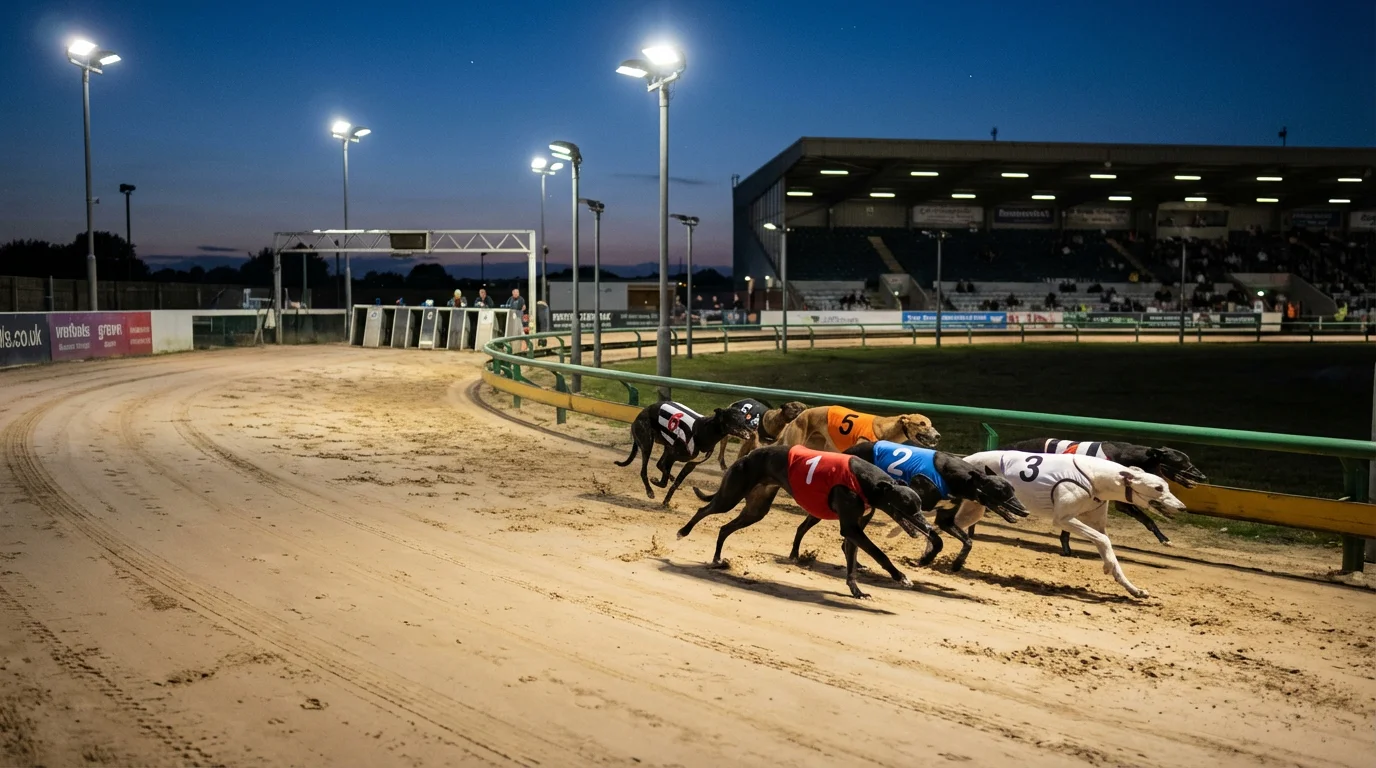
Six dogs. A sand oval. Traps that snap open like mousetraps, and a mechanical hare that no one ever catches. British greyhound racing looks deceptively simple from the stands, but the result sheet tells a story that most punters never bother to read properly. That is a problem, because every line of a greyhound result is a compressed data packet: finishing position, trap number, sectional splits, starting price, race comments, weight, grade, distance beaten, forecast and tricast dividends. Miss one element and you are making decisions with half the picture.
Unlike horse racing, where fields regularly stretch to a dozen runners with human jockeys adding another layer of variables, greyhound racing strips the sport down to its mechanical essentials. Six runners wearing colour-coded jackets launch from numbered traps on a fixed oval. There are no jockeys to assess, no riding tactics to decode, no draw bias that changes with the going in the same way it does on turf. The variables that matter are the dog, the trap, the track, and the recent form. That is precisely why the result line carries so much weight: it captures the entire race in a single row of data.
For the punter willing to learn the shorthand, British greyhound results become a research tool rather than a scoreboard. A finishing position tells you who won. But the race comment tells you why trap three got crowded on the second bend. The sectional time reveals whether the leader burned out or was always in control. The starting price tells you where the market stood when the traps opened. All of this information is free, public, and updated within minutes of every race at every GBGB-licensed track in the country.
What a British Greyhound Result Contains
A standard result line from a GBGB-regulated meeting includes: finishing position, trap number and colour, dog name, starting price (SP), finishing time, calculated time (adjusted for going), distance beaten, dog weight, race grade, and a shorthand race comment describing the dog's run. Forecast and tricast dividends are listed separately for each race. Together, these elements form the raw data behind every informed greyhound bet.
This guide breaks down every component of that data. From reading race results and understanding odds to choosing bet types, analysing trap bias, and building strategies grounded in actual numbers. Whether you have been going to the dogs for years or you are placing your first bet online, the information here applies to every GBGB meeting, every track, every race card. The dogs do not lie. The results do not lie. The only variable left is whether you are reading them properly.
How to Read a Greyhound Race Result
Pull up any result from a GBGB meeting and you will see a block of data that looks like noise until you know where to look. Every abbreviation has a purpose. Every number is a measurement someone decided was worth recording. The trick is knowing the hierarchy: which elements are diagnostic and which are merely descriptive.
A typical result line reads something like this: a dog finishes second from trap four, returns a time of 29.65 over 480 metres, with an SP of 3/1, beaten one and a half lengths, race comment reads "MsdBrk, EP, Crd2". That single line tells you the dog missed the break, showed early pace despite the slow start, then got crowded on the second bend. The finishing position alone says "second". The rest of the line explains what happened and, critically, whether this dog might have won under different circumstances.

Here is what each core element means and why it matters for your next bet:
Finishing position is the obvious starting point, but it is the least useful number in isolation. A dog that finishes first in a weak A6 race has done something very different from a dog that finishes third in an open race against category one opposition. Context is everything, and the grade column provides that context.
Trap number tells you where the dog started. Traps are numbered one to six, running from the inside rail outward, with standardised jacket colours: red for trap one, blue for two, white for three, black for four, orange for five, and striped black-and-white for six. The trap number matters because it determines the dog's path to the first bend, and at many tracks, inside traps carry a measurable statistical advantage.
Finishing time is recorded in seconds, but raw time is only useful when compared against the same distance at the same track under similar conditions. A 29.50 at Romford and a 29.50 at Towcester represent very different performances because the tracks have different circumferences, bends, and surfaces. This is why calculated time, which adjusts for going and sometimes for wind, is a more reliable comparison tool.
Starting price is the final odds offered by the on-course market at the moment the traps open. SP is the benchmark used for settlement when no early price has been taken, and it reflects the collective judgment of the on-course bookmakers. A dog drifting from 2/1 to 5/1 in the final minutes is telling you something the form might not.
Distance beaten is measured in lengths. One length in greyhound racing is approximately 0.08 seconds, though this varies with distance and speed. A dog beaten a short head had a fundamentally different race from one beaten seven lengths, even if both finished second.
Weight is recorded in kilograms at kennelling. Weight fluctuation between races is a form indicator. A dog gaining a kilo over two weeks might be recovering fitness; a dog dropping weight might be peaking or might be stressed. Consistent weight is generally a positive sign.
SAw — Slow Away. The dog was slow to leave the trap, losing ground at the start.
Bmp1 — Bumped at the first bend. Contact that may have cost positions or momentum.
RnUp — Ran Up. The dog stayed close to the leaders without leading, often finishing strongly.
Different results platforms display varying levels of detail. The GBGB official site at gbgb.org.uk provides the definitive record. Timeform adds proprietary ratings and sectional splits. Racing Post integrates results with betting data and race cards. Greyhound Stats offers historical archives with searchable form. The data is the same at its core; the depth and presentation differ. Smart punters cross-reference at least two sources to make sure nothing has been missed.
What Sectional Times Reveal About Race Dynamics
Final time is the headline. Sectional times are the footnotes that actually matter. A dog that runs 29.50 over 480 metres might have led from trap to line in a controlled effort, or it might have been five lengths behind at the second bend and closed like a freight train in the run-in. The final time is identical. The race dynamic is completely different. Sectional splits expose this.
Most sectional breakdowns divide a standard four-bend race into segments: the run to the first bend (early pace or break time), the first bend through the back straight, the third and fourth bends, and the run-in to the finish. Early pace is the most widely tracked split because it determines who reaches the first bend in front, and in greyhound racing, the dog on the rail at the first bend wins more often than any other single factor would predict.
Where do you find sectionals? Timeform provides them for most UK meetings. Some tracks publish their own splits through the GBGB timing system. Third-party sites like Greyhound Stats archive sectional data that you can filter by track, distance, and dog. The coverage is not universal yet, but it is improving season by season, and for the major meetings, the data is comprehensive.
Practically, sectional times let you do something that finishing positions alone cannot: separate dogs by running style. A dog with fast early pace and a fading run-in is a front-runner. A dog with a slow break but a rapid final section is a closer. Neither style is inherently better, but each interacts differently with the trap draw, the track geometry, and the other dogs in the race. A closer drawn in trap one at a tight track faces a different challenge than a closer drawn in trap six at a galloping track. Sectional data makes this visible.
The punter who studies sectionals before a race has a structural advantage over the punter who only checks final times. Final times tell you how fast a dog ran. Sectionals tell you how the dog ran, and that is the information that carries forward into the next race.
Decoding Race Comments and Run Descriptions
Race comments are written in shorthand, and learning the dialect lets you read a dog's race before watching the replay. Every GBGB result includes a brief narrative describing key moments of the run: where the dog broke, what happened on the bends, whether it led, challenged, faded, or ran on. These comments are composed by the track judge immediately after the race and follow a standard vocabulary.
Here are the comments that matter most. "Led" followed by a bend number (Ld1, Ld2) tells you when the dog took the lead. "EvCh" means the dog had every chance and simply was not good enough on the day. "SAw" (slow away) and "QAw" (quick away) describe the trap exit. "Crd" (crowded) and "Bmp" (bumped) indicate interference, which is critical because a crowded dog may have been running far better than its finishing position suggests. "RnOn" (ran on) means the dog was staying on at the finish, implying it might benefit from a longer distance. "Fdd" (faded) tells you the opposite: the dog weakened late, possibly after setting too hot a pace or racing over a trip that stretches its stamina.
The real skill is connecting the comment to the circumstances. A dog noted as "Crd2, RnOn" was crowded on the second bend but still ran on at the finish. That is a dog whose form is better than the bare result shows. Conversely, "Led1-Crd3-Fdd" tells you the dog led until the third bend, got crowded, and faded. Was the fade caused by the crowding or by the dog's fitness? You cannot always answer this from a single result, but tracking comments over three or four runs reveals a pattern. Dogs that repeatedly "ran on" from behind are closers. Dogs that repeatedly "led" and then "faded" might need a shorter distance. The comment is the narrative; three races of comments are the plot.
Results tell you what happened. Odds tell you what the market expects next.
How Greyhound Racing Odds Work
Six runners. No jockeys. Odds that shift in seconds. Greyhound markets are among the most volatile in racing, and that volatility is exactly where value hides for the punter who understands how prices are set.
Greyhound odds in the UK operate through two parallel systems. On-course bookmakers at the track set their own prices based on market flows and their assessment of the race. Off-course bookmakers — the online firms most punters use — offer early prices that may differ significantly from the on-course market. The starting price, or SP, is the final on-course price at the moment the traps open. This two-tier system creates discrepancies, and discrepancies are opportunities.
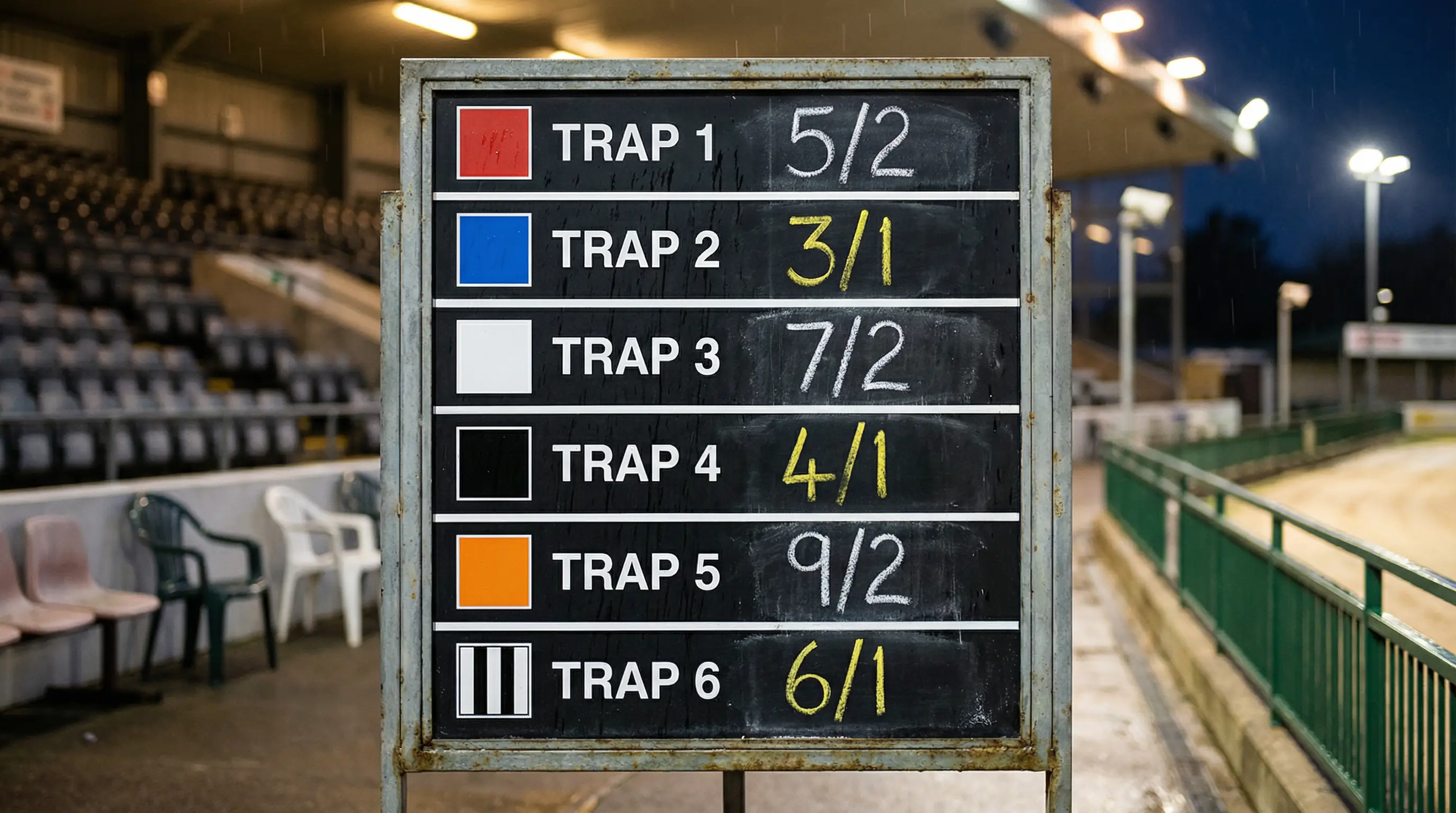
The mechanics are straightforward. In a six-dog race, the bookmaker builds a market by assigning a percentage probability to each dog, then adds an overround (the built-in margin that ensures the book profits regardless of the result). A typical greyhound book runs at 115 to 125 percent, meaning the total implied probabilities exceed 100 percent by 15 to 25 percentage points. That excess is the bookmaker's edge. Your job as a punter is to find spots where the bookmaker's probability assessment is wrong by more than the overround covers.
Greyhound odds are displayed in fractional format in the UK. A dog at 5/2 returns two and a half times your stake plus the stake itself. Stake ten pounds, and a winning bet returns thirty-five pounds: twenty-five pounds profit plus your ten-pound stake back. The shorter the price, the higher the market's confidence. A 1/2 favourite is expected to win roughly two out of three times. An 8/1 outsider is expected to win about once in nine. Whether those expectations are accurate for a specific race is the entire question.
Win Bet Example
Dog: Ballymac Donut | Trap 3 (White) | Odds: 5/2 | Stake: £10 | Return: £35
What makes greyhound odds different from horse racing odds is the compressed timeframe. Horse racing markets form over hours, sometimes days, with ante-post prices available weeks ahead of major races. Greyhound markets typically form within the hour before a race, and meaningful price movements happen in the final minutes. A dog that opens at 3/1 on the early-morning show can be 6/4 by the time the hare passes the traps. This speed rewards the punter who has done their homework before the market moves and punishes the punter who takes prices reactively.
The six-runner field also amplifies each price movement. In a twenty-runner horse race, one horse shortening from 10/1 to 7/1 causes small ripples across the rest of the field. In a six-dog greyhound race, the same percentage shift redistributes probability much more aggressively. When one dog shortens, the others drift noticeably. This means a single piece of information — a trainer switch, a trap reshuffle after a non-runner, a kennel whisper — moves the entire market. Paying attention to these movements, and understanding what is driving them, is a core skill for greyhound punters.
SP, Early Price, and Best Odds Guaranteed
Taking SP blindly is the fastest way to donate margin to the bookmaker. The starting price is a useful benchmark, but it is a reactive price — it reflects where the on-course market settled after all the money came in. By definition, if you take SP, you are accepting whatever price the market decided at the last moment. Sometimes that works in your favour. More often, it does not, because late money on favourites tends to compress their SP below the early price.
Early prices are offered by online bookmakers, usually from the morning of the meeting. These prices are set by traders using form, historical data, and market modelling. The advantage of taking an early price is locking in a number before market forces compress it. If you fancy a dog at 4/1 and the early price is 4/1, you can take it and know exactly what you are getting. If the dog then opens at 5/2 SP, you have secured a better price. If it drifts to 6/1, you have taken worse — but this is where Best Odds Guaranteed enters the equation.
Best Odds Guaranteed, commonly shortened to BOG, is an offer from certain bookmakers that guarantees you the higher of your early price and the SP. If you back a dog at 4/1 early and the SP comes back at 6/1, BOG means you get paid at 6/1. If the SP is 3/1, you keep your 4/1. It is, in effect, a free option — and any punter not using it on eligible races is leaving money on the table. Not all bookmakers extend BOG to greyhounds (it is more common on horse racing), so checking the terms before placing your bet is essential. The ones that do offer it give you a genuine structural advantage.
The practical rule is simple: if you have done your analysis and identified value, take the early price and use a bookmaker that offers BOG on greyhounds. If you are unsure about a race and just want to watch it unfold, SP is fine — but understand that you are trading control for convenience.
Greyhound Bet Types: From Singles to Tricasts
Greyhound betting has more options than most punters ever use. The majority of recreational bettors stick to win singles, occasionally an each way. That is fine, but it means they are ignoring bet types that can extract significantly more value from races where the form points to a specific outcome. Understanding the full menu lets you match the bet to the situation rather than forcing every race into the same format.
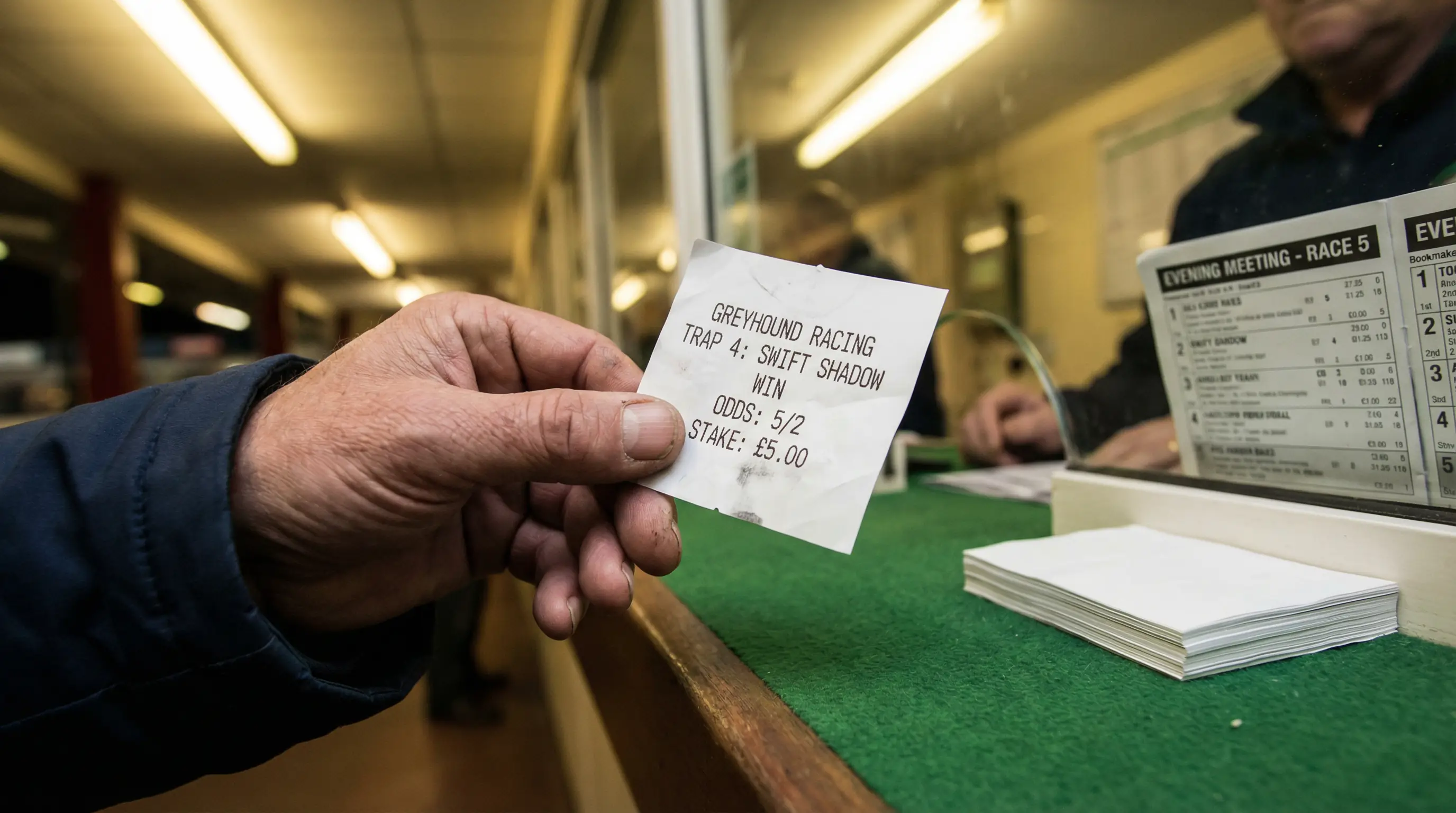
The core bet types in British greyhound racing fall into two categories: singles (one selection, one race) and multiples (selections across multiple races). Within singles, the most common are win, place, and each way. Within multiples, doubles, trebles, and accumulators are standard. Sitting between singles and multiples are the exotic bets — forecasts and tricasts — which involve predicting the exact finishing order within a single race. Each type carries a different risk-reward profile, and choosing the wrong type for a given race is as costly as choosing the wrong dog.
Win
The simplest bet: pick the dog that finishes first. Full stake rides on one outcome. Best when you have a strong opinion on a single runner.
Place
Your dog needs to finish in the top two in a six-runner race. Lower returns than a win bet, but twice the chance of collecting. Suited to races where you like a dog but do not trust the trap draw.
Each Way
Two bets in one: a win bet and a place bet at a fraction of the win odds (typically one quarter in greyhound racing). Useful for outsiders at bigger prices where the place portion alone can return a profit.
Forecast
Predict first and second in exact order (straight forecast) or any order (reverse forecast, which costs double). Pool-based dividends that often exceed the odds of each individual dog.
Tricast
Predict first, second, and third in exact order (straight tricast) or any order (combination tricast, which costs six times the unit stake). Regularly pays triple-figure dividends in open races.
Accumulator
Link win or place bets across multiple races. Returns multiply with each leg. High potential payout, but one losing leg kills the entire bet. Best used sparingly with strong selections.
A win bet is a statement of conviction. A place bet is a statement of confidence without certainty. An each way bet is a hedged position. A forecast is an analytical bet that says you can identify the two best dogs in order. A tricast is the same conviction extended to three places. An accumulator is a leverage bet that trades probability for payout. Knowing which tool to reach for is half the skill.
Exotic Bets: When Forecasts and Tricasts Pay Off
A six-dog race with a combination tricast costs just six unit stakes and the dividends regularly run into triple figures. That ratio of cost to potential return is what makes exotic bets the hidden engine of greyhound betting for punters who do their analysis properly.
Forecast dividends are calculated through the Computer Straight Forecast formula, a mathematical model that determines the payout based on the SP of the first and second dogs and the overall composition of the market. The CSF is not a fixed-odds bet; it is a calculated dividend announced after the race. This means you do not know the exact payout until the result is confirmed. In practice, forecasts involving two outsiders pay significantly more than forecasts involving a favourite and a second favourite. A straight forecast with a 5/1 winner and a 6/1 second can return forty to sixty times the stake. A forecast with a 1/2 favourite and a 2/1 second might return under ten times.
Tricasts extend the same logic to the first three finishers. A straight tricast requires you to name first, second, and third in exact order — a demanding bet but one that rewards precision lavishly. A combination tricast covers all six possible orderings of your three selections, costing six times the unit stake. For a race where you can confidently identify the three best dogs but cannot separate them in order, the combination tricast is the pragmatic choice.
The mathematics favour exotic bets in races with open markets. When no dog is a clear favourite and the prices are spread evenly, forecast and tricast dividends tend to be higher because the pool is distributed more widely. Conversely, in races with a dominant favourite, exotic dividends are compressed. The practical lesson: use forecasts and tricasts selectively, targeting open races where your form analysis gives you an edge on the likely first two or three finishers rather than spreading exotic bets across every race on the card.
Trap Statistics and Draw Bias in UK Greyhound Racing
Trap one does not always win. But when it does, it wins for reasons you can measure, and those reasons are baked into the geometry of the track. Every greyhound track has a first bend, and the dog that reaches it in front with the inside rail has a structural advantage that persists through the rest of the race. This is not opinion; it is physics applied to an oval.
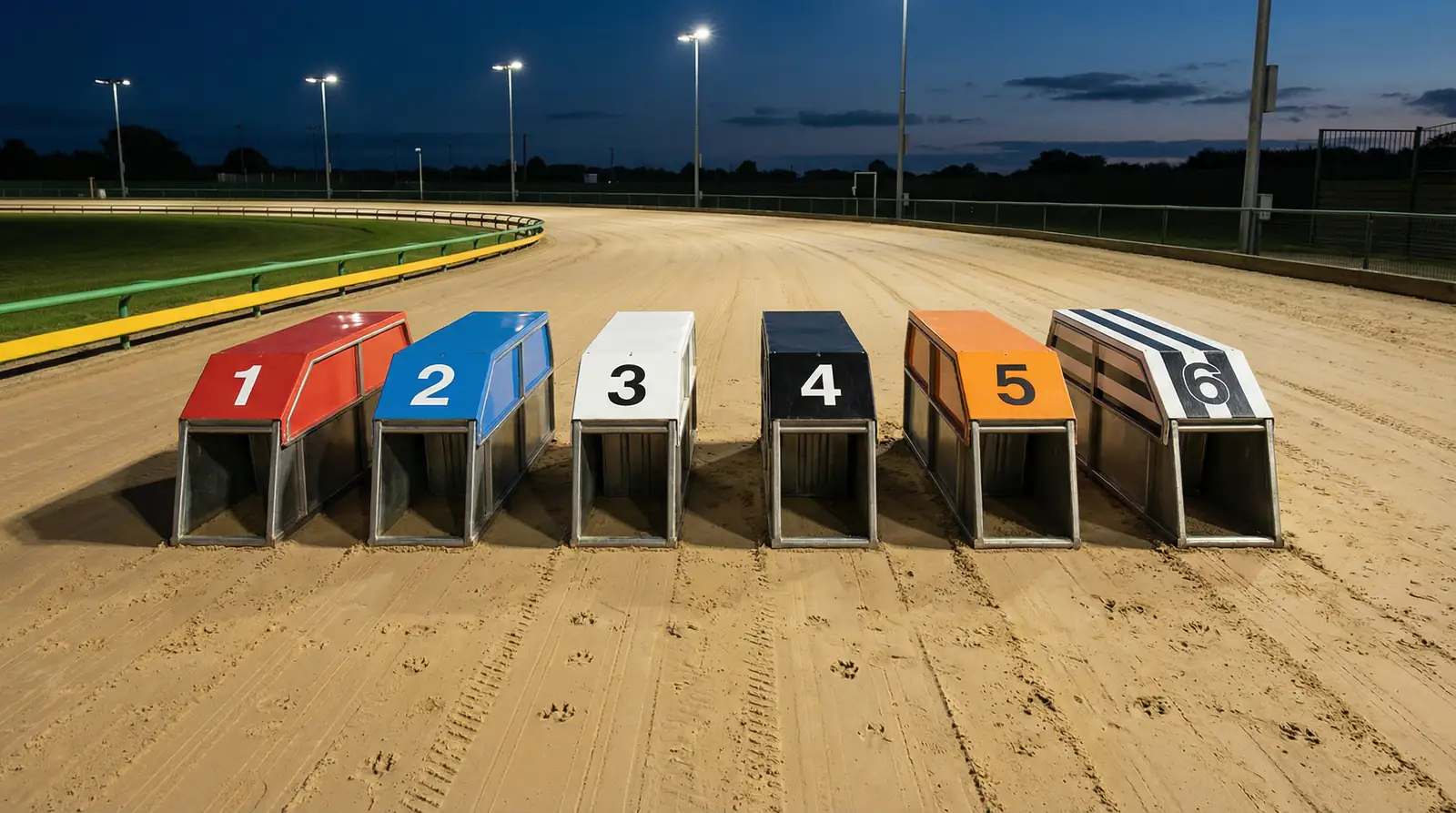
The run-up from the traps to the first bend is the key variable. At tracks with a short run-up, inside traps (one, two, three) have a significant advantage because the dogs reach the bend before the field has spread, and the inside dog claims the rail. At tracks with a longer run-up, outside traps have more time to cross in, and the bias is less pronounced. Some tracks — Monmore is a notable example — have such a strong inside bias that trap one win percentages sit well above the 16.7 percent you would expect from a random distribution across six traps.
The data is publicly available. Sites like Greyhound Stats and the GBGB's own records publish trap win percentages broken down by track and distance. At some tracks and distances, trap one wins 25 percent or more of all races. At others, trap six performs closer to the field average. These are not marginal differences. Over a season of racing, a trap win rate eight percentage points above expectation represents a massive edge when factored into your betting.
Inside Traps 1-3
- Shorter path to the first bend, natural rail advantage
- Favour railers and dogs with quick early pace
- Strongest bias at tight tracks with short run-ups like Romford and Crayford
- Dogs drawn inside can be crowded if they break slowly, losing the rail position they are supposed to exploit
- Statistically overrepresented among winners at the majority of UK tracks
Outside Traps 4-6
- Wider path, more room to run but a longer route to the first bend
- Favour wide runners and dogs that need clear air
- Competitive at galloping tracks with long run-ups like Towcester and Nottingham
- Dogs drawn outside avoid first-bend crowding but must cover extra ground on every bend
- Occasionally deliver higher-value results because the market underestimates specific trap-style combinations
The practical application is straightforward: before placing any bet, check the trap statistics for that specific track and distance. A dog with strong form drawn in trap one at a track where trap one wins 24 percent of the time is a fundamentally different proposition from the same dog drawn in trap six at the same track. Form tells you how good the dog is. Trap statistics tell you whether the draw will help or hinder. The punter who combines both pieces of information sees the race more clearly than the punter who only reads form.
One caveat: trap bias is a long-term statistical tendency, not a guarantee for individual races. A trap one dog that breaks slowly and gets bumped on the first bend can still lose to a trap six dog that flies the lids. The bias works over hundreds of races, not one. Use it as a weighting factor in your analysis, not as a replacement for form reading.
UK Greyhound Tracks: What Every Punter Should Know
Romford on a Friday night plays nothing like Towcester on a Tuesday, and your bets need to know the difference. The GBGB currently licenses 18 tracks across England and Wales, each with its own circumference, surface composition, hare system, distance menu, and racing character. Treating all tracks as interchangeable is the fastest way to turn good form analysis into bad bets.
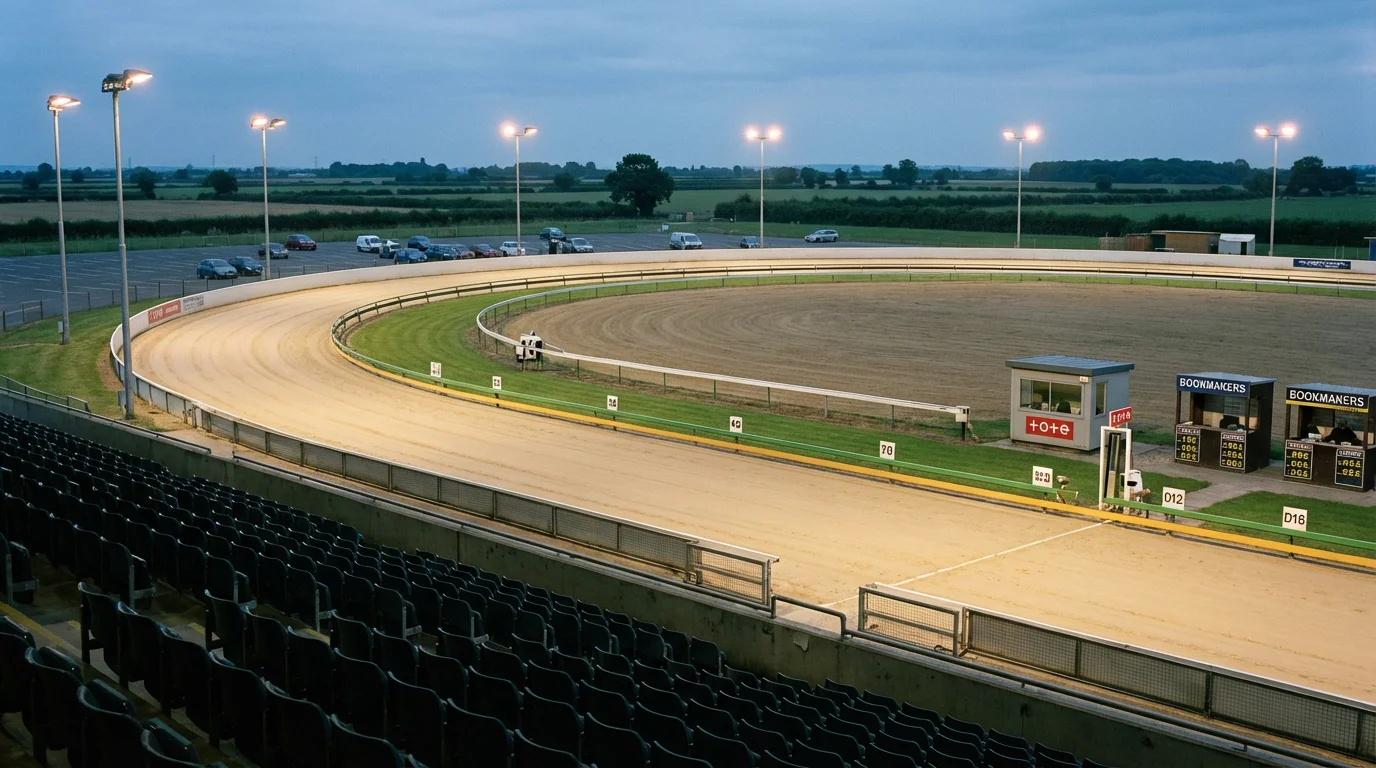
The key variables are circumference (which determines bend tightness and favours different running styles), surface (all UK tracks run on sand, but the sand composition and drainage vary), hare type (inside or outside McGee, Swaffham, or similar systems), and distances offered (ranging from 210-metre sprints to 900-metre-plus marathon events). Tracks with tight bends like Romford and Crayford punish wide runners and amplify inside trap bias. Tracks with sweeping bends like Towcester and Nottingham produce fairer racing where the best dog wins more often regardless of trap.
Towcester is the home of the English Greyhound Derby, which returns to the Northamptonshire circuit in 2026 with heats beginning on 30 April and the final scheduled for 6 June. It is the largest track in the UK, with a long run-up to the first bend and a reputation for fair racing. The generous circumference means trap bias is less pronounced, and the results more frequently reflect genuine ability. For the bettor, Towcester rewards form analysis and punishes those who rely on trap shortcuts.
Romford is the Friday night favourite, a tight East London circuit that generates some of the most competitive graded racing in the country. The short run-up to the first bend gives inside traps — especially trap one — a significant statistical edge. Wide runners struggle here. If your dog is drawn in traps five or six at Romford, the form needs to be exceptional to overcome the draw disadvantage. The atmosphere is electric, the markets are liquid, and the racing is fast.
Monmore Green in Wolverhampton hosts several Category One competitions, including the prestigious Golden Jacket and Winter Derby. The standard 480-metre trip produces tight, competitive racing. Monmore has invested heavily in facilities and regularly attracts the country's leading open-race greyhounds.
Hove (Brighton and Hove) sits at the south coast and offers a mix of sprints and standard trips. It runs frequent meetings and provides a solid supply of graded racing data. Sheffield and Sunderland serve the northern circuit, each with distinctive track profiles that reward local knowledge. Nottingham is a galloping track that suits stayers and dogs with a strong finishing kick.
The 2026 GBGB racing calendar features 50 Category One competitions and 27 Category Two events spread across the track network, marking the centenary of organised greyhound racing in Britain. This expanded programme means more open-race data, more opportunities for form analysis, and a richer betting landscape than in recent seasons.
Do not transfer form between tracks without adjusting for circumference, bend tightness, distance, and going conditions. A dog that ran 29.30 at Romford and 29.80 at Towcester may have produced two equally strong performances despite the half-second difference. Adjusted times and track-specific speed ratings exist precisely to solve this problem.
Greyhound Betting Strategies Built on Results Data
Strategy without data is just superstition with a betting slip. The beauty of greyhound racing from an analytical perspective is that the sport generates a dense, consistent data set: six runners, fixed starting positions, standardised distances, measurable times, published form, and frequent races. No other betting sport gives you this volume of structured information at this frequency. The question is not whether you can build a data-driven approach — it is whether you will.
Start with form cycle analysis. Every greyhound goes through performance cycles: improving after a break, peaking during a run of good results, declining as fitness or motivation wanes. The form figures (the sequence of finishing positions from recent races) are the first indicator. A dog with recent figures of 6-4-2-1 is on an improving trajectory. A dog with figures of 1-1-3-5 may be on the decline. Neither pattern is conclusive on its own, but combined with race comments, sectional times, and grade context, the pattern becomes actionable.
Speed ratings strip out the noise. Raw times are affected by going conditions, wind, track configuration, and the pace of the race. Adjusted times — sometimes called speed ratings or calculated times — account for these variables and allow you to compare performances across different tracks and meetings. Services like Timeform publish their own speed ratings for greyhounds, and Greyhound Stats provides the raw data to calculate your own. A dog with a speed rating of 30.00 at Romford and 30.05 at Hove has run two almost identical races, even though the raw times may differ by half a second.
Trainer patterns are underused and overvalued simultaneously. Underused because most punters ignore them entirely. Overvalued because some punters treat a trainer's overall win rate as if it applies equally to every dog in the kennel. The useful angle is track-specific trainer form: which trainers perform disproportionately well at which tracks. Some kennels have a strong record at their local circuit and a weaker one away. This information is in the public record if you look for it.
Grade context is the single most overlooked factor. A dog dropping from A2 to A3 is not declining — it has been placed against easier opposition, which is often the precursor to a winning run. A dog jumping from A5 to A3 after a couple of wins is being tested at a higher level and may struggle. The grade column on the race card is not just a label; it is a statement about the competitive environment, and that environment determines whether the form translates.
Anti-strategies deserve a mention. Backing favourites blindly is a long-term losing play in greyhound racing because the overround erodes the returns on short-priced dogs. Ignoring the trap draw because "the best dog wins anyway" is demonstrably false at tight tracks. Chasing losses after a bad night by increasing stakes is not a strategy; it is a surrender of discipline. The punter who avoids these traps is already ahead of the majority.
Do
- Use adjusted times to compare performances across tracks and meetings
- Check trainer form at the specific track, not just overall statistics
- Factor the trap draw into every selection, weighted by track-specific bias data
- Track your bets, review your results, and adjust your approach based on evidence
Don't
- Chase losses by increasing stakes after a losing run
- Ignore non-runner reshuffles, which can dramatically alter trap dynamics
- Back a dog based on name, colour, or gut feeling without checking the form
- Treat all tracks as identical when comparing times and form
Pre-Race Checklist: What to Verify Before Every Bet
Before you tap "Place Bet", run through this. It takes ninety seconds and saves you from the kind of lazy mistakes that eat bankrolls. Not every race deserves a bet, and the quickest way to find out is to subject your selection to a short checklist that covers the factors most likely to determine the outcome. If any step raises a red flag, either skip the race or reconsider the bet type.
This is not about perfection. It is about consistency. A punter who checks these six points before every bet will avoid the most common errors and make sharper selections over time. The information for every item is publicly available from the GBGB results database, Timeform, or dedicated greyhound stats platforms.
Pre-Race Verification
- Check recent form at this specific track, not just overall form from other venues
- Confirm the trap draw matches the dog's running style — railers in low traps, wide runners in high traps
- Compare the dog's adjusted time to the rest of the field over the same distance
- Look for trainer patterns at this track: some kennels consistently outperform at certain circuits
- Verify the going conditions and whether the dog handles the current surface state
- Review any SP drift or shortening in the market that might indicate late information
The checklist is not a guarantee of winners. Nothing is. But it filters out the bets where the data is either incomplete or working against you, and that alone improves your long-term return. Discipline is not glamorous, but it is what separates the punters who sustain a bankroll from the ones who reload every month.
Greyhound Betting: Questions Punters Ask Most
These three questions show up every day in greyhound betting forums and search queries. Most answers online get them half right. Here is the full picture.
How do greyhound racing odds work, and what does SP mean?
Greyhound racing odds in the UK are set by bookmakers based on the perceived probability of each dog winning. In a six-runner race, the bookmaker assigns a price to each dog and builds in an overround (typically 115-125 percent) to ensure a margin. Odds are displayed in fractional format: a dog at 3/1 returns three times your stake plus the stake itself on a winning bet.
SP stands for Starting Price. It is the final odds offered by the on-course bookmakers at the moment the traps open. If you have not taken an early price, your bet is settled at SP. The SP is determined by the on-course market and reflects the collective weight of money placed in the final minutes before the race. Early prices, offered by online bookmakers earlier in the day, may differ from the SP. If you take an early price and the SP turns out to be higher, Best Odds Guaranteed (where offered on greyhounds) ensures you receive the better of the two prices.
What is the best trap position in greyhound racing?
There is no single best trap across all UK tracks, but trap one (red jacket, innermost position) holds a statistical advantage at the majority of circuits. The reason is geometric: the inside trap has the shortest path to the first bend, and the dog that reaches the first bend on the rail avoids the crowding and wide running that cost positions. At tight tracks with short run-ups to the first bend — Romford and Crayford are classic examples — trap one win percentages can reach 22-25 percent, well above the 16.7 percent expected from a random distribution.
However, the "best" trap depends on the track, the distance, and the dog's running style. At galloping tracks with longer run-ups, such as Towcester and Nottingham, the inside advantage is less pronounced and outside traps become more competitive. A wide-running dog drawn in trap six at a galloping track may be better served than a railer drawn in trap one at the same venue. Always check track-specific trap statistics for the distance your race covers before weighting the draw in your analysis.
What do forecast and tricast bets mean in greyhound betting?
A forecast bet requires you to predict which dogs will finish first and second. A straight forecast demands the exact order: you name dog A first and dog B second. A reverse forecast covers both possible orderings (A first/B second and B first/A second) and costs twice the unit stake. Forecast dividends are calculated using the Computer Straight Forecast formula based on the SPs of the finishing dogs, and payouts are declared after the race.
A tricast extends this to the first three finishers. A straight tricast names first, second, and third in exact order. A combination tricast covers all six possible orderings of three named dogs, costing six times the unit stake. Tricast dividends are typically much higher than forecast dividends because predicting three finishing positions is substantially harder. In open races where no single dog dominates, combination tricast dividends regularly exceed one hundred times the unit stake, making them one of the highest-value bet types in greyhound racing for punters who can reliably identify the three strongest dogs in a field.
The Final Straight: Where Data Meets the Dog
Greyhound betting sits at the intersection of data and instinct, and the punter who leans too far in either direction loses something. Pure data analysis without watching a single race misses the visual cues — how a dog moves, how it responds to pressure, whether it shows enthusiasm in the pre-race parade. Pure instinct without data is just gambling with extra steps. The best approach borrows from both: let the numbers narrow your selections, then let your eye confirm or reject what the numbers suggest.
The GBGB's 2026 Rules of Racing amendments, effective from January, include enhanced transparency measures such as published reasons for all withdrawals and updated racecourse licensing criteria. These incremental improvements in data availability work in the punter's favour. More information, consistently structured, means more edges for those who bother to use it.
If you are starting out, the single best investment is not a betting system or a tipster subscription. It is a spreadsheet. Record every bet you place: the dog, the trap, the track, the odds, the result, the race comment, and your reasoning. After fifty bets, review the data. You will see your own patterns — which tracks you read well, which bet types work for you, where you keep making the same mistake. The dogs generate their data automatically. The least you can do is generate yours.
British greyhound racing is fast, frequent, and data-rich. Every GBGB meeting, from a Tuesday afternoon at Sunderland to a Saturday night open race at Towcester, produces a new set of results that feeds directly into the next round of analysis. The data is there, updated after every race, structured and consistent. Whether you treat this sport as entertainment with a betting slip attached or as a serious analytical exercise is your choice. The information is the same either way. The difference is what you do with it.
