

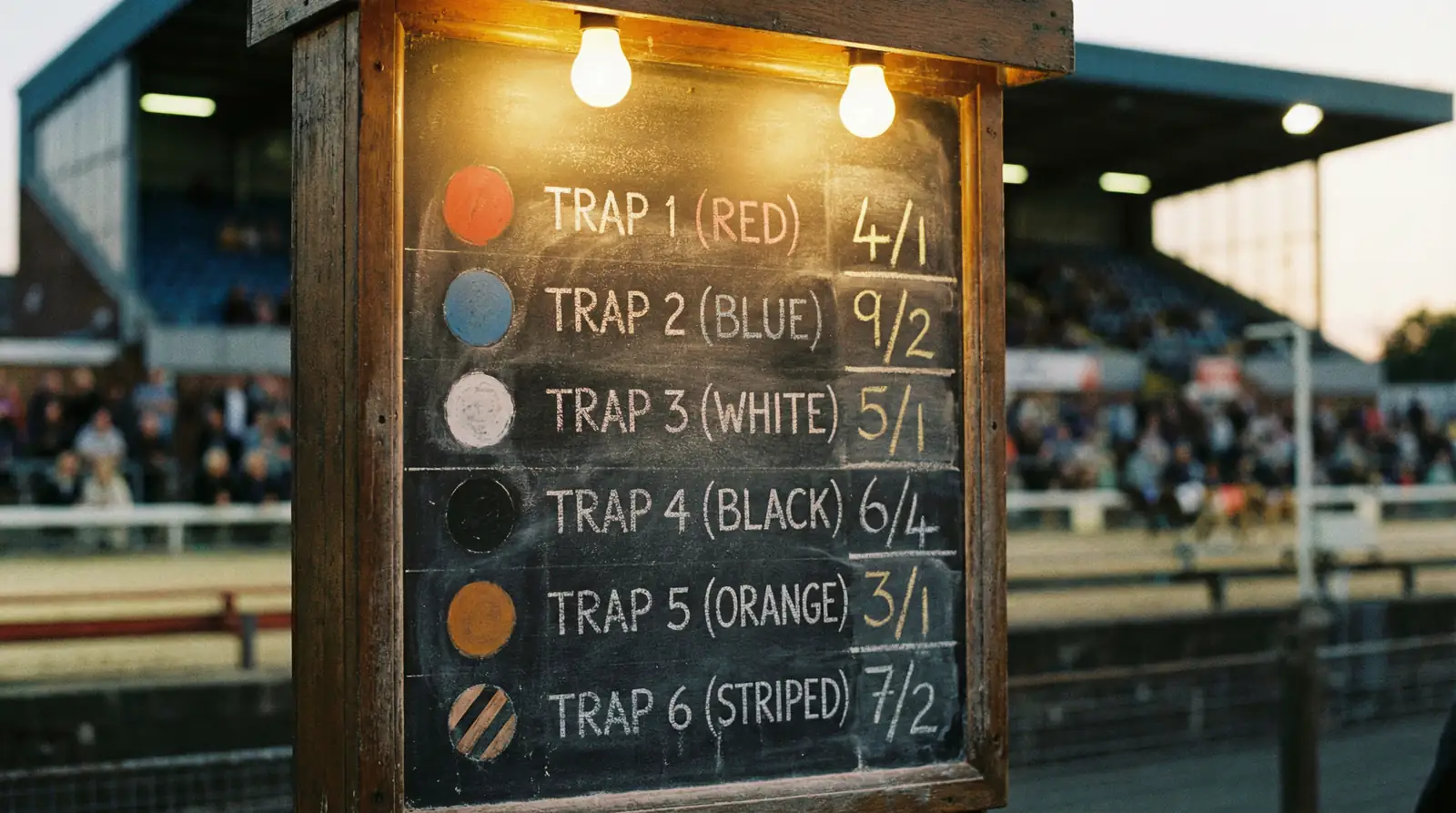
Why Greyhound Odds Move Faster Than Any Other Racing Market
In horse racing, you have hours to study the market. The morning shows are published at breakfast, early prices firm up through the afternoon, and the market settles into shape well before the off. In greyhound racing, you have minutes — sometimes seconds. Prices for a 7:30 race at Romford might not appear until 7:15, and by 7:28 they have already shifted. The window between seeing a price and deciding whether to take it is compressed to the point where hesitation costs money.
The speed of greyhound odds movement comes down to structure. Six runners, no jockeys, and a race that lasts less than thirty seconds. The market for each race is thin — there is less money wagered on an A3 at Monmore on a Tuesday night than on a handicap at Cheltenham on a Saturday. Thin markets move fast because relatively small amounts of money shift the prices. A few hundred pounds on trap 3 can shorten that dog from 5/1 to 7/2 and push the rest of the field out. In horse racing, it takes serious money to move a market. In greyhounds, the market is always on a hair trigger.
This volatility is simultaneously the biggest challenge and the biggest opportunity in greyhound betting. The challenge is obvious: if you wait too long, the price you wanted has gone. The opportunity is less obvious but more valuable: because the market forms so quickly and with less money, it is more likely to misprice runners. Horse racing markets are refined by millions of pounds from professional punters, syndicates, and exchanges. Greyhound markets are shaped by a smaller pool, which means inefficiencies survive long enough for an informed bettor to exploit them.
Understanding how these odds are formed, what drives them, and how to navigate the timing of your bets is not an optional extra in greyhound betting. It is the infrastructure on which every other decision rests. You can analyse form perfectly and still lose money if you consistently take the wrong price. Conversely, a punter with moderate form-reading ability who consistently beats the market on price will outperform a sharper analyst who ignores the odds. This guide breaks down the mechanics of greyhound pricing from the ground up — how odds are set, what SP really means, where value hides, and why the punter who treats odds as a tool rather than a prediction comes out ahead.
How Greyhound Odds Are Formed
Odds are not opinions. They are prices — set by money, not sentiment. Understanding this distinction is the first step toward using odds as an analytical tool rather than treating them as a prediction.
Greyhound odds originate from two sources that operate in parallel: the on-course bookmaker (the track book) and the off-course bookmakers (the high-street and online firms). At the track itself, the bookmaker frames a market based on form, trap draw, and the weight of money from punters at the meeting. This is a live, reactive process — the track book opens with a tissue (an initial set of estimated odds), and prices adjust as bets are placed. If money comes for the trap 2 dog, its price shortens and the rest of the field drifts. The track book at a greyhound meeting is a small, fast-moving auction.
Off-course bookmakers price greyhound races using a combination of their own form assessments, the track book prices, and their liability management. The early prices offered by online bookmakers are loosely based on probability assessments by their trading teams, who factor in recent form, grade, trap position, trainer stats, and any known market tendencies. Once the early prices go live, they adjust in real time based on betting activity across the firm’s customer base. A rush of money on one dog shortens its price and forces the others out, just as on-course, but the off-course market is larger and often moves slightly differently because the customer profile is different — more recreational punters, fewer sharp bettors close to the track.
The interplay between these two markets creates the final price picture. Track books are influenced by what punters physically present at the meeting are doing with their money. Online books are influenced by their broader customer base. The two sometimes disagree — a dog that is popular at the track might drift online, or vice versa — and these disagreements represent genuine pricing differences that an attentive bettor can exploit.
One structural factor that separates greyhound odds from horse racing: the overround. The overround is the bookmaker’s built-in margin — the percentage by which the total implied probabilities of all runners exceed 100%. In horse racing, competitive markets can see overrounds as low as 105–110%. In greyhound racing, overrounds of 115–125% are common, and on less popular meetings they can climb higher. This means the bookmaker takes a larger slice from every greyhound market, which makes finding value harder but also makes the reward for finding it more significant — because most punters are paying that margin without knowing it exists.
The practical takeaway: greyhound odds are not fixed truths about a dog’s chances. They are prices generated by money flow, bookmaker margin management, and market mechanics. They reflect collective opinion, not objective probability. When you learn to distinguish between what the market thinks and what the data shows, you start seeing odds not as answers but as questions — and the best bettors are the ones asking whether the price is right.
Starting Price: How SP Works in Greyhound Racing
SP is the price at the moment the traps open — the market’s final word. It is the odds recorded by the official SP reporter at the track just before the race starts, and it serves as the settlement price for any bet placed at “SP” rather than at a fixed early price. In UK greyhound racing, the SP is determined by the on-course market: the track bookmaker’s board price at the time of the off.
For punters betting at the track, SP is simply the price showing when the traps open. For those betting online, choosing SP means you accept whatever the final on-course price turns out to be. Your bet is placed blind, in a sense — you know you are backing trap 4, but you do not know whether trap 4 will go off at 3/1 or 7/2 or 5/2 until the race is underway. This introduces uncertainty, and uncertainty has a cost.
The case for taking SP is straightforward: if you have not had time to assess the market, or if you are placing your bet close to the off and cannot see the early prices, SP guarantees you a live market price rather than nothing at all. In practice, many punters take SP out of convenience — they place their bet without checking whether a fixed early price is available, or they assume SP will be broadly fair. Sometimes it is. Sometimes it is not.
The case against SP is equally straightforward. Because the SP is determined by the on-course market at the moment of the off, it reflects whatever money has arrived in the final minutes. If a dog attracts late support — from trackside punters, from information that has not filtered to online bettors — its SP will be shorter than the early price was. If you could have taken 5/1 early and the SP comes back 7/2, you have lost value without changing your selection. Over a hundred bets, those fractional price differences add up to a meaningful sum.
SP also carries a structural disadvantage in greyhound racing specifically. Because the on-course market is thin and the number of bettors at the track is relatively small, greyhound SPs can be more erratic than horse racing SPs. A handful of sizeable bets in the final minute can compress or expand prices more dramatically than in a horse racing market with deeper liquidity. This means SP on greyhounds is a noisier signal — it accurately reflects the last-second market, but that last-second market is itself more volatile and less informationally efficient than a well-traded horse race.
The practical guidance is clear: take SP when you have no alternative, but prefer a fixed early price when you have assessed the market and identified value. Taking SP blindly is the fastest way to donate margin to the bookmaker.
Early Price vs SP: When to Lock In
Take the early price when you see value. Let SP find you when you do not. That is the working rule, and it covers most situations, but the nuance is worth unpacking.
Early prices on greyhound races are typically published by online bookmakers anywhere from an hour to fifteen minutes before the off, depending on the firm and the meeting. These prices are the bookmaker’s initial assessment, and they often differ from the eventual SP because the market has not yet fully formed. Early prices on fancied dogs tend to shorten as money arrives, which means taking the early price on a dog you believe is overpriced by the market can lock in value that will not be available at the off. If the early price is 5/1 and you assess the dog’s true chance at roughly 4/1, taking the early price gives you a margin of value. If the SP comes back at 3/1 because the market agreed with your assessment, you are ahead by two full points of odds.
Conversely, there are situations where the early price is shorter than it should be. If a well-known kennel has a runner and the market instinctively shortens it before the race develops, the early price might offer worse value than the eventual SP. This is rarer — the market tends to shorten favourites, not drift them — but it happens, particularly in lower-grade races where the early pricing is less carefully calibrated.
Best Odds Guaranteed (BOG) changes the equation significantly. If your bookmaker offers BOG on greyhounds, you can take the early price and be guaranteed the SP if it turns out to be higher. This eliminates the downside of locking in early: you get the better of the two prices, whichever way the market moves. With BOG active, there is almost no reason not to take an early price you consider fair or better, because the bookmaker is absorbing the risk of the price moving against you. We will cover BOG in detail in the next section, but its relevance to the early-price-vs-SP decision cannot be overstated.
Without BOG, the decision is a judgement call. If you have done your form work and believe the price represents value, take it. If you are unsure about the race or have not completed your analysis, taking SP avoids the risk of locking in a price that turns out to be shorter than what was available at the off. The worst outcome is taking an early price of 3/1 when the dog drifts to 5/1 at the off — that drift usually signals that the market has found something you missed.
Best Odds Guaranteed: How BOG Protects Your Bets
BOG is the closest thing to a free edge the bookmaker will ever give you. Best Odds Guaranteed is a promotion offered by many UK bookmakers under which, if you take an early fixed price on a runner and the SP turns out to be higher, your bet is settled at the higher SP instead. You keep your early price if the SP is lower, and you get upgraded if the SP is higher. It is, in effect, a one-way ratchet in the punter’s favour.
The mechanics are simple. You back trap 3 at an early price of 4/1. The race goes off and the SP is returned at 5/1. With BOG, your bet is settled at 5/1 — the better price. If instead the SP comes back at 3/1, your bet stays at your locked-in 4/1. You win either way, and the bookmaker absorbs the difference. This is not a theoretical benefit: over hundreds of bets, the cumulative uplift from BOG — the sum of all the times the SP exceeded your early price — adds a measurable percentage to your long-term returns.
Not every bookmaker offers BOG on greyhound racing. It is more commonly available for horse racing, and those firms that do extend it to the dogs sometimes apply restrictions: limits on stake size, exclusions for certain meetings or grades, or requirements that the bet be placed a minimum time before the off. The terms vary, and checking them before relying on BOG is essential. Some firms offer BOG on all UK greyhound meetings; others restrict it to featured or televised cards.
The strategic implication is significant. If your bookmaker offers unrestricted BOG on greyhounds, the optimal approach is to always take the early price when you consider it fair or better. You eliminate the downside risk of the price shortening (because you are already locked in) and capture the upside if the price drifts (because BOG upgrades you). The only scenario where this does not help is when the early price is poor value — shorter than what you believe the true probability warrants. In that case, no amount of BOG protection makes a bad price into a good bet.
One nuance worth noting: BOG is funded by the bookmaker’s margin on the broader market. It is not charity. Bookmakers offer it as an acquisition and retention tool because it attracts bettors, and they recoup the cost through the overround built into every race. This means BOG benefits the disciplined punter who uses it selectively on value bets, and costs the casual punter nothing because they were going to take that price anyway. Use it deliberately, and it becomes a genuine edge. Ignore it, and you are leaving money on the table that the bookmaker has already agreed to give you.
Spotting Value in Greyhound Odds
Value is not about the winner. It is about the price being wrong. This is the single most important concept in betting, and it is the one that most punters never fully internalise. A dog can win at 2/1 and still represent terrible value if its true probability of winning was 60%. Equally, a dog can lose at 8/1 and still have been a value bet if its genuine chance of winning was 15% — because over time, backing 15% chances at 8/1 produces a profit.
Value exists when the odds offered by the bookmaker imply a lower probability of winning than you assess to be true. Fractional odds convert to implied probability with a simple formula: probability equals 1 divided by (odds + 1). So 4/1 implies a 20% chance (1/5), 2/1 implies 33.3% (1/3), and evens implies 50% (1/2). If you assess a dog’s chance of winning at 30% and the bookmaker is offering 4/1 (implied 20%), you have found an overlay — the bookmaker is offering a bigger price than the probability warrants, and over repeated bets at this kind of discrepancy, you profit.
The difficulty, of course, is assessing the true probability. In a six-dog greyhound race, the baseline probability for each runner is 16.7% — one in six. Your form analysis adjusts this upward or downward based on evidence: adjusted times, trap draw, grade context, running style, trainer form, and going conditions. A dog with the fastest adjusted time, a favourable trap draw, improving form, and a trainer in good recent form at this track might warrant a 30–35% chance in your assessment. If the market is offering that dog at 5/1 (implied 16.7%), the gap between your assessment and the market price is the overlay — and that is where your profit comes from.
There are two practical approaches to estimating probability for greyhound races. The first is ranking-based: you rank the six dogs by your assessment of likely finishing order, assign rough probability estimates (perhaps 30% for your top pick, 25% for second, 20% for third, and the remainder split across the bottom three), and compare these to the market prices. This is imprecise but workable, and it forces you to think about every runner rather than just your selection.
The second approach is data-driven: you use adjusted times, trap statistics, and grade context to build a quantitative picture of each dog’s chance. If trap 1 at this track wins 22% of races at this distance, and the trap 1 dog also has the fastest adjusted time in the field and is dropping in grade, the confluence of factors might push your probability estimate to 35%. You then compare this to the market price and decide whether the bet offers value. This method is more rigorous, more time-consuming, and more reliable over a large sample of bets.
Either way, the discipline is the same: you bet when the price exceeds your assessment, and you pass when it does not. The emotional temptation is to back a dog you fancy regardless of price. The mathematical reality is that backing any runner at odds shorter than its true probability is a losing proposition in the long run, no matter how often that dog wins. Value is not a feeling. It is an equation, and the punter who respects that equation has a structural advantage over the one who ignores it.
Comparing Odds Across Bookmakers
Betting at the wrong price is a voluntary tax on every wager. If one bookmaker offers 4/1 and another offers 9/2 on the same dog in the same race, and you take 4/1 without checking, you have just given away 12.5% of your potential profit for no reason. Over a hundred bets, these fractional differences compound into a significant sum — the kind of sum that separates a break-even year from a profitable one.
Odds comparison is standard practice in horse racing, where most experienced punters use aggregator tools to scan prices across firms before placing a bet. In greyhound racing, it is less common, partly because the markets form later and move faster, and partly because many punters do not treat greyhound betting with the same analytical rigour they apply to the horses. That gap in discipline is an opportunity. The punters who consistently take the best available price on every greyhound bet are extracting a margin that most of the market leaves on the table.
The most widely used comparison tool is Oddschecker, which displays prices from multiple bookmakers side by side for each runner in a race. For greyhound meetings, Oddschecker coverage is generally good for UK licensed tracks, particularly the more popular evening and weekend meetings. The display is straightforward: select the meeting, select the race, and you see a grid of prices from every firm that has priced up the race. The best price for each runner is highlighted, and you can click through to the bookmaker to place the bet.
The practical workflow is simple but requires discipline. Once you have completed your form analysis and identified a selection, check the price across at least three or four bookmakers before placing the bet. If you have accounts with multiple firms — and any serious greyhound bettor should — take the best price available. If the differences are marginal (4/1 at one firm versus 4/1 at another), take it from the firm offering BOG. If one firm is noticeably above the rest — 5/1 when everyone else is at 4/1 — take it immediately, because that price will likely shorten as the market corrects.
The arithmetic of consistent odds comparison is persuasive. Suppose you place 200 bets per year on greyhounds at an average stake of £10. If odds comparison gains you an average of just one point of odds per bet (the difference between, say, 7/2 and 4/1), your winning bets return an extra £10 each. At a 20% strike rate, that is 40 winning bets, which means an extra £400 per year — purely from taking the best available price on the same selections you would have made anyway. No change to form analysis, no change to selection method, no change to staking. Just better prices, consistently taken. It is the easiest edge in greyhound betting, and the only cost is the two minutes it takes to check before you click.
Price and Patience: The Odds Player’s Long Game
Understanding odds does not make you a better guesser — it makes you a better trader. That distinction matters, because most punters approach greyhound betting as a prediction exercise: pick the winner, collect the money. The odds-literate bettor approaches it as a pricing exercise: find the mispriced runner, take the value, and let the mathematics play out over time.
This requires patience, and patience is the hardest skill in betting. A value bet at 6/1 will lose roughly five times out of six. That is by definition — a 15% chance means 85% of the time you are watching your selection finish behind. The short-term experience of value betting is losing more often than you win, which feels wrong even when the maths says it is right. The long-term experience, if your probability assessments are accurate, is a steady accumulation of profit driven by the fact that every winning bet pays more than the mathematical fair price. The difference between those two experiences — the short-term frustration and the long-term reward — is where most bettors give up and where disciplined ones pull ahead.
Greyhound racing is particularly well-suited to the odds player because of volume. With licensed meetings running almost every day across the UK, there is no shortage of races to analyse. A bettor focusing on value can afford to be selective — passing on races where no clear overlay exists and striking only when the price is demonstrably above fair value. Over a year, even a moderate volume of value bets — two or three per meeting, a few meetings per week — accumulates into a sample large enough for the mathematical edge to assert itself.
The fundamentals are not complicated. Learn how odds are formed and what drives price movements. Understand the difference between SP and early pricing, and use BOG when available. Develop a method — however rough — for estimating probabilities and comparing them to market prices. Take the best available odds on every bet, every time, without exception. And accept that the return on this discipline is measured in months and years, not in tonight’s results. The market is not your opponent. The market is a pricing mechanism, and the punter who understands its mechanics does not try to outsmart it on any single race. Instead, over hundreds of races, the price advantage does the work. That is the long game, and it is the only game that pays.
