

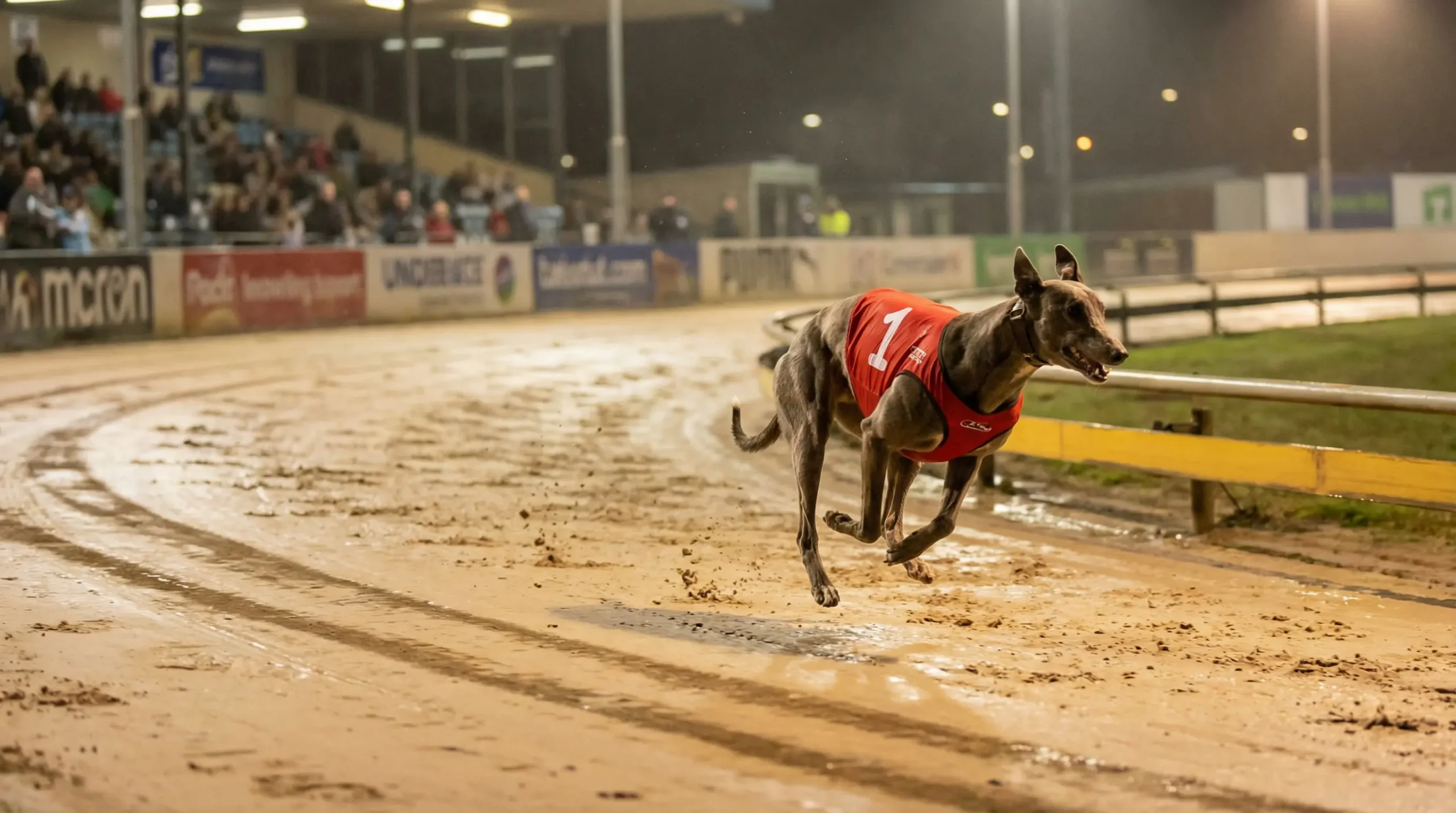
Grades Are the Hidden Architecture of Every Race Card
Ignore the grade and you’re comparing apples to greyhounds. Every race on every card at every licensed UK track carries a grade classification, and that classification does more to define the competitive reality of a race than the dogs’ names, their recent finishing positions, or the odds on the screen.
Grading is the system that organises greyhound racing into structured tiers of ability. Its purpose is blunt: match dogs of similar speed against each other so the racing stays competitive, the finishes stay tight, and the betting stays interesting. As Timeform explains, the aim is for each track to provide competitive racing by placing dogs of similar ability against one another. Without grading, you would have elite sprinters lining up against plodders from the bottom rungs — uncompetitive contests that nobody wants to watch and nobody can usefully bet on.
For punters, the grading system is not background detail. It is the lens through which every piece of form should be interpreted. A dog finishing third in an A1 race has been competing against the fastest graded runners at that track. A dog winning an A7 has beaten considerably slower opposition. The finishing position tells one story; the grade tells the real one. Making betting decisions without factoring in grade context means working with incomplete information — and that costs money.
The grading system also creates one of the most reliable betting angles in greyhound racing: the class drop. When a dog moves down a grade, it faces weaker opposition than it has been used to. When it moves up, the reverse applies. These movements happen constantly — after wins, after losses, after rest periods — and the market frequently misprices them. Understanding how grades work, how dogs move between them, and what that movement signals about future performance is a foundational skill for anyone serious about greyhound betting in the UK.
How the UK Grading System Works
Grades are assigned by time — but what that means depends on the track. The Greyhound Board of Great Britain oversees the framework, and each licensed track employs a racing manager who is responsible for grading the dogs that race at their venue. The grading decisions are based primarily on the calculated times a dog records over the standard distance at that specific track.
The standard grading scale at most UK tracks runs from A1 at the top to A9 or A10 at the bottom, though larger tracks with deeper racing populations may extend further. A1 contains the fastest graded dogs — the ones whose calculated times over the standard trip consistently place them at the top of the local racing hierarchy. Each grade below A1 represents a step down in expected race time, with the increments typically equating to roughly two to three lengths of running.
Calculated time is the critical concept here. Raw finishing time is influenced by the going, wind, race pace, and interference. Calculated time adjusts for these variables to produce a more accurate reflection of true speed. Racing managers use this adjusted figure for grading decisions, not the raw clock reading.
Above the standard A-grade structure sit open races, designated OR. These are the prestige events in UK greyhound racing — competitions that draw the best dogs from across multiple tracks. Open races are graded internally (OR1 being the highest quality, OR2 below that, and so on) and include the sport’s major competitions: the English Greyhound Derby (currently held at Towcester), the Oaks, the Cesarewitch, and the St Leger, among others. The Scottish Greyhound Derby, once a prestigious classic, was last held in 2019 following the closure of Shawfield Stadium. Dogs entered in open races are not restricted by their home-track grade; entry is based on form, time, and reputation.
Below and alongside the standard grades, several specialist categories exist. Sprint grades apply to races over shorter distances, typically 210 to 285 metres. Middle-distance grades cover trips around 480 to 500 metres at tracks where the standard distance is shorter. Staying grades cover the marathon trips — 630 metres and above — where stamina matters as much as raw speed. Hurdle races carry their own classification, and puppy races for dogs under a certain age have separate grading.
One point that trips up punters who follow multiple tracks: grades are not portable between venues. An A3 at Towcester and an A3 at Romford are not equivalent. Towcester is a large galloping track with long straights and sweeping bends; dogs naturally record faster calculated times there. Romford is a tight, sharp circuit where the geometry limits speed. The A3 designation reflects a dog’s position within the local racing population at that track, not a national ranking. This means you cannot directly compare a dog’s grade at one track to its grade at another without adjusting for the track-specific time standards. It also means that a dog transferring from one track to another may be regraded — sometimes significantly — based on the difference in local time standards.
The GBGB publishes grading guidelines that provide the framework, but racing managers retain a degree of discretion. A dog returning from a long layoff might receive a lower grade than its previous times suggest. A dog running well but finishing poorly due to bad luck in running might be held at grade. This human element means grading is not purely algorithmic — experience and judgement play a role.
Moving Up and Down: Grade Promotion and Relegation
A dog dropping from A2 to A3 isn’t declining — it’s being offered easier opposition. This is the single most important sentence in this entire article for punters, because the reflexive assumption among casual bettors is that a dog moving down the grades must be going backwards. Sometimes it is. More often, it is being repositioned to a level where its current form gives it a genuine competitive chance.
Promotion happens when a dog wins a race or records a time significantly faster than the standard for its current grade. The speed of promotion depends on the margin. A dog that demolishes an A5 field by six lengths in a fast time might jump straight to A3. A dog that wins an A5 by a short head in a modest time might only rise one rung to A4. Racing managers weigh up the quality of the performance, not just the result.
Relegation is the mirror image. A dog that finishes in the bottom half of its races over consecutive outings, or records times consistently slower than the grade standard, will be dropped. The racing manager also considers mitigating circumstances: a dog that has been crowded or baulked in recent runs may be held at grade rather than dropped, on the reasoning that the poor results were caused by race incidents rather than a lack of ability.
For bettors, the direction of grade movement is a signal. An upward move after a win means the dog now faces tougher opposition. The win that triggered the promotion might have been against weaker dogs, and the market — seeing a recent winner — often prices the dog shorter than its new competitive context warrants. Backing recently promoted dogs at short prices is one of the most common ways casual punters lose money in greyhound betting.
Downward movement, on the other hand, is where value hides. A dog that has been competing in A2 and is dropped to A3 brings A2 ability to an A3 race. Its recent form line might show nothing but losses — third, fourth, fifth — but those losses came against superior dogs. Now it faces a field of runners that are measurably slower. The losses disappear from the narrative; what remains is a dog whose raw ability exceeds the level at which it is now racing.
The most profitable version of this pattern involves dogs returning from a short break. A dog that was racing in A1 or A2, had a period of rest, and returns at A3 or A4 is essentially an upgraded runner placed in a lower division. The market sees the absence from racing and the lower grade and frequently underestimates the dog’s chances. These are the situations where experienced punters make their steadiest returns — not flashy long-priced winners, but consistent value from dogs whose grade context is misread by the public.
What Grades Mean for Your Bets
Class context is the single most underused piece of data on the race card. Punters who habitually check grade changes before betting gain an analytical advantage that most of the market does not bother to pursue. The information is freely available, it takes seconds to check, and it reshapes how you should interpret almost every other data point.
The most direct application is evaluating recent form. A dog with a form line of 4-5-3-6 looks poor at first glance. But if those runs all came in A1 or A2 and the dog is now running in A4, the form line is irrelevant to the current race. What matters is the dog’s underlying speed compared to its new rivals, and the evidence from those higher-grade runs suggests the speed is there — the opposition was simply too strong. Strip the grade context away and you would dismiss this dog. Include it and you have a potential value bet.
Grade context also sharpens your reading of race times. A dog that ran 29.40 in an A6 race and another that ran 29.55 in an A2 race have recorded different clock times, but the A2 dog was running in a faster-paced race against stronger opposition. When both dogs meet in an A4, the raw times suggest the A6 dog is faster. The grade context suggests the opposite. Adjusting for the level of competition is exactly what speed ratings are designed to do, and grade is the simplest proxy for that adjustment.
There is also a tactical dimension. Dogs that have recently been promoted tend to be front-runners who have been winning by leading from the traps. Promotion puts them against faster dogs who can match or exceed their early pace. For the first time in several runs, they face genuine competition for the lead, and many dogs that looked dominant in lower grades struggle when they can no longer dictate the race from the front. Opposing recently promoted front-runners — particularly at tracks where the run to the first bend is short and first-bend crowding is common — is a contrarian angle that produces consistent results.
Conversely, dogs dropping in grade often have a tactical advantage that goes beyond raw speed. A closer — a dog whose style is to come from behind and finish strongly — may have been struggling to pick up the front-runners in A2 because they were simply too fast. In A3, the front-runners are a touch slower, the gaps in the field are a fraction wider, and the closer can make its move more effectively. The class drop does not just put the dog against weaker opposition; it changes the race dynamics in a way that suits its running style.
For forecast and tricast bets, grade analysis is even more important. A class dropper that may not win but is clearly faster than half the field makes an excellent inclusion in exotic bets. A recently promoted dog likely to struggle can often be excluded, narrowing permutations and reducing costs. Build grade checking into your pre-bet routine. Before you look at odds, before you watch the parade, ask: has this dog gone up or down since its last run?
Ladder Logic: Grades as a Betting Compass
The grade tells you where a dog sits on the ladder — your job is to figure out which way it’s climbing. That sounds straightforward, and in principle it is. The complication is that most punters never look at the ladder at all.
They see a dog’s name, its form figures, its odds, and they make a decision. The grade is right there on the card, printed in small text next to the distance, and they skip past it. They compare a dog that finished second in A1 last week to a dog that won A5 three weeks ago and treat them as roughly equal propositions. They are not. They are separated by several grades of ability, and the one who lost at the higher level is almost certainly the better bet.
The grading system rewards punters who pay attention and penalises those who don’t. The reward comes through the class-drop angle, through understanding when recent form flatters and when it deceives. The penalty comes through backing promoted dogs at false prices, through ignoring the context of losses at higher levels, through making like-for-like comparisons between dogs that are demonstrably not competing at the same level.
None of this requires complex tools or proprietary data. It requires looking at one additional field on the race card and asking one additional question before each bet. That is the entire overhead. The return on that investment, compounded across hundreds of bets over a season, is a structural edge that the majority of the betting public hands to you for free.
The dogs racing tonight are all somewhere on the ladder. Some are climbing. Some are sliding. Some are holding steady. The market treats most of them as if their current rung is where they belong. Your advantage comes from knowing that for some of them, the rung is about to change — and the price hasn’t caught up yet.
