

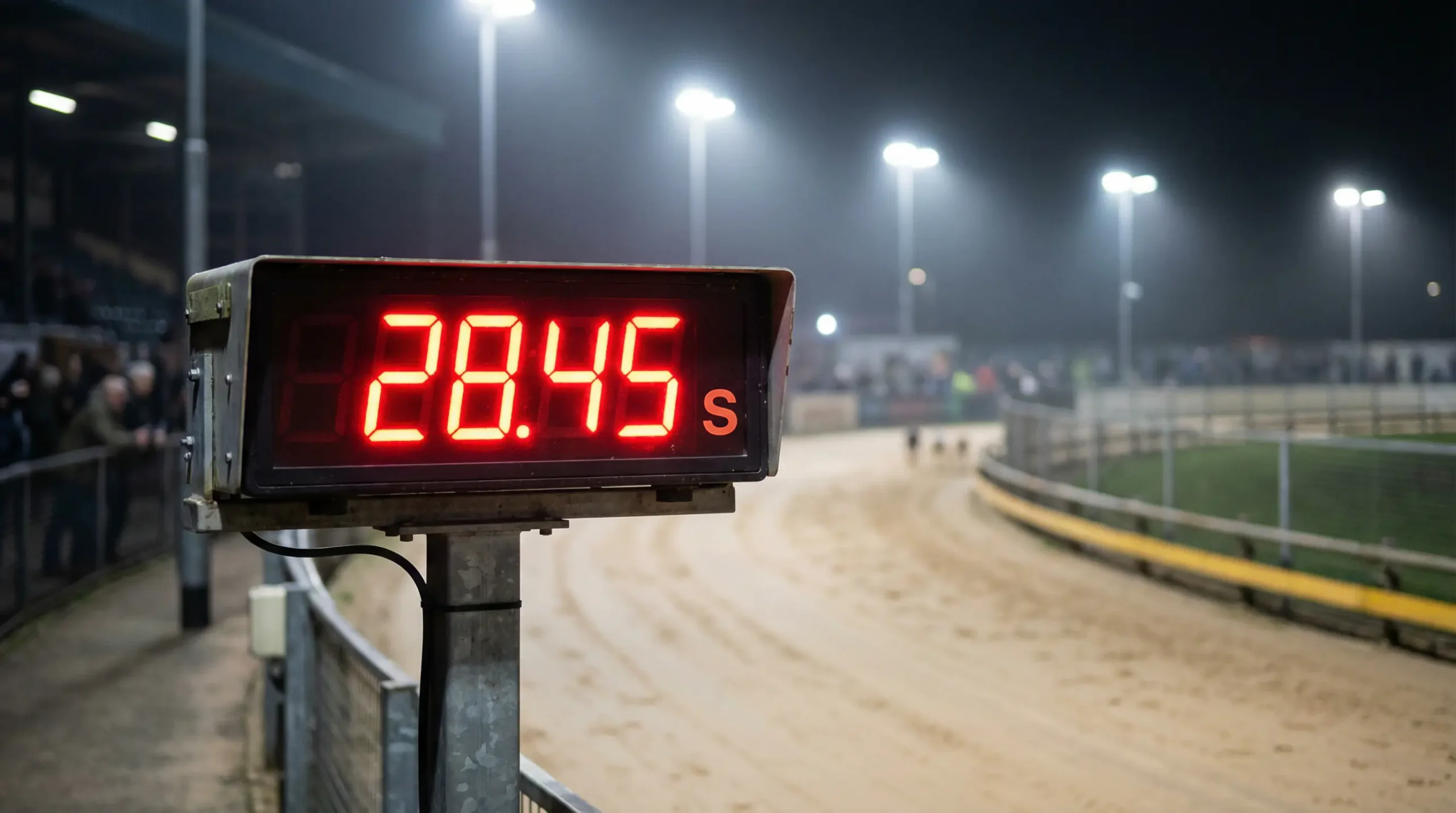
Final Time Tells Half the Story
A greyhound crosses the line in 29.35 seconds. Another finishes in 29.40. The first dog is faster — obviously. Except it led unchallenged from trap to line in a race where nothing pressured it, coasting through the final section. The second dog was bumped at the first bend, ran wide for two turns recovering lost ground, and finished with a storming run that was the fastest closing split in the entire race. Which dog ran the better race? Which one is more likely to win next time out?
Final time answers neither of those questions. Sectional times do. By breaking a race into segments — typically the run to the first bend, the middle section through the turns, and the finishing straight — sectional splits reveal how a dog distributed its effort across the race. They separate dogs that were fast all the way from dogs that were fast in bursts. They identify strong finishers disguised by slow overall times and fading front-runners flattered by a quick clock.
In a sport where races last under thirty seconds and margins are measured in fractions, the granularity of sectional data is what transforms surface-level form reading into genuine race analysis.
What Sectional Times Measure
Sectional times divide a greyhound race into defined segments, each timed independently. The standard split in UK greyhound racing is the run to the bend — the time from the traps opening to the dog reaching the first bend. This is the most commonly published sectional and the most widely used in form analysis. Some tracks and data providers also publish mid-race and finishing sectionals, though the availability of full-split data varies.
The run to the bend — often abbreviated as RTB or displayed as the sectional time — measures early pace. It tells you how quickly a dog broke from the traps and reached the first turn, which is the most tactically important moment in most greyhound races. A fast run-to-bend time indicates a dog with sharp early speed that is likely to be among the leaders into the first turn. A slow RTB suggests a dog that is either naturally slow out of the boxes or deliberately held up to deploy its speed later in the race.
The middle sectional covers the portion of the race through the bends — typically from the first bend to the start of the home straight. This section measures a dog’s ability to maintain speed through the turns, which involves a combination of bend technique, balance, and sustained power. Dogs that lose time through the bends — either because they run wide, check behind slower dogs, or simply lack bend speed — will show a weaker middle sectional relative to their rivals.
The finishing sectional covers the home straight — the final run from the last bend to the line. This split identifies dogs with strong closing speed, the ones who finish their races well and can overhaul rivals in the last 50 to 80 metres. A fast finishing sectional from a dog that was mid-division at the final bend is a clear signal of late speed that was not fully utilised — the kind of dog that, with a better early position next time, could turn a close third into a win.
Combined, these three splits describe the complete energy profile of a dog’s race. A fast RTB followed by progressively slower splits indicates a front-runner that uses its energy early and decelerates. A slow RTB followed by the fastest finishing split in the race indicates a closer whose overall time understates its actual ability. The final clock time is the sum of all three sections; the sectionals tell you where the time was gained and lost.
How to Read and Interpret Sectional Splits
Raw sectional numbers are only useful in context. A run-to-bend time of 4.10 seconds means nothing in isolation — you need to know the track, the distance from the traps to the first bend, and how that time compares to the sectionals posted by other dogs in the same race and at the same track over recent meetings.
The first step in interpreting sectionals is establishing a track-specific benchmark. At each track, there is a typical range for the run-to-bend time at each distance. A fast RTB at Romford, where the run to the first bend is short, will be a different absolute number from a fast RTB at a track with a longer approach to the turn. Collect sectional data from several races at your regular track, and you will quickly develop a sense of what constitutes fast, average, and slow for each section of the race.
Once you have benchmarks, the analytical work begins. Compare each dog’s sectional profile against the track norms and against the other dogs in the same race. Look for discrepancies between overall time and sectional performance. A dog that recorded a slow overall time but had the fastest finishing sectional in the race was faster than its final position suggests — it simply ran into problems earlier in the race that cost it ground. Conversely, a dog with a quick overall time but a slow finishing split was tiring at the end and may have been flattered by an uncontested lead.
Sectional comparison between dogs in the same race is particularly revealing. If Dog A led from the traps with a fast RTB and held on to win by a neck, while Dog B had a slow RTB but produced the fastest finishing split by two lengths’ worth of time, the narrative is clear: Dog B is the faster dog in raw terms but lost the race through a poor start. If both dogs meet again and Dog B draws a better trap — one that gives it a cleaner break — the sectional data tells you it should be rated as the superior runner despite losing last time.
Trend analysis across multiple runs adds another dimension. A dog whose finishing sectional has improved over its last three races is gaining fitness and running-on ability. A dog whose RTB is getting progressively slower might be losing its trap speed through age or a minor physical issue. These trends are invisible in overall finishing times but emerge clearly when you track the sectionals run by run.
One important caveat: sectional times are influenced by race circumstances. A dog that is bumped at the first bend will record a slower middle sectional not because it lacks bend speed, but because it lost momentum in an incident. Always cross-reference sectional data with race comments to ensure you are reading the splits in proper context. A slow section caused by interference is very different from a slow section caused by a lack of ability.
Using Sectionals to Predict Future Races
The predictive power of sectional times comes from their ability to separate true ability from race-day circumstances. A dog’s overall time is a product of ability plus luck plus positioning. Its sectional profile strips away some of that noise and gets closer to the underlying performance.
The most direct predictive application is identifying dogs whose finishing speed was not fully utilised. If a dog consistently produces the fastest or second-fastest finishing split in its races but finishes third or fourth because it was poorly positioned through the bends, the data suggests a dog with more ability than its recent results show. All it needs is a better early position — a faster break, a more favourable trap draw, a less crowded first bend — and that closing speed converts into a winning performance. These dogs are often available at longer prices because the form book shows losses, not the underlying speed that the sectionals reveal.
Sectionals also help predict how dogs will handle distance changes. A dog with a strong finishing split over 480 metres is a candidate for stepping up to 630 metres, because the closing speed suggests stamina reserves that are not being fully tested at the standard trip. A dog whose finishing split is consistently the slowest in the race might struggle over longer distances and could be better suited to shorter trips where its early speed is more decisive.
For forecast and tricast betting, sectionals provide an additional layer for ordering the expected finishing positions. If you know which dogs in a race have the fastest early pace (from RTB data) and which have the strongest finishing kicks (from closing splits), you can construct a plausible race shape. The fast starters will be at the front through the bends; the strong finishers will be closing in the straight. The predicted finishing order follows from the interaction of these speed profiles against the trap draws and track geometry.
Track-transfer predictions are another useful application. When a dog moves from one track to another, its overall times are not directly comparable because different circuits produce different raw times. But sectional profiles transfer more reliably. A dog with a fast RTB at Track A will likely show sharp early speed at Track B, regardless of the absolute time. The proportional speed — how the dog distributes its effort across the race — is an inherent characteristic, not a product of the track. Sectional profiling allows you to assess dogs racing at unfamiliar tracks with more confidence than overall-time comparison alone.
The Split-Second View: Why Sectionals Matter
Sectional times are the closest thing to an X-ray in greyhound racing. They look beneath the surface of the result and show you what actually happened at each stage of the race. Two dogs with the same finishing time ran different races; the sectionals tell you which one has more to give.
The punters who use sectional data consistently develop a deeper understanding of each dog’s capabilities than those who rely on overall times alone. They see potential that the form figures hide. They recognise danger that the clock does not capture. They build a picture of each race before the traps open that accounts for energy distribution, pace dynamics, and tactical flow — not just which dog has the quickest time on the card.
Not every track publishes comprehensive sectional data, and not every race will have the splits you need. But where the data is available, using it is a genuine analytical advantage. A fraction of a second in a sectional split can represent a length or more of running — and in a sport decided by necks and short heads, that fraction is the difference between the right bet and the wrong one.
