

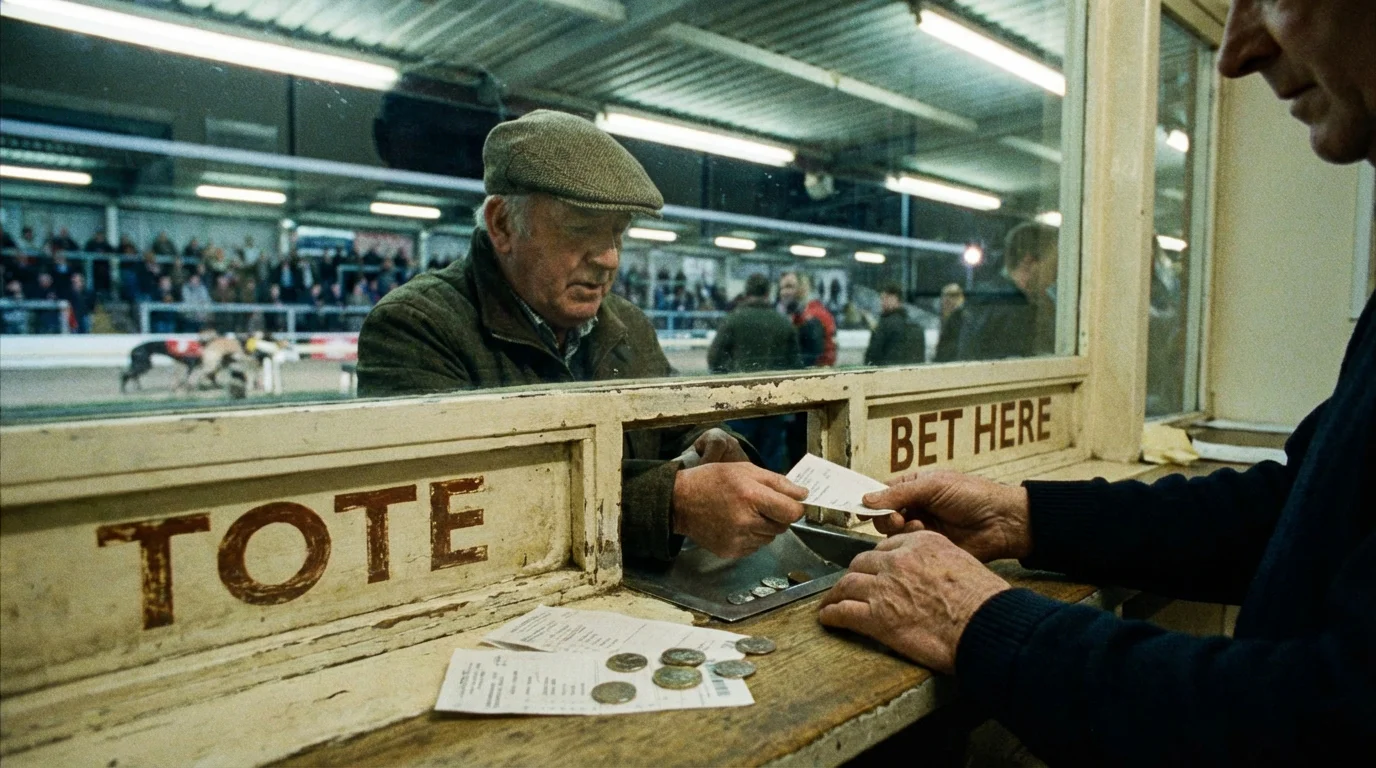
Pool Betting: A Different Way to Wager on Dogs
Most greyhound betting in the UK is conducted at fixed odds — you see a price, you take it, and if your dog wins, you collect at that price. Tote betting works differently. Instead of fixed odds, the Tote operates a pool system where all stakes on a particular bet type are combined into a single pool, the operator takes a percentage, and the remainder is distributed among the winning bettors. Your payout depends not on a pre-agreed price, but on how much money was staked and how many other punters backed the same dog.
Pool betting has a long history in UK greyhound racing, predating the era of online bookmakers and exchange betting. At many tracks, the Tote windows were the primary betting option for trackside punters, and the Tote dividend — announced after each race — was a central part of the race-night experience. While fixed-odds betting now dominates the market, the Tote remains available at tracks and through online platforms, and it offers specific advantages in certain situations that fixed-odds betting cannot match.
Understanding how the Tote works, when it offers value, and how it compares to fixed-odds alternatives gives you an additional tool in your betting approach — one that most greyhound punters overlook entirely.
How Tote Pool Betting Works
The Tote pool operates on a pari-mutuel system. All stakes placed on a particular bet type — win, place, forecast, or tricast — are combined into a single pool. The pool operator deducts a commission, known as the take-out, which funds operational costs and profit. The remaining money is divided among the winning bettors in proportion to their stakes.
The critical difference from fixed-odds betting is that the payout is not determined until after the race. When you place a Tote bet, you do not know what you will receive if your selection wins. The dividend depends on the total size of the pool, the take-out percentage, and how much of the pool was bet on the winning outcome. If the winning dog attracted little public support, the dividend is large. If it was heavily backed, the dividend is smaller. This mirrors fixed-odds betting in principle — favourites pay less, outsiders pay more — but the exact numbers are different because the calculation is based on the actual money in the pool rather than on a bookmaker’s assessment of probability.
The take-out varies by bet type and operator. For win pools on greyhound racing, the take-out is typically around 16-20%. For forecast and tricast pools, the take-out tends to be higher — often 25-30% — reflecting the additional complexity and the larger potential dividends. The take-out is the operator’s guaranteed margin and is deducted before the pool is distributed, which means the effective odds available to punters through the Tote are, on average, slightly lower than those available from fixed-odds bookmakers.
Tote dividends are declared after each race as a return to a standard stake — usually £1. A declared Tote win dividend of £4.30 means that a £1 win bet on the Tote returned £4.30 (£3.30 profit plus the £1 stake). For place and forecast bets, the dividend is declared separately and can vary significantly from the equivalent fixed-odds payout.
One structural feature of the Tote is that the pool is entirely self-contained. The operator does not take a position against the bettor — it simply facilitates the pool and takes its commission. This means the Tote has no incentive to shade the odds against popular selections in the way a bookmaker might shorten a favourite that is attracting heavy money. The payout is determined purely by the pool arithmetic, not by a bookmaker’s risk management.
Tote Bet Types for Greyhound Racing
The Tote offers several bet types on greyhound racing, each with its own pool and its own dividend calculation.
The Win pool is the simplest — you select the dog you think will win, and the pool is divided among those who backed the winner. The Win dividend is equivalent to the starting price in concept, though the actual figure may be higher or lower than the SP depending on the distribution of money in the pool.
The Place pool pays out on dogs that finish in the first two places. In greyhound racing, with only six runners, the Tote typically pays two places. The Place dividend is calculated separately for each placed dog and is usually much smaller than the Win dividend, reflecting the higher probability of a dog finishing in the top two.
The Exacta is the Tote’s version of the forecast — you select the first two finishers in exact order. The Exacta pool often produces dividends that differ from the Computer Straight Forecast, sometimes significantly. Because the CSF is calculated from starting prices while the Exacta is calculated from actual money in the pool, the two figures can diverge when the Tote pool attracts a different betting pattern from the fixed-odds market.
The Trifecta is the tricast equivalent — first three in exact order. Trifecta pools in greyhound racing tend to be smaller than at horse racing meetings, which means the dividends can be volatile. A lightly wagered Trifecta pool can produce an unexpectedly large or small dividend depending on how the money was distributed across the permutations.
The Swinger — available at some meetings — requires you to pick two dogs to finish in the first three in any order. It is a more forgiving bet than the Exacta because the two selections do not need to finish first and second, and the order does not matter. Swinger dividends are generally smaller than Exacta dividends but the strike rate is higher.
Jackpot and Placepot bets — where you must pick placed dogs across multiple races — are available at selected greyhound meetings. These are pool bets that span several races and can produce very large dividends when few punters find all the winners, though they are significantly harder to win than single-race pool bets.
Tote vs Fixed Odds: When Each Wins
The question is not whether the Tote is better or worse than fixed odds — it is when each option offers superior value in a specific race.
The Tote tends to offer better value than fixed odds when you back an outsider that the public has largely ignored. In a fixed-odds market, the bookmaker sets the price for every dog based on its assessment. On the Tote, the dividend is determined by the actual distribution of stakes. If the public has piled money onto the favourite and left the outsiders largely unbacked, the Tote dividend on an outsider winner can exceed the bookmaker’s fixed-odds price. This is because the bookmaker has already built a margin into the outsider’s price, while the Tote simply distributes the pool — and a lightly backed winner receives a disproportionate share of a pool swollen by favourite money.
Conversely, the Tote tends to offer worse value on heavily backed favourites. The pool arithmetic means that a popular selection backed by the majority of the money produces a compressed dividend. If 60% of the pool money is on the favourite, the Tote dividend for the favourite winning is modest — possibly lower than the fixed-odds starting price. In these situations, fixed odds are almost always the better choice.
For forecast and tricast bets, the comparison is between the Tote Exacta/Trifecta and the CSF/CT. The Tote pools for exotic bets at greyhound meetings can be thin, which introduces volatility. A thin Exacta pool might produce a dividend of £45 when the CSF pays £38, or it might produce £25 when the CSF pays £38. The variance cuts both ways, and there is no reliable way to predict which direction it will go before the race. Punters who regularly check both the Tote dividend and the CSF after each race develop a feel for which tracks and which race types tend to produce favourable Tote comparisons.
The Poolside Perspective: Tote as a Tool
The Tote is not a replacement for fixed-odds betting. It is a parallel market that occasionally offers better terms on specific selections in specific races. The punter who uses it most effectively is the one who checks the Tote dividend history at their regular track, identifies the patterns — which bet types and which race profiles tend to produce favourable Tote dividends — and routes selected bets through the pool when the numbers suggest it is the smarter option.
For outsiders in races with a dominant favourite, the Tote is frequently the better channel. For exotic bets at meetings with healthy pool sizes, the Tote can produce dividends that match or exceed the CSF. For routine win bets on mid-market selections, fixed odds are usually superior.
Most greyhound punters never compare the two. They have a bookmaker account, they take the price on screen, and they do not consider whether the Tote might have paid more. That default behaviour creates the inefficiency that Tote-aware punters can exploit. It is not a large edge and it does not apply to every race. But over the course of a season, consistently routing the right bets through the right market adds a small, steady contribution to overall returns — the kind of incremental gain that separates attentive punters from habitual ones.
