

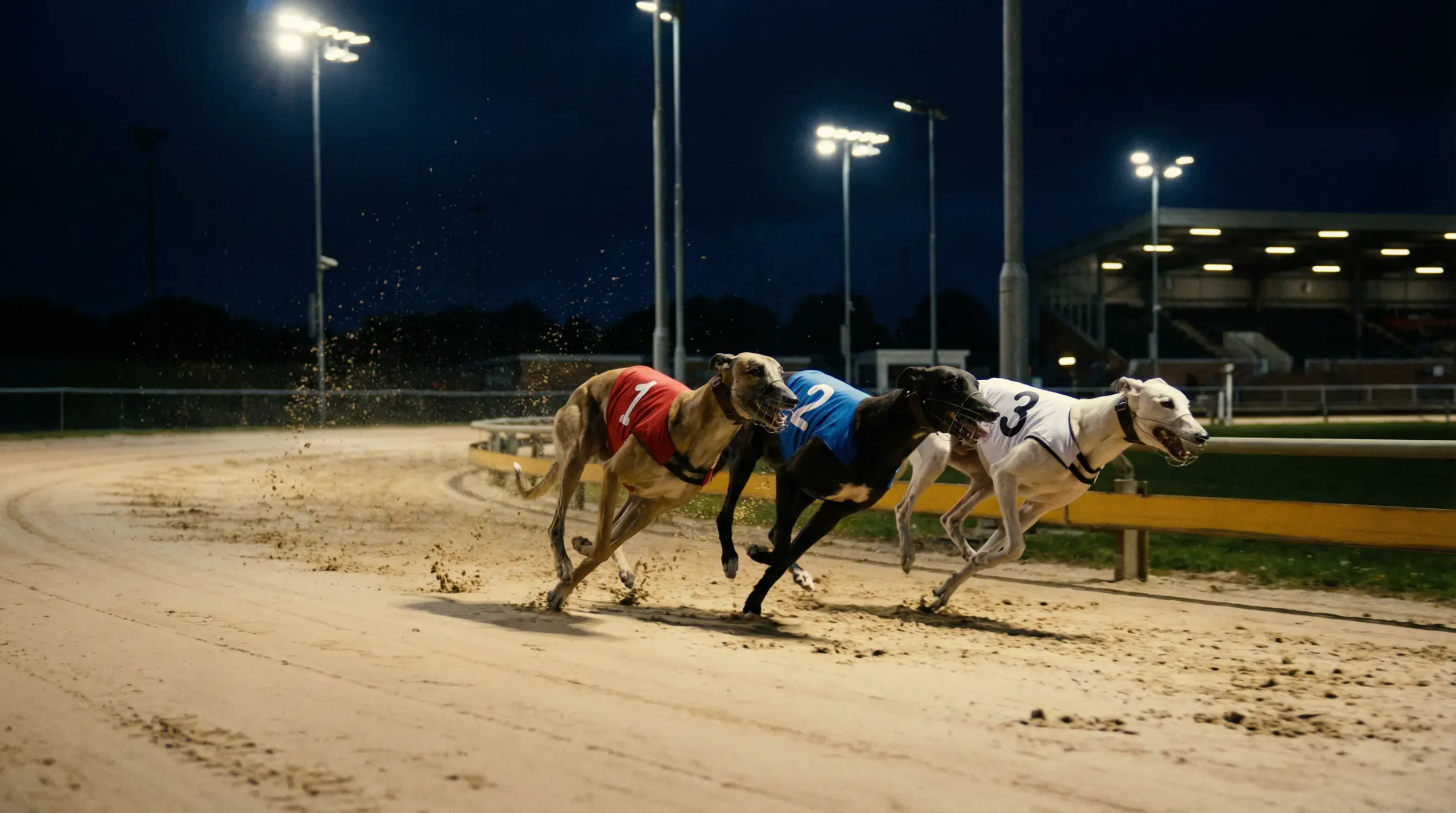
Three Dogs, Six Combinations, One Big Payout
If forecast bets are the step up, tricasts are the leap. A tricast asks you to predict the first three finishers in a greyhound race — the highest-paying standard bet the sport offers. In a six-dog field, there are 120 possible exact-order combinations for the top three places, and that difficulty is reflected directly in the dividend. Tricast payouts routinely reach three figures and, in open races with unexpected results, can stretch into the hundreds from a single unit stake.
Greyhound racing is uniquely suited to tricast betting because the small field size keeps the maths manageable. With only six runners, a disciplined form analyst can usually narrow the realistic top-three contenders to four dogs — sometimes three. That compression turns the tricast from a lottery into a calculated play, particularly when the form clearly separates a group of contenders from the rest of the field.
There are two ways to play: straight and combination. Each has its own cost structure, strike rate, and strategic logic. Knowing when to use which — and when to leave the tricast alone entirely — is what determines whether this bet type builds your bankroll or drains it.
Straight Tricast: Exact Order of the Top Three
A straight tricast requires the first, second, and third finishers in the precise order they cross the line. Dog A wins, Dog B runs second, Dog C takes third — exactly that sequence. Any deviation and the bet loses. No partial credit, no near-miss consolation.
The cost is a single unit stake, which makes the straight tricast extraordinarily cheap relative to its potential return. A £1 bet that can return £50, £200, or significantly more is a risk-to-reward ratio you will not find in any other standard greyhound bet type.
The dividend is calculated after the race using the Computer Tricast formula, which factors in the starting prices of all three placed dogs. When the market correctly identified the top three and they finish in expected order, the dividend tends to be modest — perhaps £15 to £40. When one or more outsiders are involved, the payout escalates rapidly. A tricast involving a 5/1 winner, a 6/1 second, and an 8/1 third can comfortably produce returns of £200 to £400 from a single pound.
The strategic case for straight tricasts is strongest when the race shape is highly predictable. Sprint races at tight tracks are good candidates — the short distance and sharp bends limit the variables, and the finishing order often follows directly from trap speed and the first-bend running positions. If you can identify a likely leader, a reliable runner-up, and a specific dog whose style earns it third place, the exact order becomes an informed prediction rather than a guess.
Discipline is essential. You will lose straight tricasts far more often than you win them. A punter who lands one in every twelve to fifteen attempts is performing well. The arithmetic works because a single successful straight tricast at £80 or £150 covers a long run of £1 losing stakes. The key is selectivity — playing only the races where your analysis gives you genuine conviction about the top three and their likely order.
Combination Tricast: Any Order, Six Bets
A £1 combination tricast costs £6 but covers every permutation. You select three dogs, and if they fill the first three places in any order, you collect. The underlying mechanism is six straight tricasts rolled into one bet — each of the six possible orderings of your three dogs across the top three positions.
The maths is non-negotiable. Three dogs can be arranged in six sequences, so a combination tricast always costs six times the unit stake. A £2 combination tricast is £12. A £5 combination is £30. This cost structure is the single most important consideration when deciding whether a combination tricast is worthwhile, because the dividend needs to exceed six units just to break even.
In practice, breaking even is rarely the problem. Tricast dividends below £6 are almost unheard of in greyhound racing because the bet is inherently difficult. The real risk is choosing the wrong three dogs entirely, not landing a dividend too small to cover the cost. When your three selections do fill the places, you collect the Computer Tricast dividend for whichever of the six sequences matched the actual finishing order.
Combination tricasts shine in races where three dogs are clearly superior to the rest of the field but their internal ordering is uncertain. This is common in evenly graded races where the top-rated runners have similar recent times and comparable form. If the gap between the best three and the rest of the field is obvious but the gap between those three is narrow, the combination tricast captures all the value without requiring you to call the exact sequence.
You can extend combination tricasts to four or more selections, but the cost escalates sharply. Four dogs produce 24 permutations — a £1 four-dog combination costs £24. Five dogs produce 60 permutations and a £60 outlay. At these levels, the cost begins to erode the expected profit even when the bet lands, and most experienced punters limit their combination tricasts to three selections unless they have a very specific reason to widen the net.
What Real Tricast Dividends Look Like
Tricast dividends can be modest or monstrous — it all depends on how predictable the field was. The Computer Tricast formula generates returns based on the starting prices of the three dogs involved, and the range is enormous.
At the conservative end, three short-priced dogs filling the places in a predictable order might return £15 to £40. These are races where the market got it broadly right, and the dividend reflects the low difficulty of the prediction. A £1 combination tricast costing £6 still turns a profit, but the margin is thin.
The middle range — where most productive tricast punters operate — produces dividends of £60 to £150. These typically involve a reasonably fancied winner with at least one outsider in the places. This is the sweet spot: dividends large enough to absorb several losing bets, but occurring often enough to keep the approach sustainable over a season.
At the upper end, unexpected results generate extraordinary returns. When outsiders sweep the top three — a 10/1 winner, a 7/1 second, another unfancied dog third — tricast dividends of £300, £500, and occasionally four figures are possible. These are rare by nature, but they are the reason tricast betting has a dedicated following among punters who tolerate low strike rates in exchange for periodic windfall returns.
The factor that most influences dividend size is the price of the second and third dogs. A short-priced favourite winning compresses the dividend because the market expected that outcome. It is the placing dogs that determine whether the tricast pays £30 or £300. The most valuable tricast scenarios are not necessarily shock results, but races where the winner is identifiable and the placing dogs are hard to predict — a strong favourite winning from a wide-open supporting cast.
The Three-Dog Rule: When Tricasts Make Sense
Don’t tricast every race. Tricast the races where the top three are clear but the order isn’t. That distinction is the entire philosophy of profitable tricast betting compressed into a single sentence.
Playing tricasts indiscriminately — a combination on every race across an evening card — is one of the fastest ways to erode a bankroll. At £6 per race across eight or ten races, you are spending £48 to £60 a meeting on bets with a strike rate that might be one in four on a good night. The maths does not support blanket tricast betting.
The disciplined approach is to apply a strict filter: play a tricast only when you can identify exactly three dogs with a realistic chance of filling the places and the remaining runners are clearly inferior. This maximises the probability of your selections sweeping the top three, because the eliminated dogs are genuine no-hopers rather than borderline contenders you chose to ignore.
Several conditions favour tricast betting. Races where the form clearly separates three contenders from three also-rans. Tracks with strong trap biases, where the draw effectively eliminates one or two runners from serious contention. Sprint races, where the short distance limits late-race drama and the finishing order tends to follow directly from the early running.
Races to avoid include those with six evenly matched runners where no separation exists, and races dominated by a single short-priced favourite with a genuinely open battle for the places behind. In the first case, you cannot confidently exclude any runners. In the second, you would need multiple place combinations that push the cost beyond productive levels.
The best tricast punters treat the bet as a specialist tool, not a default setting. They might play two or three tricasts across a full evening meeting, and on some nights they play none at all because no race met their criteria. That selective discipline is the difference between tricast betting as a strategy and tricast betting as a habit — and the gap in long-term profitability between the two is substantial.
