

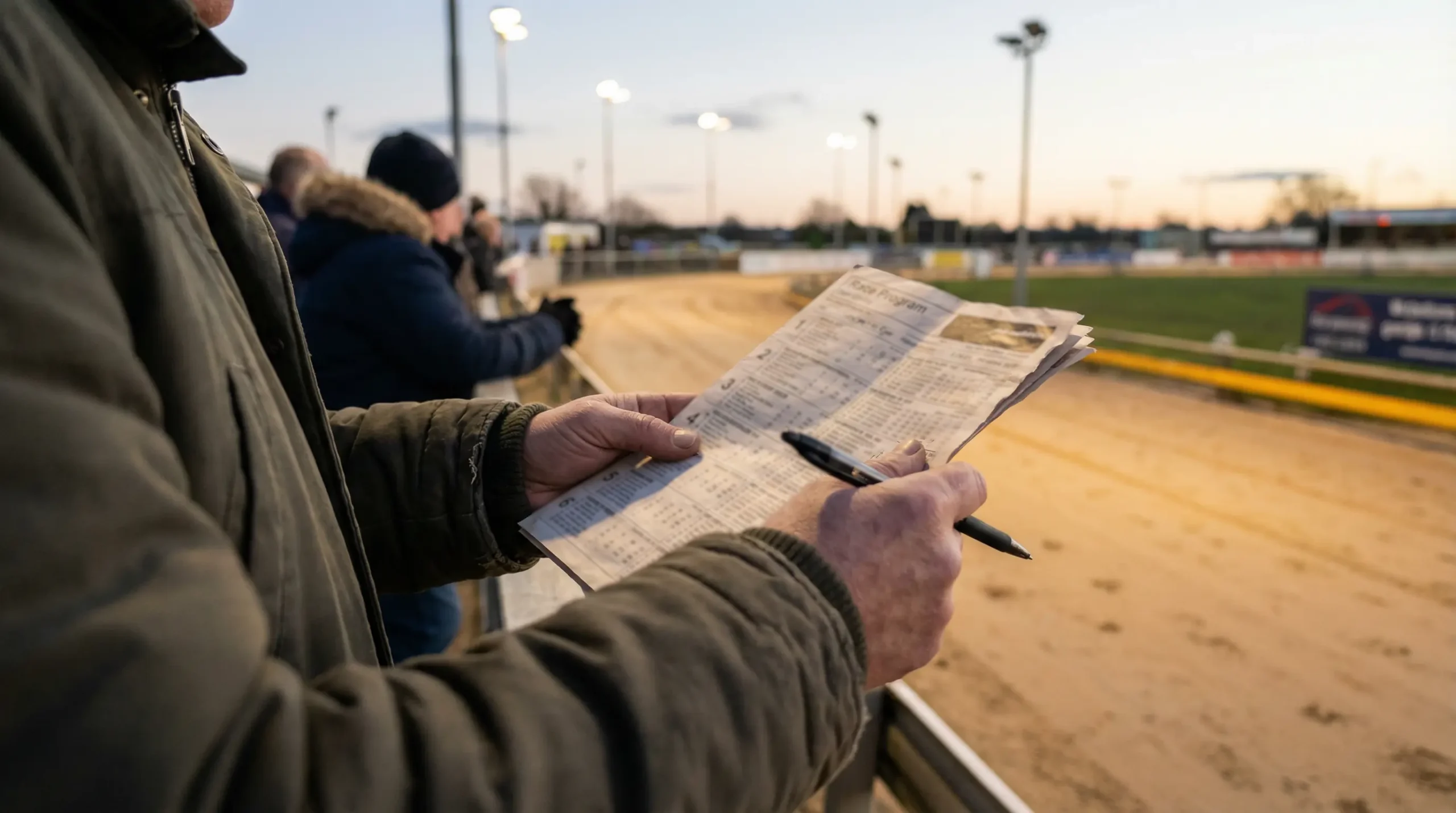
The Race Card Is Your Pre-Race Intelligence Brief
A greyhound race card compresses each runner’s recent history, physical condition, competitive level, and tactical profile into a few lines of data. Once you learn to read those lines fluently, they tell you more about the probable outcome of a race than watching a dozen replays or following a dozen tipsters.
The difficulty for newcomers is that race cards are designed for speed, not accessibility. They are written in abbreviations, formatted in tight columns, and packed with numbers that assume existing knowledge. The first time you look at a greyhound race card, it reads like encrypted text. The tenth time, it reads like a story — one that reveals which dog has the best chance of winning and why.
Cards are published by the Racing Post, Timeform, At The Races, and individual track websites. The format varies slightly between providers, but the core data is consistent. Learn one layout and you can read them all. The investment is in understanding the structure, not memorising different presentations.
Everything you need to form a betting opinion is on the card. The question is whether you can decode it faster and more accurately than the rest of the market.
Every Section of the Race Card Decoded
A standard UK greyhound race card layers information from general context down to dog-specific detail. Working through it systematically is the fastest route to fluency.
The header carries the fundamentals: race time, track, distance, grade, and prize money. This is the context layer. A 480-metre A3 at Romford with £200 to the winner is a very different contest from a 640-metre OR1 at Towcester offering £5,000. The grade establishes the quality of the runners. The distance tells you which type of dog is suited — sprinter, standard, or stayer. The track tells you which trap biases and running lines apply. None of these details should be skimmed.
Below the header, each dog is listed with its trap number, name, trainer, and form figures. The trap number corresponds to the starting box and the coloured jacket — trap one is red, two blue, three white, four black, five orange, six striped black and white. The trainer name matters for kennel form tracking: some trainers consistently produce peak-fitness dogs for specific meetings or distances.
The form figures are a numerical shorthand showing recent finishing positions, most recent on the right. A line reading 3-2-1-1 shows clear improvement. A line reading 1-1-4-6 suggests a dog that was winning but has lost form. The figures are a quick filter — they tell you which dogs are in the conversation and which are probably not — but they do not tell the full story. For that, you need the race comments.
Times are printed alongside the form, given in seconds and hundredths for each recent run. These raw times need careful interpretation because they are affected by track, going, and pace. A 29.50 over 480 metres at one track is not the same as 29.50 at another — circumferences and surfaces differ. For meaningful comparison across tracks, you need adjusted times or speed ratings. Within a single track, raw times are more directly comparable, though going conditions still introduce variation.
Weight is recorded on race night and published on the card in kilograms. A stable weight suggests consistent condition. A drop of half a kilogram or more might indicate hard trialling or a return from illness. A notable increase could mean a well-rested dog or one that has put on condition. Weight changes are secondary indicators, but in tight races they can be the detail that swings a marginal decision.
Race comments describe how the dog ran in each recent race using standardised abbreviations. This is the narrative layer — the part that explains not just where the dog finished, but how it got there. A dog that led from the first bend and won by four lengths had a completely different experience from one that was bumped at the second bend, recovered, and finished a close second. The form figure might be similar; the story behind it is not.
Most published cards also include a tipster or correspondent comment on each dog’s chances. These are worth reading as a starting point, but they should not replace your own analysis. The value of reading the card yourself is forming an independent view before anyone else’s opinion colours your thinking.
Common Race Card Abbreviations
Race comments use standardised abbreviations to describe the key events in a dog’s run. Learning these is essential for reading cards at speed.
Trap-break shorthand covers the start. QAw means quick away — the dog broke sharply from the boxes. SAw is slow away — late out and immediately at a disadvantage. MsdBrk is missed break — significantly slow out, effectively losing the race in the first stride. EP indicates early pace, a dog showing good speed in the opening section.
Positional abbreviations describe where the dog raced. Ld1 or Led1 means it led at the first bend. Ld2 means it led at the second. DispLd indicates a disputed lead — racing neck and neck with another dog for the front. Mid means mid-division. Rls indicates the dog hugged the inside rail throughout.
Incident shorthand describes problems. Bmp1 means the dog was bumped at the first bend — contact with another runner that cost momentum. Crd means crowded, squeezed for room between rivals. Baulked or Blk indicates a serious impediment. Wide means the dog was forced to race wide around the bends, covering extra ground. SAw, Crd1 tells you the dog was slow out and then crowded at the first bend — a double setback that makes any finishing position look better in context.
Finishing shorthand covers the closing stages. RnOn means the dog ran on strongly to the line — a sign of stamina and determination. FinWl means finished well, suggesting the dog has more to offer over a slightly longer trip. Tired indicates the dog weakened late, possibly unsuited by the distance or short of peak fitness. ChlRnIn means the dog challenged on the run-in, the final straight before the line.
Distance abbreviations describe margins. Nk is a neck, Hd is a head, SHd is a short head — the narrowest winning margin. These tell you how close the dog was to a different outcome. A dog beaten a neck into second was a stride away from winning; a dog beaten eight lengths into fourth was outclassed.
Assembled into a full comment, “QAw, Ld1, Bmp2, RnOn, 2nd Nk” reads: quick away, led at the first bend, bumped at the second bend, ran on to the line, finished second by a neck. In fifteen characters, you know the dog has early pace, leads races, encountered trouble and fought through it, and was narrowly denied. That is a profile of ability and resilience — exactly the information you need for your next bet.
From Card to Bet: Practical Application
Reading the card is analytical. Converting that reading into a betting decision requires a structured sequence that moves from raw data to informed judgement.
Start with the header. Grade and distance set the parameters — what type of race is this, and what quality of dog should you expect? Then scan the form figures for each runner, looking for patterns: improving sequences, declining form, consistency, or erratic runs. Flag the dogs whose figures suggest competitiveness at this level.
Next, read the race comments for your flagged dogs. Look for excuses. A dog with a form line of 5-4-3 might look like it is running into form, but if the comments reveal it was badly hampered in the first two runs, the improvement is steeper than the numbers suggest. The dog may have been capable of a top-two finish in each of those races if the trouble had not occurred. Conversely, a dog whose comment reads “led, unchallenged, won easily” might have beaten a weak field, and the bare result flatters its true ability.
Check the trap draw against each dog’s running style. A railer in trap one is perfectly placed. A railer in trap five has a problem — it needs to cut across four rivals to reach the rail, and in a fast-breaking greyhound race, that usually means crowding and lost ground. A wide runner in trap six at a track with a long run to the first bend has a clear route. The interaction between style and draw is the tactical layer of the card, and it can override raw form.
Finally, check weight and trainer. Stable weight from a trainer in good current form reinforces a positive view. A significant weight shift or a kennel that has gone quiet adds a note of caution. These are secondary factors, but in a race where two or three dogs are closely matched, secondary factors become decisive.
The entire process should take under five minutes per race once you are fluent. Speed matters — most meetings carry eight to twelve races, and thorough analysis across a full card is a time investment. The punters who consistently put in that time consistently outperform those who glance and guess.
Card Fluency: Read Faster, Bet Smarter
Reading a greyhound race card is a skill that sharpens with repetition. The abbreviations become automatic. The patterns in form figures resolve at a glance. The interplay between trap draw, running style, and race comments starts to assemble itself into a coherent picture of how the race will most likely unfold.
Punters who read cards well do not need tips. They are not following the market or backing favourites by default. They are forming their own view from primary data, and that independent assessment is the foundation of long-term profitability in any betting market.
Every card is a compressed intelligence document. The trap numbers, form figures, times, weights, and comments are the raw material. Your job is to process that material faster and more accurately than the punter standing next to you at the track or clicking through the same screens online. Start with one race per meeting, read it thoroughly, and check your assessment against the result. The fluency comes with practice. The returns follow the fluency.
