

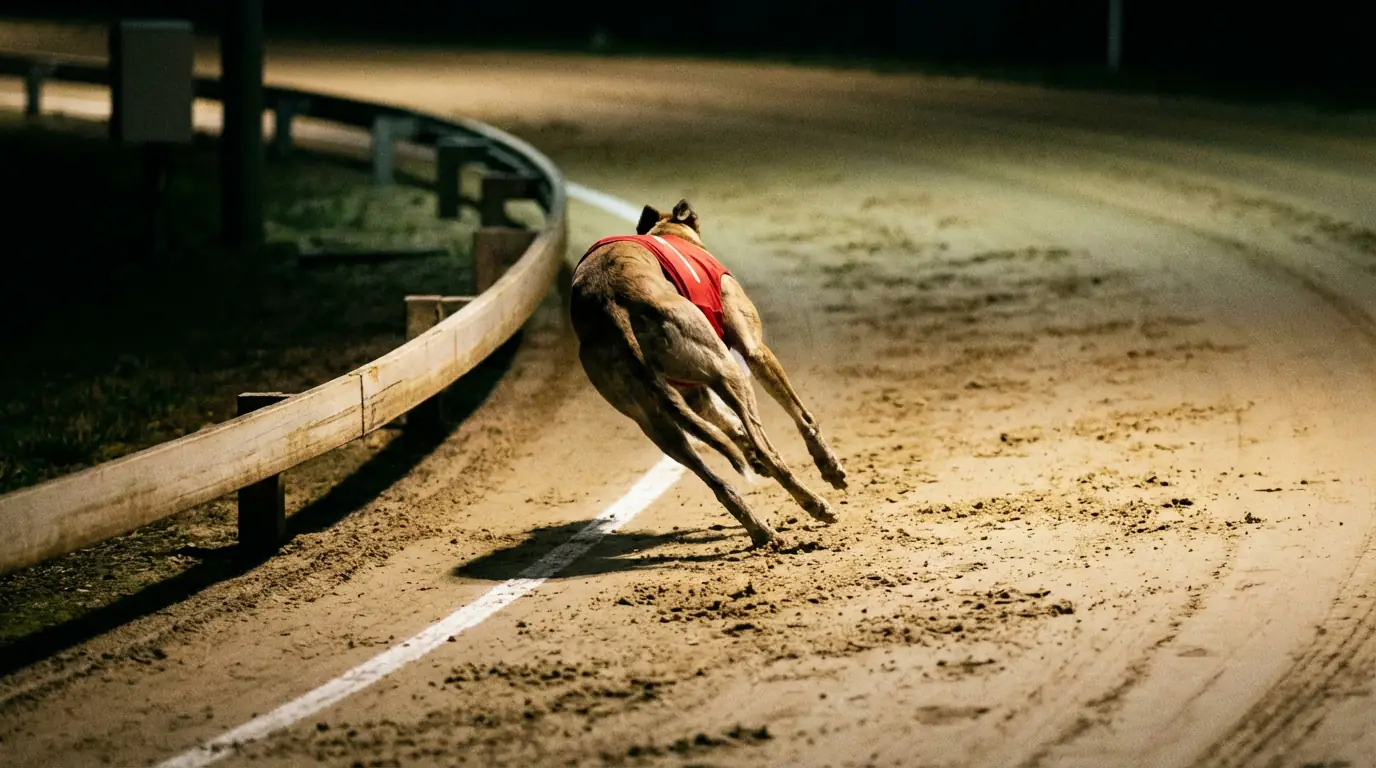
Not All Greyhounds Race the Same Way
Two greyhounds can record identical times over the same distance and run completely different races. One breaks fast from the traps, hugs the rail through both bends, and holds the lead to the line. The other starts slowly, swings wide around the field, and powers home in the final 50 metres. Same clock, same distance, same result — but the route, the energy distribution, and the tactical profile could not be more different.
Running style is one of the most important variables in greyhound race analysis, and it is consistently underweighted by punters who focus primarily on times and finishing positions. How a dog runs determines where it needs to be drawn, which opponents cause it problems, and how it responds to different race shapes. A fast dog in the wrong trap or facing the wrong type of rival can be beaten by a slower dog whose style fits the circumstances perfectly.
There are four broad categories of running style in greyhound racing: railers, wide runners, front-runners, and closers. Most dogs lean towards one category, though some show flexibility depending on the trap draw and opposition. Understanding these styles — and recognising them from the race card — is a core analytical skill for serious punters.
Railers: Inside-Line Specialists
A railer is a greyhound that naturally gravitates towards the inside rail and runs the shortest possible line around the track. From the moment the boxes open, a railer angles inward, seeking the rail position that minimises the distance it has to cover through the bends. Once on the rail, it stays there — tight to the inside, cutting every corner, saving ground on every turn.
Railers have a clear advantage when drawn in traps one or two. From these starting positions, the rail is immediately accessible. The dog breaks, finds the rail within a stride or two, and enters the first bend on the shortest line. At tight tracks with sharp bends, this positional economy translates directly into lengths gained over dogs running wider paths.
The problem for railers is being drawn in traps four, five, or six. From the outside, reaching the rail requires cutting across the paths of multiple rivals. In a fast-breaking field, that inward move creates crowding — the railer tries to cut in, the dogs on its inside resist, and the result is bumping, checking, and lost momentum. A railer drawn in trap six at a tight track faces a scenario where its natural instinct to find the rail actively works against it.
Race card comments identify railers through abbreviations like Rls (raced on rails), RlsRn (rails run), and EP,Rls (early pace on rails). A consistent pattern of these comments across recent runs confirms the style. When you see a confirmed railer drawn in trap one at a track with strong inside-trap bias, you are looking at a dog whose style and draw are in perfect alignment — one of the most reliable betting configurations in greyhound racing.
Wide Runners: The Outside Route
Wide runners are the opposite of railers. They naturally race on the outside of the field, taking the longer route around the bends but avoiding the congestion that frequently occurs on the inner line. Where railers seek the shortest path, wide runners seek the clearest one.
The advantage of running wide is uninterrupted progress. While railers and mid-pack dogs jostle for position on the inside, the wide runner cruises around the outside with nothing in front of it and nobody bumping into it. At tracks where first-bend crowding is common — tight circuits with short runs to the first turn — the wide runner’s route avoids the carnage entirely. The dog covers more ground but runs it cleanly.
Wide runners perform best from traps five and six, where they are already on the outside and can maintain their natural line without needing to navigate across other dogs. From trap one or two, a wide runner faces a dilemma: it either runs against its instinct by staying on the rail, or it moves outward across the field, losing ground and risking interference.
The betting implications are straightforward. A wide runner drawn in trap six at a track with a sweeping first bend and a long back straight has an excellent setup. The wide line costs minimal extra distance at a larger track, and the unimpeded run allows the dog to maintain speed without checking or swerving. At a tight track, the extra ground covered by running wide is more penalising — every extra metre adds up when the total race distance is only 400 metres. Track selection is critical when assessing wide runners.
Identifying wide runners from the card: look for comments like Wide, MvdWide, EvCh (every chance — often used when a dog raced prominently on the outside), and ChlWide (challenged wide). A dog that consistently shows these comments is one that naturally takes the outside route.
Front Runners vs Closers: Early Pace vs Late Pace
The railer-versus-wide-runner distinction is about lateral positioning. The front-runner-versus-closer distinction is about when a dog does its best running — early or late in the race.
Front-runners break fast from the traps and establish an early lead. Their race plan is simple: get to the front, dictate the pace, and hold the lead to the line. They win by controlling the race from the start, and they are at their most dangerous when they have a clean break and get to the first bend in front. The combination of a front-runner with sharp trap speed drawn in trap one at a tight track is one of greyhound racing’s most potent configurations.
The weakness of front-runners is what happens when they do not lead. A front-runner that gets bumped at the first bend, or breaks slowly and finds itself behind other dogs, often fails to recover. Its energy distribution is front-loaded — it expends maximum effort in the first half of the race to establish position. If that effort does not produce the lead, the dog has less in reserve for the closing stages. Race comments for front-runners typically include QAw (quick away), EP (early pace), Ld1 (led first bend), and ALd (always led).
Closers are the mirror image. They break at a moderate pace, settle into mid-division or towards the rear, and produce their best speed in the final section of the race. Their finishing kick can be devastating — they sweep past tiring front-runners in the final 50 to 80 metres, often winning on the line when they looked beaten at the third bend.
Closers are harder to bet on because their running style introduces more uncertainty. They depend on the race unfolding in a way that allows them to deploy their finishing speed — they need gaps in the field to run through, and they need the early pace to be strong enough that front-runners tire. When the early pace is slow and the front-runner has plenty in reserve, the closer never gets the opportunity to finish. Race comments for closers include RnOn (ran on), FinWl (finished well), ChlRnIn (challenged on the run-in), and LateGn (late gain).
The interaction between these styles in a single race is what creates race shape. A field loaded with front-runners produces a fast early pace that benefits closers — the leaders burn each other out. A field with only one front-runner and several closers often produces a slow early pace that suits the leader — nobody pressures it, and the closers do not have enough track remaining to catch up. Reading the mixture of styles in a field before the race is one of the most valuable analytical exercises in greyhound betting.
Matching Running Style to Trap Draw
Running style analysis only reaches its full value when combined with trap draw assessment. A dog’s style tells you what it wants to do; the trap draw tells you whether the track will let it.
The ideal combinations are clear. Railers belong in traps one and two. Wide runners belong in traps five and six. Front-runners benefit from inside draws at tracks with short runs to the first bend, where early speed translates directly into a commanding lead. Closers are less trap-sensitive but prefer draws that keep them clear of first-bend trouble — trap six can work well for a closer that swings wide and avoids the pack.
The mismatches are equally clear, and they are where betting value often hides. A strong railer drawn in trap five is out of position. Its form might be excellent — wins, fast times, consistent places — but all of that was achieved from inside draws. Now it has to cross the field to find the rail, and the probability of trouble increases sharply. The market might still price this dog at short odds based on its recent results, without fully discounting the trap disadvantage. Opposing this dog — or at least not backing it — is an application of running-style-plus-trap analysis that produces long-term profit.
The same logic applies in reverse. A moderate dog with a style that perfectly suits its draw can outperform its form. A wide runner with middling form drawn in trap six at a large track with sweeping bends has everything in its favour tactically. Its finishing position might not reflect brilliance, but the setup reduces interference and maximises its chance of a clean run. At longer prices, these dogs offer consistent value.
Before every bet, ask two questions: what does this dog want to do, and does the draw let it? When the answers align, you have a positive setup. When they clash, you have a warning sign that the form might not translate.
The Style Factor: Why How They Run Matters as Much as How Fast
Greyhound racing is often treated as a pure speed contest. Run the times, rank the dogs, back the fastest one. But the reality is more nuanced. Speed is useless without a clear run. A dog can be the fastest in the field and still lose if its running style puts it in the wrong part of the track at the wrong time.
The punters who incorporate running style into their analysis see races differently. They do not just ask which dog is quickest — they ask how the race will unfold. Which dog leads? Where does the crowding happen? Who benefits from a fast pace, and who suffers? These are questions about dynamics, not raw ability, and the answers come from understanding the running styles in the field and how they interact.
Style analysis turns a six-dog race from a simple speed comparison into a tactical puzzle. The dog with the best form is not always the best bet. Sometimes the best bet is the dog whose style, trap draw, and race conditions combine to give it the clearest path to the finish line — regardless of whether it has the fastest clock time in the field.
