

Timing Your Bet Is a Bet in Itself
Every greyhound punter faces the same decision before every race: bet now or bet later. Take the price currently on offer — the early price — or wait and accept whatever the starting price turns out to be when the traps open. It sounds like a minor operational detail. It is not. The timing of your bet can be the difference between backing a dog at 5/1 and backing it at 3/1, and that difference compounds relentlessly across hundreds of bets over a season.
The starting price and the early price are two distinct mechanisms for determining what you get paid if your dog wins. Each has advantages, each has risks, and the optimal choice depends on the specific race, the specific dog, and how you expect the market to move between now and the off. Treating them as interchangeable — or, worse, never thinking about the choice at all — is one of the quieter ways punters leave money on the table.
Understanding both pricing mechanisms, and the promotion that bridges them, is a practical skill that every serious greyhound bettor should develop. The dogs and the form get all the attention. The price you actually take gets far less — and it deserves more.
How Starting Price Is Determined
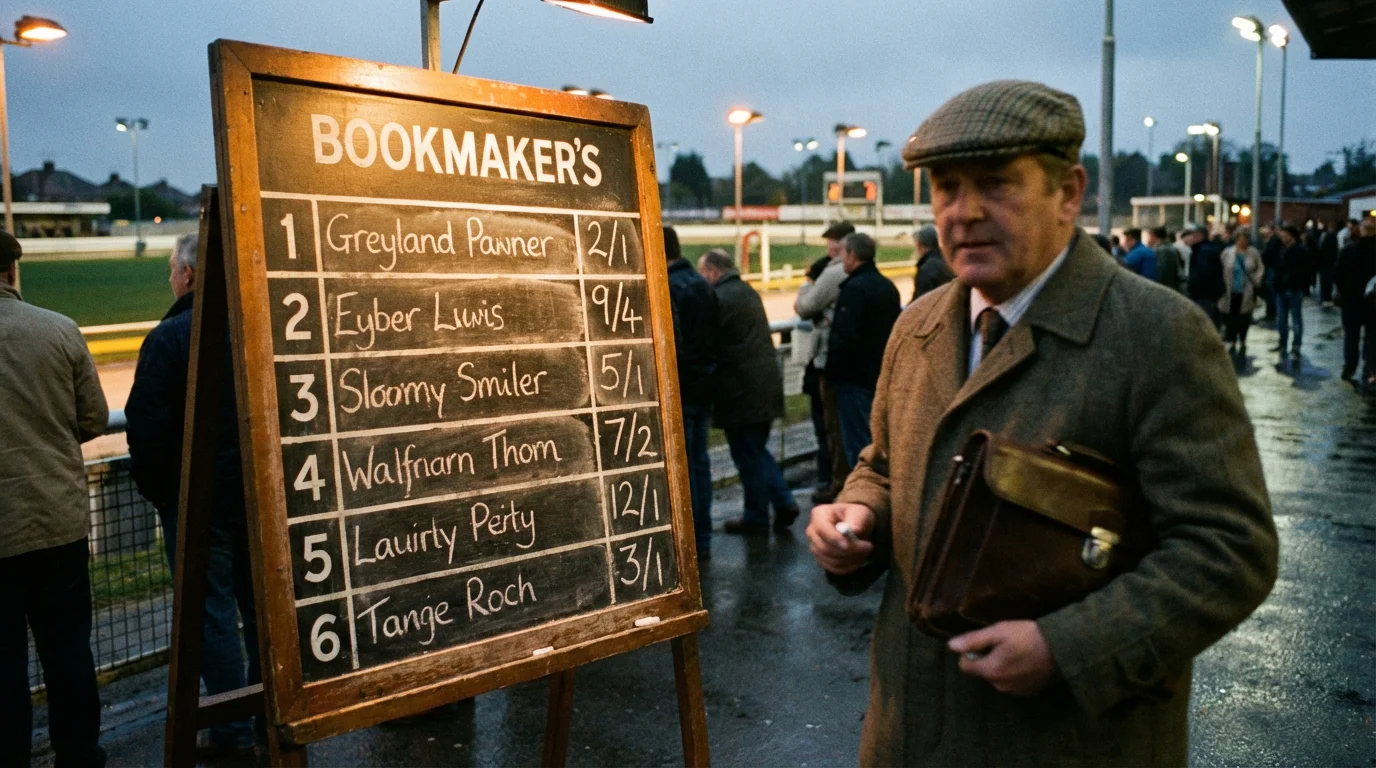
The starting price is the official odds of a dog at the moment the race begins. In UK greyhound racing, the SP is determined by an independent assessor — the SP reporter — who monitors the on-course bookmakers’ boards at the track and records the prevailing odds at the off. The SP reflects the final state of the on-course market after all money has been wagered.
This means the SP is not set by any single bookmaker. It is a consensus price derived from the competitive interplay of on-course layers, each adjusting their boards in response to the bets they are taking. If a dog attracts heavy support in the final minutes before the race, its SP will shorten. If money comes for other runners and the dog drifts in the market, the SP will be longer. The SP is, in essence, the market’s final verdict on each dog’s chance.
For online punters who select SP rather than taking a fixed price, the payout is determined by this on-course process. You do not know what you will be paid until after the race. This introduces uncertainty — your dog might win at 4/1 or at 7/2 depending on late market movements — but it also means you benefit if the price drifts outward in the final minutes.
The SP carries a certain intellectual honesty. It is the price at which the market, having processed all available information including late money, grade changes, paddock appearance, and any last-minute intelligence, values each runner’s chance. For punters who lack the time or inclination to monitor market movements, taking SP removes the need to make timing decisions — you simply accept whatever the market concludes.
The disadvantage of SP is equally clear: you have no control. If a dog you fancied at 6/1 in the morning is backed down to 3/1 by the off, your SP bet pays 3/1. You identified the value early but did not lock it in. The information advantage you had — seeing the value before the rest of the market — was surrendered by waiting.
Early Price: Locking In Before the Market Moves
Early prices are the fixed odds offered by bookmakers in advance of the race, typically available from the morning or early afternoon for evening meetings. When you take an early price, the odds are locked in at the moment you place the bet. It does not matter what happens to the market afterwards — if you backed a dog at 5/1 and it drifts to 8/1 or contracts to 2/1, your bet pays at 5/1 regardless.
The strategic appeal of early prices is that they allow you to capture value before the market corrects. Bookmakers set their early-morning prices based on their own assessment of each dog’s chance, often using algorithms, form data, and historical patterns. These initial prices are not always accurate. A dog that the bookmaker prices at 6/1 might be genuinely worth 4/1 based on the form — and when the betting public recognises this, the price shortens as money pours in. By taking the 6/1 early, you locked in the value that later bettors will not get.
Early prices are most advantageous when you are backing a dog that is likely to attract support. If your analysis identifies a runner with strong form, a favourable trap draw, and a class drop — the kind of profile that experienced punters gravitate towards — the odds will almost certainly shorten between the morning market and the SP. Taking the early price captures the highest available return.
The risk of early prices is the opposite scenario: the dog drifts. New information emerges — a change of going, a non-runner that alters the race dynamics, or a negative paddock report — and the price lengthens. You are locked in at the shorter price while later bettors get better odds. In these situations, you would have been better off taking SP.
There is also the issue of non-runners. If a dog is withdrawn after you have placed an early-price bet, the remaining runners are subject to a Rule 4 deduction that reduces your payout. The deduction is applied to compensate for the removal of a runner that might have been beaten, but it means your locked-in price is effectively reduced. SP bets are not subject to Rule 4 because the starting price is already calculated with the non-runner removed.
The discipline with early prices is straightforward: take them when you believe the price will shorten, and avoid them when you are uncertain about market direction. If you have no view on whether the price will move, SP is the neutral choice.
Best Odds Guaranteed: The Safety Net
Best Odds Guaranteed is a promotion offered by most major UK bookmakers that eliminates the primary risk of taking an early price. Under BOG terms, if you take an early fixed price and the starting price turns out to be higher, the bookmaker pays you at the SP instead. You receive whichever is better — the price you took or the price at the off.
This effectively gives you a free option. Take the early price to lock in value if the dog shortens. If the dog drifts instead, the BOG promotion ensures you still get the longer SP. The downside of early-price betting — being locked into a shorter price while the market moves against you — is removed entirely.
BOG is not universally available on all greyhound races. Most bookmakers restrict it to selected UK meetings, particularly those broadcast on television. Some operators offer it across all UK greyhound meetings; others limit it to specific tracks or time periods. The terms can also vary — some bookmakers cap the maximum SP they will pay under BOG, especially on larger stakes. Checking which bookmakers offer BOG on the specific meeting you are betting on is a routine step that should happen before you place the bet, not after.
When BOG is available, the strategic calculus changes completely. There is almost no reason to take SP if you can take an early price with BOG protection. The early price gives you a floor — the minimum you will receive — and the BOG promotion gives you an upside if the market moves in your favour. It is a genuinely asymmetric proposition: you capture the benefit of both timing options while bearing the risk of neither.
The only scenario where SP might still be preferable even with BOG available is when you expect significant non-runners that would trigger Rule 4 deductions on early-price bets. In these cases, the SP — which is calculated post-withdrawal — avoids the deduction entirely. For most standard graded races, however, non-runners are relatively infrequent, and the BOG advantage outweighs the Rule 4 risk.
The Timing Decision: A Practical Framework
Reduce the timing decision to a simple flowchart. First: is BOG available on this race from your bookmaker? If yes, take the early price. The BOG promotion removes the downside, so there is no reason to wait. You lock in the current odds and get a free upgrade if the SP is higher.
If BOG is not available, the decision becomes a judgement call. Ask: is this dog likely to shorten or drift? Dogs with obvious form claims — recent winners, class droppers, favourable draws — tend to shorten as the public backs them. Take the early price. Dogs with less obvious appeal — returning from a break, unfancied in the market, unproven at the track — tend to hold their price or drift. SP is the safer choice here, because you are not giving up value by waiting.
There is a third category: dogs whose form you rate but whose profile is not the kind that attracts public money. These are the hidden-value runners — perhaps a dog with poor recent form figures that came in higher grades, or a dog whose running style suits the trap draw in a way that is not immediately obvious. These dogs often maintain their early prices because the public does not back them. In these cases, the early price and the SP are likely to be similar, and the choice between them is less critical.
The broader principle is this: treat the timing of your bet as an active decision, not a default. Every time you take SP without thinking, you are accepting whatever the market decides. Every time you take an early price without checking for BOG, you are taking a risk that a free promotion could have eliminated. The dogs do not change between morning and evening. The prices do. And the price you accept is half the equation of every bet you place.
