
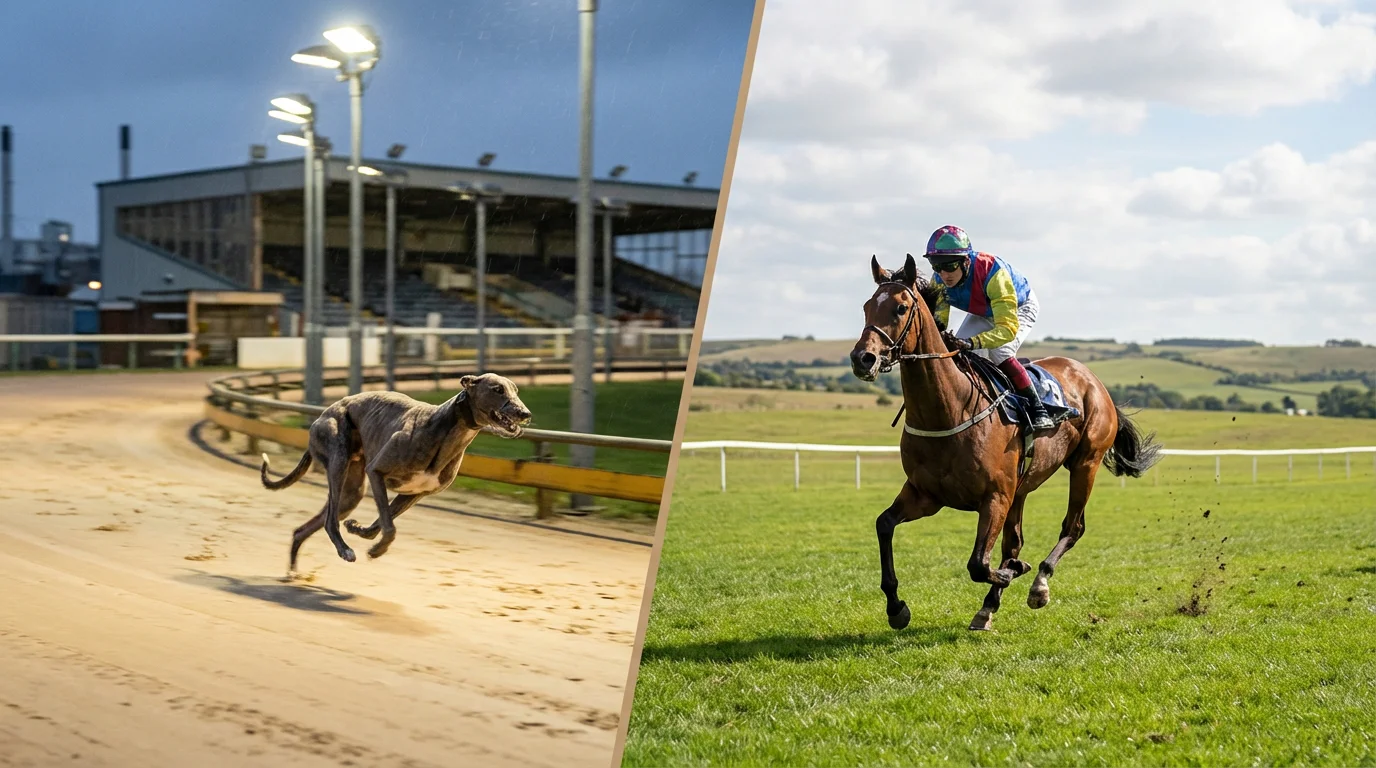
Two Racing Sports, Two Different Betting Worlds
Greyhound racing and horse racing are both built on the same premise — animals competing around a track, with a betting market attached to the outcome. The overlap ends there. The field sizes are different, the race durations are different, the form analysis is different, and the market dynamics diverge in ways that reward different types of punters. Treating greyhound betting as a scaled-down version of horse racing, or vice versa, misses the structural distinctions that define each sport’s betting landscape.
Many UK punters bet on both. The racing calendar overlaps, the bookmaker accounts are the same, and the betslip looks identical whether you are backing a greyhound or a thoroughbred. But the analytical approach that works for one does not transfer cleanly to the other, and the punter who takes the time to understand the differences — rather than applying a single method to both — gains an advantage in each.
This is not a case for one being better than the other. Each sport offers distinct betting opportunities that suit different analytical strengths, risk tolerances, and time commitments. Knowing which suits you, and why, is a practical question worth answering.
Field Size, Frequency, and Market Dynamics
The most fundamental structural difference is field size. Greyhound races feature six runners. Horse races routinely contain eight to twenty or more. This single variable ripples through every aspect of the betting experience.
In a six-dog race, each runner has a baseline win probability of approximately 16.7%. The small field makes each dog a significant contender, and the favourite’s win probability is typically high — 30-40% in many graded races. This compression means that favourites win more often in greyhound racing than in horse racing, which affects the volatility of results and the type of value available. In horse racing, with larger fields, outsiders win more frequently because the probability is spread more thinly across more runners. Big-priced winners are a regular feature of the form book in horses; in greyhounds, they are less common but the forecasts and tricasts they produce pay handsomely.
Racing frequency is another major distinction. A single greyhound track might stage eight to twelve races in an evening, and multiple tracks run simultaneously across the UK on any given night. The total number of greyhound races available for betting on a typical evening far exceeds the horse racing programme. This volume means greyhound punters have more opportunities per session but also face more temptation to over-bet. Selectivity — the discipline to pass on races that do not offer value — is arguably more important in greyhound betting than in horse racing, where the lower volume imposes a natural limit on the number of bets available.
Market depth differs substantially. Horse racing attracts significantly more betting turnover than greyhounds, which means the odds are set by a larger and more informed pool of money. The horse racing market is generally more efficient — prices more accurately reflect true probabilities — which makes finding value harder. The greyhound market, with its lower turnover and smaller analytical community, is less efficient. Mispricings are more common, and a punter with a disciplined analytical approach can exploit them more readily than in the more competitive horse racing market.
The bookmaker margin also differs. Greyhound racing carries a higher average overround than horse racing, reflecting the smaller fields and the higher proportion of recreational bettors in the greyhound market. This higher margin is a cost that punters must overcome to be profitable, and it makes price shopping and BOG usage even more important in greyhound betting than in horses.
Form Analysis: Greyhounds vs Horses
The form analysis toolkit for each sport shares common principles — recent results, times, competitive level — but the specific variables and their relative importance differ considerably.
In horse racing, the jockey is a major variable. The human element introduces tactical decisions during the race — when to make a move, which position to take, how to handle pace — that can determine the outcome independently of the horse’s raw ability. There is no equivalent in greyhound racing. The dog runs on instinct and training; no jockey makes real-time decisions. This makes greyhound form more purely about the animal’s ability and less about external human factors, which simplifies the analysis in one respect while making the physical and conditional variables more important.
Going conditions affect both sports, but the scale of impact differs. In horse racing, the going can transform a race — a horse that excels on firm ground may be completely ineffective on soft, and vice versa. The range of going conditions in horse racing is wider (from firm to heavy on turf, plus all-weather variations), and the impact on individual runners is more dramatic. In greyhound racing, the going matters but the variance is smaller. The sand-based surfaces at UK tracks produce a narrower range of conditions than turf, and while the effect on times is measurable, it rarely transforms the competitive hierarchy as dramatically as in horse racing.
Trap draw in greyhound racing has no direct equivalent in horse racing. The draw matters in flat racing on certain courses, but it is one factor among many and is often overridden by pace, tactics, and jockey decisions. In greyhound racing, the trap draw is a primary variable — it determines the dog’s starting position, its access to the rail or the outside, and its vulnerability to first-bend crowding. No horse racing punter weights the draw as heavily as a greyhound punter should weight the trap.
Race distances introduce different analytical challenges. Greyhound races last under 30 seconds over standard trips, which means the margin for error is minimal and the importance of the start is amplified. Horse races last from one minute to over four minutes, providing far more time for tactical changes, position recovery, and stamina to assert itself. The shorter greyhound race rewards analytical precision about early speed and trap draw; the longer horse race rewards judgement about pace, stamina, and tactical riding.
Which Betting Style Suits You?
The differences between greyhound and horse racing betting favour different punter profiles, and understanding which profile you fit helps you allocate your time and bankroll efficiently.
Greyhound betting suits punters who value frequency, data-driven analysis, and the ability to specialise deeply at a small number of tracks. The small field sizes make form analysis more manageable per race, but the high number of races per evening rewards punters who can work through a large card efficiently. The lower market efficiency means that a systematic, disciplined approach can find value more frequently than in horse racing — but it also means the margins are thinner and the bookmaker overround is harder to overcome without consistent price shopping.
Horse racing betting suits punters who enjoy deeper tactical analysis, are comfortable with larger fields and more variables, and have the patience to wait for specific race conditions that favour their approach. The greater market efficiency means value is harder to find, but the deeper liquidity and wider range of bet types (particularly on exchanges) provide more flexibility in how bets are structured. Horse racing also offers a richer media and information ecosystem — more coverage, more expert analysis, more publicly available data — which some punters find enhances their engagement with the sport.
Punters who bet on both should resist the temptation to apply a single approach uniformly. The analytical habits that serve you well in horse racing — weighing jockey bookings, assessing pace scenarios, reading the going description — need recalibration for greyhound racing, where the variables are different and the priorities shift. Maintaining separate analytical frameworks for each sport, rather than blending them into a generic racing approach, produces better results in both.
The Crossover: Lessons from Each Sport
Despite the differences, each sport offers transferable lessons that can sharpen your betting in the other.
From horse racing, the most transferable skill is going analysis. Horse racing punters are trained to assess the going as a primary variable and to adjust their expectations accordingly. This discipline, applied to greyhound racing — where going analysis is less widely practised — gives horse racing crossover punters an immediate edge. They instinctively check conditions, adjust for the surface, and treat raw times with appropriate scepticism. Many pure greyhound punters never develop this habit to the same degree.
From greyhound racing, the most transferable skill is trap draw and positional analysis. Greyhound punters learn to think in spatial terms — where is the dog starting, where does it need to be at the first bend, what path will it take through the race? This spatial awareness, applied to horse racing draw analysis on certain courses, produces a more rigorous assessment than many horse racing punters achieve. The greyhound punter’s instinct to map the early running positions before the race starts is a tactical advantage in any draw-sensitive flat race.
Both sports teach bankroll management, selectivity, and the importance of value over volume. The punter who learns these lessons in one and applies them in the other is better equipped than someone who has only ever bet on a single sport. The differences between greyhound and horse racing are real and important, but the foundational principles of profitable betting — find value, manage your money, stay disciplined — are universal.