
Staggered Starts: When Not Every Dog Leaves the Trap Together
In a standard greyhound race, all six dogs break from the traps simultaneously. In a handicap race, they do not. Handicaps use staggered starting positions — some dogs start from traps set further back on the track than others — to equalise the field based on ability. The fastest dogs start from behind; the slowest dogs start ahead. The theory is simple: if the handicapper gets it right, all six dogs reach the line at approximately the same time, producing a competitive finish regardless of the raw speed differences between the runners.
Handicap races appear regularly on UK greyhound cards, though they are less common than standard graded races. They create a distinct betting challenge because the normal relationship between raw speed and finishing position is deliberately disrupted. A dog that would win by six lengths in a level race might only scrape home by a neck in a handicap — or might not win at all, if the yardage allowance given to the slower dogs more than compensates for the speed gap.
Understanding how handicaps are structured, how the yardage is allocated, and where the betting value tends to hide in these races gives you the tools to approach them with the same analytical rigour you apply to standard races — adjusted for the different dynamics.
How Greyhound Handicap Races Are Structured
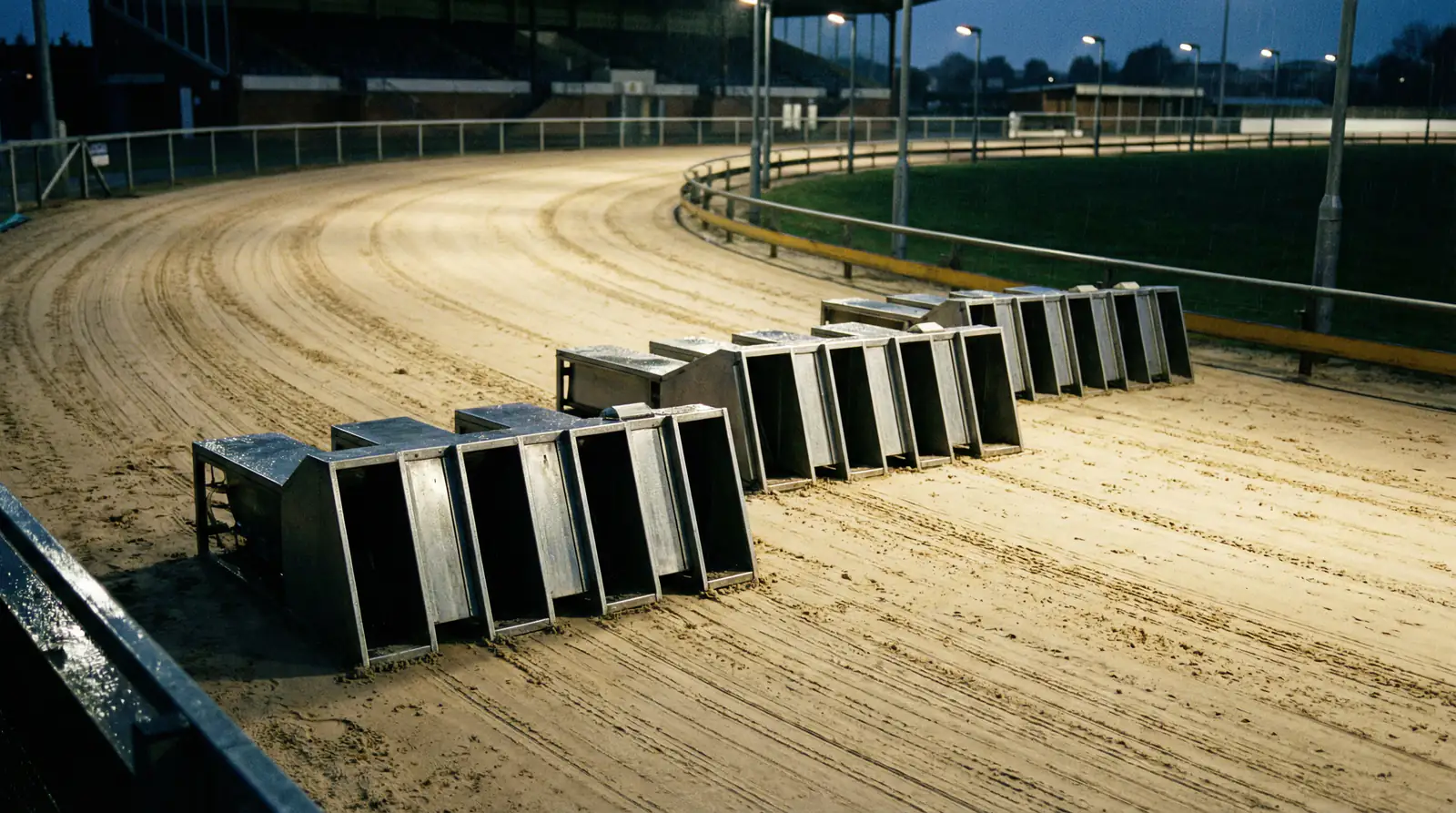
The structure of a greyhound handicap race revolves around the starting positions. Instead of a single set of traps at one location, the track uses multiple trap positions set at intervals along the straight. The fastest dog — the scratch dog — starts from the rearmost position. The other dogs start progressively further forward, with the slowest dog in the field receiving the largest head start.
The handicapper — usually the racing manager at the track — assigns the starting positions based on each dog’s recent form, calculated times, and grade. The goal is to produce a race where the different starting positions neutralise the speed differences between the runners. If Dog A is three lengths faster than Dog B over the standard distance, Dog B starts approximately three lengths ahead. If the handicapping is accurate, both dogs should reach the line together.
The number of starting positions varies by track and by the specific handicap race, but a common format uses two or three different trap positions. In a typical two-position handicap, the faster dogs start from the standard boxes while the slower dogs start from traps set several metres ahead. In a three-position handicap, the field is split into three groups starting from three different points. The precise distances are printed on the race card and are an essential piece of data for analysing the race.
Handicap races are sometimes run at distances that differ from the standard track trip, because the staggered starts mean the dogs starting furthest back run a longer total distance than those starting ahead. This distance differential is part of the handicapping — the scratch dog covers more ground, which is the mechanism by which the handicap functions. The implications for stamina and running style are real: the dog starting from the back runs a genuinely longer race, and if it is on the margins of its stamina limit at the standard distance, the extra metres in a handicap can tip the balance against it.
The field composition in handicap races often brings together dogs from different grades who would never meet in a standard race. An A3 dog and an A6 dog might compete in the same handicap, with the yardage allowance bridging the grade gap. This cross-grade competition creates unusual form matchups that the standard race card does not produce, and it is one reason handicaps can be harder to analyse — the runners have no shared form lines to compare.
Understanding Yardage Allowances
The yardage allowance is the distance advantage given to each dog based on the handicapper’s assessment of relative ability. It is expressed in metres and printed on the race card next to each runner. The scratch dog is shown at zero — no allowance — and each other dog shows the number of metres head start it receives.
Reading the allowances gives you a direct view of the handicapper’s opinion. A dog receiving eight metres from the scratch dog is rated as approximately eight metres slower over the race distance. A dog receiving only two metres is considered nearly as fast as the scratch runner. These implicit speed ratings are the handicapper’s best estimate, and they are worth treating as an informed opinion — not infallible, but based on data and racing knowledge.
The accuracy of the yardage allowance is the central question in handicap betting. If the handicapper has assessed the speed differences correctly, the race is a genuine coin-flip between all runners and no dog has a built-in advantage. In practice, the handicapper is working with imperfect data — calculated times that may not reflect a dog’s current form, recent runs that may have been affected by interference, or dogs whose improvement or decline since their last run the handicapper could not have anticipated.
Where the yardage is wrong — either too generous or too stingy for a particular dog — the betting value appears. A dog that has improved since the handicap was set but is still carrying a yardage allowance based on its earlier, slower form is effectively better than the handicapper thinks. It receives a head start that overcompensates for its actual speed deficit, giving it a genuine advantage in the race. Conversely, a dog that has regressed but is still rated off its peak form receives too little allowance and faces a tougher task than the handicapper intended.
The timing of the handicap assessment matters. If the handicap was set based on runs from three or four weeks ago and a dog has had a significant change in form since then — a break, a trial, a change in training regime — the yardage may not reflect the dog’s current ability. This lag between the assessment and the race is the primary source of exploitable value in handicap betting.
Betting on Handicap Races: Key Considerations
The first consideration is whether the handicap is well framed. A well-framed handicap is one where the yardage allowances look proportionate to the actual speed differences, producing a race where every dog has a realistic chance. A poorly framed handicap — where one dog looks to have received either too much or too little start — creates a clear favourite and reduces the competitive uncertainty.
Assessing the framing requires comparing the yardage allowances to your own assessment of each dog’s current ability. If you believe Dog C is three metres faster than the handicapper has estimated, and it receives a five-metre head start, Dog C has a built-in advantage of two metres — a significant edge in a race where the field is supposed to be equalised. This discrepancy between the official handicap and your private assessment is the foundation of handicap betting value.
Running style takes on altered significance in handicaps. In a standard race, front-runners benefit from leading the field into the first bend. In a handicap, the dogs starting from the front are the slower ones — they have the head start but not the raw speed. The faster dogs, starting from behind, have ground to make up. A strong front-runner starting from the rearmost position faces a different challenge from the same dog in a level race: it needs to close the gap on dogs that are already ahead before it can assert its natural speed advantage. If it encounters traffic from the mid-field dogs while trying to close, the handicap becomes a tactical obstacle as well as a distance one.
Dogs starting from the front with good early pace have a specific advantage in handicaps. They break from their advanced position, establish an early lead over the dogs behind them, and try to maintain that advantage to the line. The question is whether the head start is sufficient. If the allowance is accurate, the faster dogs should catch them. If the front-starting dog has improved, or if the chasers have a difficult first bend, the head start can hold.
Forecast and tricast betting in handicaps is complicated by the cross-grade nature of the field. In a standard race, you can use grade context and speed ratings to rank the likely finishing order. In a handicap, the yardage allowances distort the natural speed hierarchy, making the finishing order harder to predict. Many experienced punters avoid exotic bets in handicaps entirely, focusing on win and each-way bets where the analytical challenge is more manageable.
Levelling the Field: Handicap Betting Tactics
Handicap races are a puzzle — one where the handicapper has tried to make every piece the same size, and your job is to find the pieces that do not quite fit. The dogs where the yardage is wrong, where recent form has shifted since the assessment, where the running style interacts with the starting position to create an advantage the numbers did not anticipate.
The tactical approach is to treat the handicapper’s assessment as a baseline — a starting point, not a final answer. Overlay your own form analysis on top of the yardage. Ask whether each dog’s current ability matches the allowance it has received. Look for the dog that is better than the handicapper thinks, back it at the price the market offers, and accept that the compressed nature of handicap races means the margins will be small and the results will be close.
Handicaps are not every punter’s favourite race type, and there is no shame in passing on them if the cross-grade complexity does not suit your analytical approach. But for punters who enjoy the intellectual challenge of assessing relative speed across different ability levels, and who are willing to develop the specialist skill of reading yardage allowances against current form, handicap races offer a distinct niche within the greyhound betting calendar — one where a different type of analysis produces a different type of edge.