
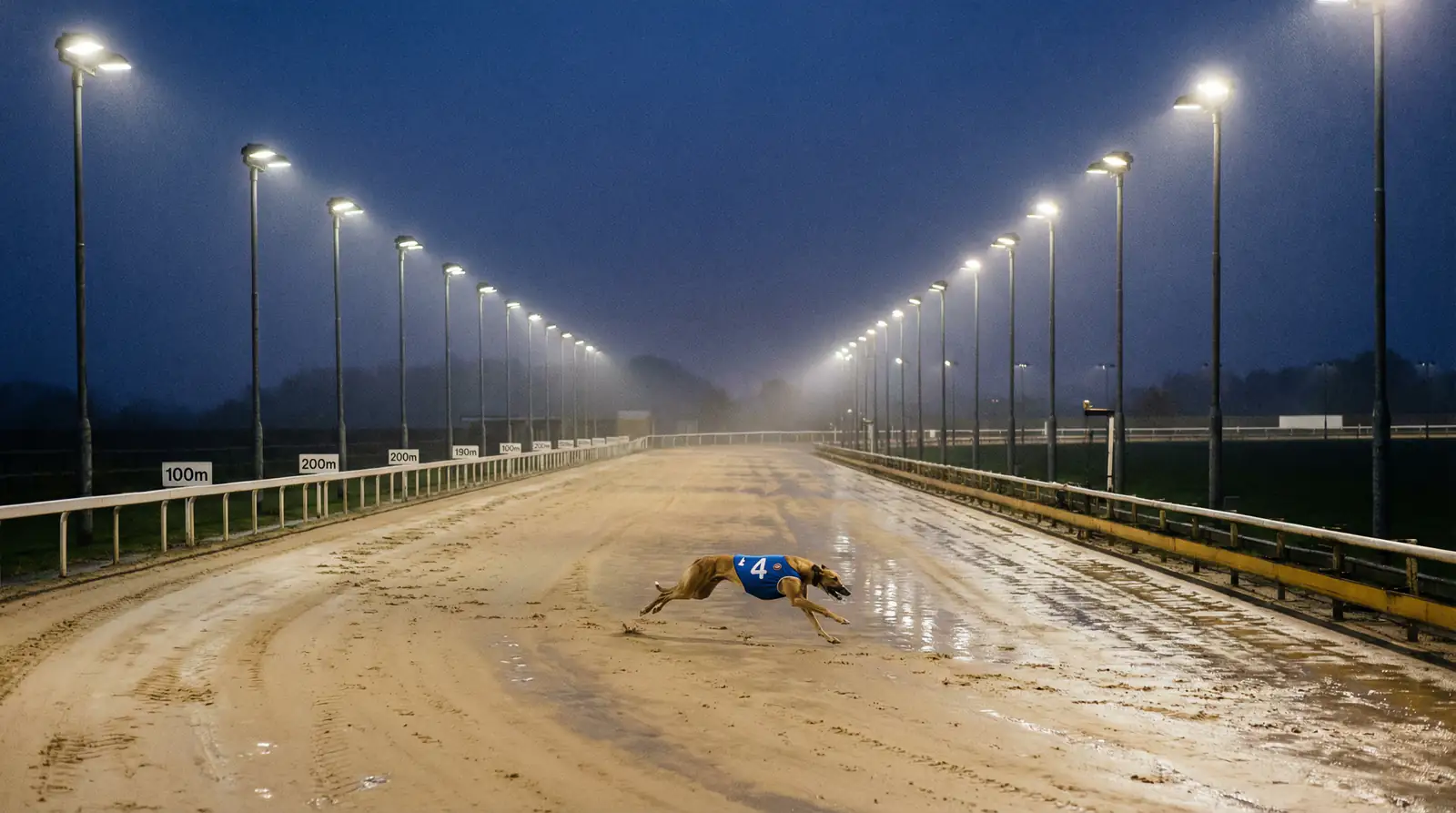
Distance Changes the Entire Shape of a Race
A greyhound that dominates over 270 metres might struggle to hold its position over 480. A dog that finishes strongly over 630 metres might not have the early pace to feature in a sprint. Distance is not a minor variable in greyhound racing — it changes the entire character of the contest, determining which physical attributes matter most, which running styles are rewarded, and which dogs have a genuine chance of winning.
UK greyhound tracks offer races at multiple distances, and the menu varies by venue. Most tracks have a standard trip — typically between 450 and 500 metres — alongside shorter sprints and longer staying events. Understanding what each distance category demands, and how individual dogs respond to changes in trip, is fundamental to reading the form book accurately and placing bets that account for the full picture.
Punters who ignore distance do so at their own expense. A dog’s form figures mean nothing without the context of the trip they were recorded over. Two seconds of difference in raw time might reflect a distance change from sprint to standard, not a change in the dog’s ability. Distance is the frame within which all other form data must be interpreted.
Sprint Races: 210m–285m
Sprint races are the shortest events in greyhound racing, typically covering one turn or less. At many UK tracks, the sprint distance involves a straight run to the first bend and a short section around it, with the finish line positioned on the back straight. Some tracks offer straight-course sprints with no bends at all, though these are less common in the licensed calendar.
The characteristics of sprint racing are distinct from any other distance category. Early pace is everything. The dog that breaks fastest from the traps and reaches the first bend in front wins the majority of sprint races, because there is simply not enough track remaining for slower starters to recover. Trap speed — the time from boxes opening to reaching full stride — is the single most important performance metric in sprints, outweighing finishing speed, stamina, and even raw top speed over longer trips.
Trap draw is amplified in sprints. At tracks where the sprint distance involves a bend, the inside traps have an even more pronounced advantage than over standard trips. The dog on the rail has less ground to cover through the turn, and with the race lasting barely fifteen seconds, there is no time to make up lost ground. Trap one in a sprint race at a tight track is one of the strongest draw advantages in all of greyhound racing.
From a betting perspective, sprint races tend to produce more predictable results. The faster-starting dog wins more often, and form is more consistent because fewer variables can interfere. There is less time for crowding incidents at the bends, less opportunity for closers to make up ground, and less influence from stamina differences. This predictability has a double edge: while the right selection wins more often, the odds on sprint favourites are typically short, and the value in backing the obvious dog is limited. The money in sprint betting lies in identifying the second and third fastest trappers for forecast and tricast bets, where the dividends are more rewarding.
Standard Distance: The 480m Benchmark
The standard distance — between 450 and 500 metres at most UK tracks, with 480 metres being the most common — is the backbone of British greyhound racing. The majority of graded races are run over this trip, which typically involves four bends and two straights. It is the distance at which most greyhounds are graded, the distance at which most form is recorded, and the distance that produces the most comprehensive data for betting analysis.
Standard-distance racing demands a balance of attributes. Early pace matters — the dog needs to break reasonably well and secure a workable position by the first bend. But it is not the only factor. Mid-race speed through the bends, the ability to maintain pace without tiring, and tactical positioning all play significant roles. A dog that breaks slowly but has exceptional bend speed can recover ground that would be permanently lost in a sprint. A dog with a strong finish can run down front-runners that begin to tire on the second circuit.
This blend of demands is what makes standard-distance form the most reliable predictor in greyhound betting. Over 480 metres, the randomness introduced by trap breaks and first-bend incidents is partially offset by the length of the race — there is enough track for quality to assert itself. Consistent dogs tend to produce consistent results, and the form book over standard trips is more predictive than over sprints or staying distances.
For punters, the standard distance is where the deepest pool of comparable data exists. Times are more directly comparable between races at the same track, grade assessments are based on standard-distance performance, and the volume of races provides a large enough sample for trends to be statistically meaningful. If you are building your greyhound betting approach around a single distance category, the standard trip is where the analytical tools work best and the data speaks most clearly.
Middle Distance and Staying Races: 630m+
Middle-distance and staying races cover 630 metres and beyond, with some tracks offering marathon trips up to 900 metres or further. These races are fundamentally different from sprints and standard trips — they involve six bends or more, multiple changes of pace, and a premium on stamina that is largely irrelevant at shorter distances.
The physical demands of staying races favour a different type of greyhound. Where sprinters need explosive trap speed and standard-distance dogs need a balance of pace and bend work, stayers need sustained effort over a prolonged period. The ability to maintain running speed through the fifth and sixth bends, when fatigued dogs begin to decelerate, is the defining attribute of a genuine stayer. Not every greyhound has it. Dogs that look impressive over 480 metres can fade dramatically when asked to sustain that speed for an additional 200 metres.
Running style takes on additional importance at staying distances. Front-runners face a particular risk: leading from the traps over 630-plus metres requires sustained energy output that many dogs cannot maintain. A front-runner that burns its reserves establishing a lead through the first four bends is vulnerable to closers who have been conserving energy in mid-pack. Some of the most dramatic finishes in greyhound racing occur in staying events, where a dog that was three lengths down at the final bend sweeps past a tiring leader in the closing 50 metres.
Betting on staying races requires an adjusted analytical approach. Times over staying trips are less directly comparable than standard-distance times because the pace of the race is more variable — a slowly run 630-metre race might produce a similar time to a fast-run standard trip, but the competitive dynamics are completely different. Form from standard-distance races is a weaker predictor of staying performance because it tells you nothing about a dog’s stamina reserves. Previous form over similar distances is the most reliable indicator, and dogs stepping up from standard to staying trips for the first time represent a genuine unknown.
The market often struggles with staying races, which creates opportunities. Because the form book is less predictive and fewer punters have developed expertise in reading staying form, the odds can be less efficient than for standard-distance races. Dogs with proven staying form that the casual punter overlooks — perhaps because their standard-distance form is modest — can represent significant value.
How Distance Should Influence Your Bet Selection
Distance should be the first filter you apply when assessing a race. Before you study form figures, before you check trap draws, before you evaluate odds — ask whether each dog in the race is suited to the trip. A dog with five recent runs over standard distance that is now entered in a sprint is stepping into a different race type entirely. Its form may or may not translate, depending on whether it has the early speed that sprints demand.
Look for distance consistency in the form. Dogs that have raced repeatedly at the same distance and performed well have demonstrated suitability. Dogs switching distances are less reliable, and the market does not always price this uncertainty correctly. A dog stepping up from 480 to 640 metres for the first time might be priced on its standard-distance form, but that form tells you nothing about whether it can sustain the pace for an extra 160 metres.
Trap draw interacts with distance in ways worth remembering. The inside-trap advantage is strongest in sprints, where the short race duration magnifies any positional edge. It diminishes at longer distances, where the extra bends and additional track give outside runners more opportunities to find favourable positions. A wide runner that struggles in sprints because it cannot reach the outside quickly enough might thrive over staying trips where the extended race duration suits its style.
The Distance Question: Does Your Dog Stay?
The simplest and most underasked question in greyhound betting is whether the dog you are backing is suited to the distance it is racing over. It sounds obvious, yet the number of punters who back a dog on general form reputation without checking its distance record is higher than it should be.
Stamina is not visible in a form figure. A dog with a form line of 1-1-2-1 looks like a near-certainty — until you notice those results were all over 270 metres and it is now entered in a 640-metre race. The wins mean nothing at the new trip. What matters is whether this dog has ever demonstrated the ability to sustain its speed over twice the distance. If the form book offers no evidence, the bet is a guess.
The punters who profit from distance awareness tend to specialise. They develop expertise in one distance category — sprints, standard, or staying — and build their analysis around the specific demands of that trip. They know which dogs stay, which dogs sprint, and which are versatile enough to compete across categories. That knowledge, accumulated over months of focused observation, creates an edge that generalist punters cannot match.
Distance is the frame around every greyhound race. Get the frame wrong and the entire picture is distorted. Get it right and the form, the draw, the odds — everything else falls into clearer focus.