
The Rulebook Behind Every Race Card
Every greyhound race run in the UK follows a codified set of rules governing everything from the weigh-in procedure to the distance between starting traps. These rules are not administrative background noise — they have direct consequences for how races are run, how results are determined, and how your bets are settled. A non-runner declared after betting has opened triggers specific settlement rules. A dog that interferes with another at the first bend may face a stewards’ inquiry. A reserve runner brought in at the last minute changes the competitive dynamics of the race.
Understanding the rules does not require memorising every clause in the regulatory handbook. It does require knowing the regulations that directly affect betting outcomes — non-runner procedures, void race conditions, photo-finish protocols, and the circumstances under which a result can be amended after the race. These are the rules that determine whether your bet pays out, and ignorance of them costs punters money every week.
The GBGB: Who Regulates UK Greyhound Racing
The Greyhound Board of Great Britain (gbgb.org.uk) is the governing body responsible for the regulation and administration of licensed greyhound racing in the UK. The GBGB sets the rules of racing, licenses tracks and trainers, administers the grading system, and oversees the welfare standards for racing greyhounds. Every licensed track in England, Scotland, and Wales operates under GBGB authority.
The GBGB’s regulatory role covers both the sporting and welfare dimensions of the sport. On the sporting side, the board establishes the rules that govern race procedures, grading, and discipline. On the welfare side, it sets standards for kennel conditions, veterinary care, injury management, and retirement procedures for retired racers. The dual mandate means that the GBGB is both the sporting regulator and the welfare watchdog — a combination that shapes the operational framework of every meeting.
For punters, the GBGB’s most relevant function is maintaining the integrity of racing. The board conducts drug testing on runners, investigates suspicious race patterns, and has the authority to impose penalties on trainers and tracks that breach the rules. While integrity issues are relatively rare in UK greyhound racing compared to some international jurisdictions, the GBGB’s presence as an active regulator provides a level of confidence that the results are genuine and the competition is fair.
The GBGB also publishes official results, race cards, and statistical data through its website at gbgb.org.uk. This is the definitive source for race results and the data that underpins the grading system. For punters conducting form analysis, the GBGB’s results archive is the primary reference — the figures there are official, verified, and consistent across all licensed tracks.
Race Day Procedures: From Kennels to Traps
The procedures that govern race day are designed to ensure fairness, consistency, and the welfare of the dogs. Understanding the sequence — from arrival at the track to the moment the traps open — gives you context for several common scenarios that affect betting outcomes.
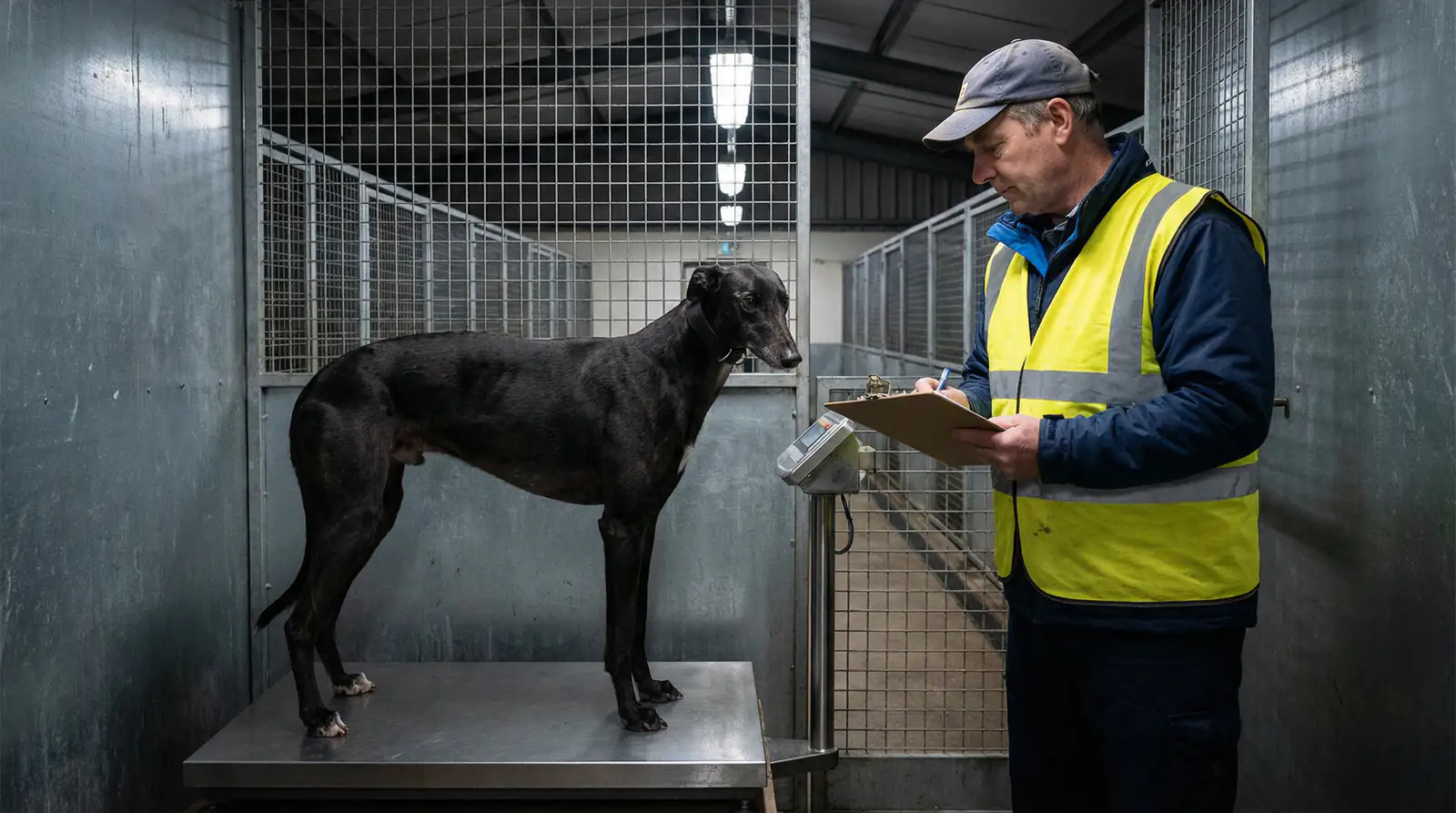
Dogs arrive at the track several hours before their scheduled race. They are housed in the track’s racing kennels, which are separate from the public areas and supervised by kennel staff. The kennels provide a controlled environment where each dog is identified, checked by the track veterinary surgeon, and weighed. The vet check includes a visual examination for fitness to race — any dog showing signs of injury, illness, or distress can be withdrawn on veterinary advice.
The weigh-in is compulsory and the results are published as part of the race card. Each dog’s weight is recorded in kilograms and compared to its previous racing weight. Significant weight changes are flagged and may prompt additional veterinary examination. The weigh-in data is available to punters on the race card, and as discussed in other guides, tracking weight changes is a useful secondary indicator of condition and fitness.
Before each race, the dogs are paraded in front of the public — the race-day parade gives punters a chance to visually assess each runner. Experienced punters look for signs of physical condition: muscle tone, coat quality, demeanour, and how the dog moves. A dog that looks bright, alert, and moves freely is in better condition than one that appears dull, stiff, or reluctant. These visual assessments are subjective, but practised observers can detect signs that the form book does not capture.
The dogs are then loaded into the starting traps by kennel staff. The trap draw — which dog goes in which box — is determined by the racing manager as part of the race card preparation, not randomly at the track. Each trap corresponds to a jacket colour: red for trap one, blue for two, white for three, black for four, orange for five, and black-and-white stripes for six (GBGB Rule 118). Once all dogs are loaded, the hare is set running, and the traps open mechanically when the hare reaches the release point.
After the race, the finishing order is determined either visually by the judge or, in close finishes, by the photo-finish camera. The photo finish is the definitive record — if the visual impression differs from the photograph, the photo takes precedence. Results are confirmed by the judge and announced officially, at which point bets are settled. In the event of a dead heat — where two or more dogs cannot be separated — bets on both runners are settled at half odds.
Non-Runner Rules and Reserve Dogs
Non-runners are an inevitable part of greyhound racing, and the rules governing their treatment have direct implications for your bets.
A dog can be withdrawn from a race for several reasons: injury discovered during the vet check, illness, a trainer’s decision that the dog is not fit to race, or a veterinary ruling at the track. When a withdrawal occurs before racing begins, the track may replace the dog with a reserve runner — a pre-nominated substitute that was listed on the race card as a potential replacement.
Reserve dogs are important for punters because they change the competitive dynamics of the race. The original six-dog field was assessed by the market based on those specific runners. If a fancied dog is withdrawn and replaced by a reserve with different form, different running style, and a different speed profile, the race is no longer the same contest. If the reserve is significantly weaker than the withdrawn dog, the remaining runners benefit from reduced competition. If the reserve is a late entrant with sharp form, it can disrupt the expected race dynamics.
Betting rules on non-runners vary by bookmaker but follow common principles. If you backed a dog that is subsequently withdrawn, your bet is void and the stake is returned. If you backed another dog in the same race and a non-runner is declared, the remaining bets stand but may be subject to Rule 4 deductions — a percentage reduction from any winning payout that compensates for the removal of a runner. The size of the Rule 4 deduction depends on the odds of the withdrawn dog: if a short-priced favourite is withdrawn, the deduction is larger because its removal significantly alters the market.
For forecast and tricast bets, non-runners create additional complications. If one of your selected dogs is withdrawn, the bet is void. If a non-selected dog is withdrawn, your bet stands but the reduced field size may affect the Computer Straight Forecast or Computer Tricast dividend calculation. Understanding these settlement rules before placing exotic bets is essential — particularly at meetings where reserves are listed and withdrawals are a realistic possibility.
How Rules Affect Your Betting Decisions
The rules of racing are not abstract regulatory text — they are practical factors that influence your betting decisions in specific, recurring situations.
Non-runner awareness should be part of your pre-bet process. Before placing any bet, check whether the declared runners match the race card. Late withdrawals after the card is published are common, particularly for early-morning bets on evening meetings. If a key runner is withdrawn and replaced by a weaker reserve, the competitive balance of the race shifts, and bets placed on the original card may no longer represent value.
Dead-heat rules affect expected value calculations. In a tight race, the possibility of a dead heat means your winning bet might pay at half the quoted odds. While dead heats are rare — the photo-finish camera typically separates runners — they do occur, and in races where two or more dogs are closely matched, the dead-heat possibility marginally reduces the expected return on each selection.
Stewards’ inquiries can amend the result after the race. If the stewards determine that interference affected the finishing order — for example, a dog that cut across another runner’s path and caused it to check — the offending dog may be demoted and the affected dog promoted. This can change the settled positions and, consequently, the forecast and tricast dividends. Bets are settled on the amended result, not the original finishing order.
Void race conditions apply when a race is declared void — typically because of a faulty start, a hare malfunction, or a safety incident on the track. If a race is voided, all bets are cancelled and stakes returned. Understanding that this possibility exists, however rare, reinforces the importance of treating each bet as an isolated decision rather than part of a dependent chain — one more reason why accumulators carry additional structural risk in greyhound racing.