
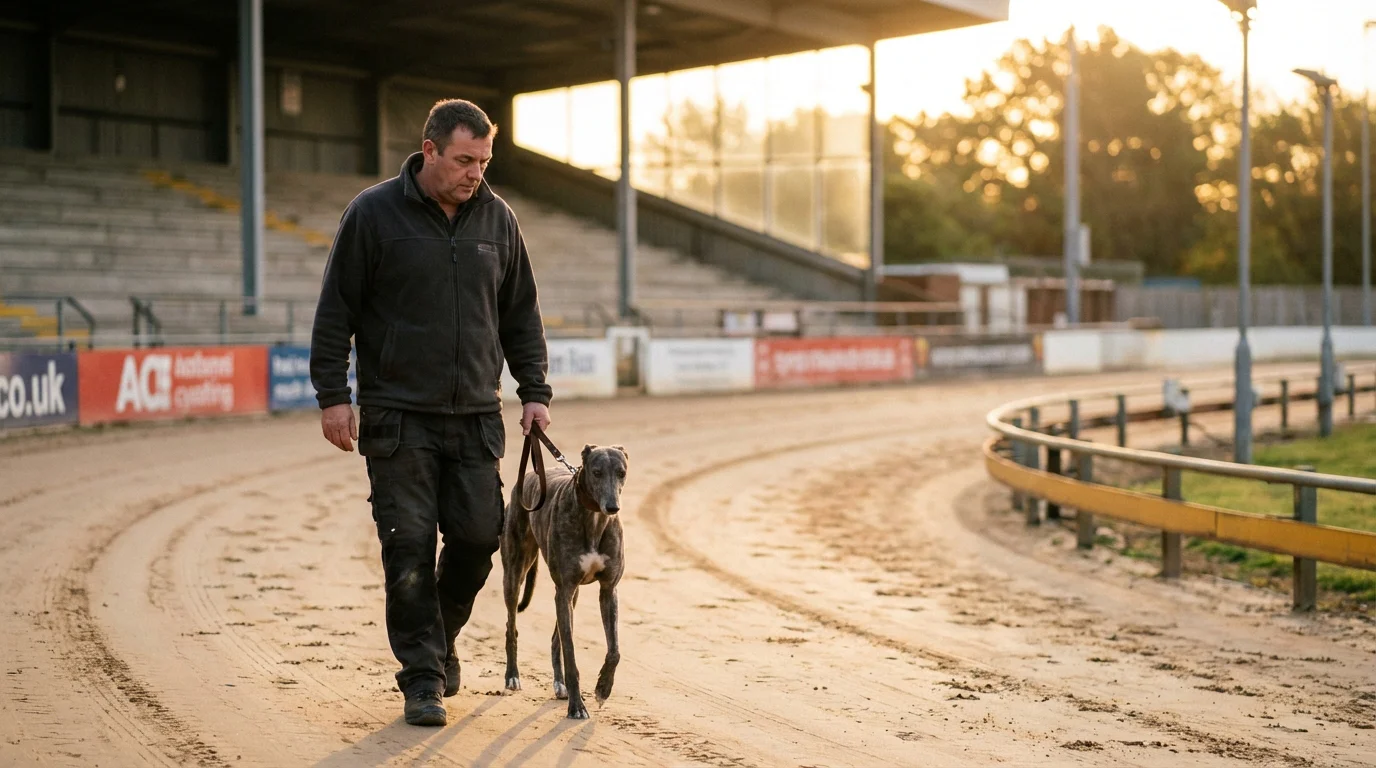
The Name Below the Dog’s Name Matters More Than You Think
Every greyhound race card lists two names for each runner: the dog and its trainer. Most punters read the first and ignore the second. That is a mistake worth correcting, because the trainer’s influence on a greyhound’s race-day performance is substantial and, more importantly, measurable.
A greyhound trainer controls the variables that determine whether a dog arrives at the track in peak condition or slightly below par. Diet, exercise regime, trialling schedule, rest periods, race selection — these decisions are all made by the trainer, and they directly affect whether a dog runs to its ability on any given night. Two dogs with identical raw speed can produce very different results if one is managed by a trainer who consistently peaks dogs for the right races while the other is handled by someone whose preparation is less precise.
For punters, trainer form is a data layer that sits alongside dog form, trap draw, and grade context. It is not the most important factor in any individual race, but it is a persistent background influence that, when tracked over time, reveals patterns the market does not fully price. Kennels run hot and cold. Trainers develop specialisms at certain tracks or over certain distances. Some consistently produce dogs that improve after a rest; others are better at maintaining form through busy racing schedules. These patterns are real, they are trackable, and they are underused by the betting public.
What a Greyhound Trainer Actually Does
The trainer’s role extends far beyond simply getting a dog to the track on race night. At licensed UK kennels, the trainer is responsible for the complete management of every dog in their care — from daily feeding and exercise to long-term career planning (GBGB Rules of Racing).
Physical conditioning is the foundation. Greyhounds are athletes, and their training programmes are structured around building and maintaining peak fitness for racing. This involves a combination of galloping — often on a private trial track or schooling facility — walking exercise for baseline fitness, and rest days for recovery. The balance between work and rest is critical. A dog that is over-trialled arrives at the track fatigued. One that is under-prepared lacks the sharpness to compete. Getting this balance right, consistently, across a kennel of twenty or thirty dogs is what separates top trainers from average ones.
Race selection is another key responsibility. The trainer decides which races to enter each dog in, based on the dog’s current form, fitness, preferred distance, and the competitive landscape at available tracks. A shrewd trainer places dogs in races where they have the best chance of performing well — matching the dog to the grade, distance, and track that suit its profile. This is not just about winning; it is about keeping the dog in the right grade, building confidence, and managing the long-term career trajectory.
Nutrition and weight management also fall under the trainer’s remit. A greyhound’s racing weight needs to be maintained within a narrow band — too heavy and the dog loses speed; too light and it lacks power. The trainer monitors weight at every trial and race, adjusting feeding accordingly. Weight stability across a run of races is often a sign of good kennel management, while erratic weight fluctuations can indicate problems in training or health.
Finally, the trainer handles veterinary care, injury rehabilitation, and the decision about when a dog is ready to return to racing after a setback. Bringing a dog back too quickly risks re-injury and poor performance. Waiting too long means the dog loses fitness and may need regrading. The timing of comebacks is one of the subtler aspects of training, and it has direct implications for punters assessing a dog that is returning from a break.
Kennel Form: Win Rates, Track Records, and Seasonal Patterns
Kennel form is the aggregate performance of a trainer’s dogs over a defined period. It is the trainer equivalent of a dog’s individual form line, and it reveals patterns that individual results cannot.
The most basic metric is strike rate — the percentage of runners from a kennel that win their races over a given period. A trainer with a 20% strike rate across the last three months is performing above the average for a six-dog field (where the baseline is roughly 16.7%). A trainer whose strike rate has dropped from 22% to 11% over the same period is in a form trough. These trends matter because they reflect the overall condition and management of the kennel, not just the performance of one or two dogs.
Track-specific performance is another valuable dimension. Some trainers perform significantly better at certain tracks than others, often because their kennel is located nearby, allowing them to trial their dogs regularly on that surface and over those distances. A trainer whose dogs consistently outperform at Romford but struggle at Towcester has likely built their training programme around the tight, sharp circuit. When one of their dogs runs at Romford, the track familiarity provides an additional edge that is not immediately visible in the dog’s individual form.
Seasonal patterns are subtler but still detectable. Some kennels produce their best results in the summer months when the going is typically faster and drier, while others thrive in winter conditions. These patterns may reflect the trainer’s preferred conditioning approach, the type of dogs they tend to have in their kennel, or simply the availability of trial facilities in different weather conditions. Over several seasons, these trends become statistically meaningful and can inform betting decisions at the margins.
One particularly useful pattern to track is how a trainer’s dogs perform after a rest. Some trainers are exceptionally good at bringing dogs back to peak fitness after a layoff — their runners return fresh, sharp, and ready to win. Others need two or three runs to get a dog back to race fitness, and the first run back is typically a pipe-opener rather than a serious competitive effort. If you know which category a trainer falls into, you can make better decisions about whether to back or oppose a dog on its first run after a break.
The dogs-in-form metric rounds out the picture. If a trainer has five dogs racing in a given week and four of them are running well — winning, placing, or recording fast times — the kennel is in good shape overall. If four of the five are running below expectations, something systemic may be off: a change in feed supplier, a virus in the kennel, or a disruption to the training routine. Individual dog form is important, but when an entire kennel goes cold simultaneously, the cause is usually at the trainer level.
Where to Find Trainer Performance Data
Trainer statistics are publicly available, though you may need to look beyond the basic race card to find them in useful form.
The Racing Post provides trainer records as part of its greyhound form data, including recent winners, strike rates, and track-by-track breakdowns (racingpost.com). Their online platform allows you to filter by trainer and view performance metrics over different time periods — the last 14 days, the last month, or the last season. This is the most accessible source for most punters and provides enough data to identify hot and cold kennels.
Timeform publishes trainer statistics alongside its speed ratings and form analysis (timeform.com). Their data tends to be more granular, with additional metrics that allow deeper comparison between trainers at specific tracks and distances. For punters willing to invest in a subscription, Timeform’s trainer data is among the most comprehensive available.
At the track level, individual venue websites sometimes publish trainer leaderboards showing the most successful kennels at that track over the current season. These are useful because they are inherently track-specific — the data reflects how trainers perform at the particular circuit you are betting on, which is more relevant than national aggregate figures.
For the most dedicated punters, building a personal trainer database is the most effective approach. Record the trainer for every dog you assess, note the result, and over several months you will accumulate a personalised dataset that reflects the trainers most active at the tracks you regularly bet on. This approach takes time to build but produces data that is tailored to your specific betting habits and tracks, rather than generic national statistics.
One practical tip: when you identify a trainer in strong form, scan their upcoming entries across all tracks for the next week. A hot kennel does not run hot at just one track — the form tends to apply across all their runners. If a trainer has had three winners from seven runners in the past fortnight, their next few entries at any track are worth a closer look, particularly if the dogs are well drawn and running at suitable grades.
The Kennel Angle: Underrated and Underused
Trainer form occupies an unusual position in the greyhound punter’s toolkit. Almost everyone acknowledges that it matters. Almost nobody tracks it systematically. This gap between recognition and action is where the value lies.
The betting market prices dogs primarily on their individual form — recent finishing positions, times, and grade. The trainer’s name is on the card, but it is rarely a significant factor in how the market sets the odds. A dog trained by a kennel in red-hot form and a dog trained by a kennel that has gone three weeks without a winner might be priced identically if their individual form figures look similar. The market sees the dogs; it largely ignores the kennels behind them.
This creates a persistent, low-level edge for punters who track trainer performance. When a kennel is running well, their dogs tend to outperform individual form expectations — arriving fitter, sharper, and better prepared than the market accounts for. When a kennel is struggling, even dogs with strong individual form can underperform, because the systemic issue behind the scenes affects all runners from that yard.
The discipline is not complicated. Keep a simple log of trainer results at your regular tracks. Note when a kennel is winning frequently and when it goes quiet. Cross-reference that information with your race card analysis for each meeting. When you find a dog whose individual form is strong and whose trainer is in excellent current form, you have a confluence of positive signals that the market is unlikely to have fully priced. When the individual form is strong but the kennel is struggling, you have a reason for caution that the market may not reflect.
Trainer form will not make you rich on any single race. It is not a primary selection method and it should not override clear form or trap-draw analysis. But as a tiebreaker between closely matched dogs, or as a confidence booster when deciding between a bet and a pass, it provides an edge that accumulates quietly over time — the kind of edge that only shows up in the results if you track it, and only disappears if you stop.