
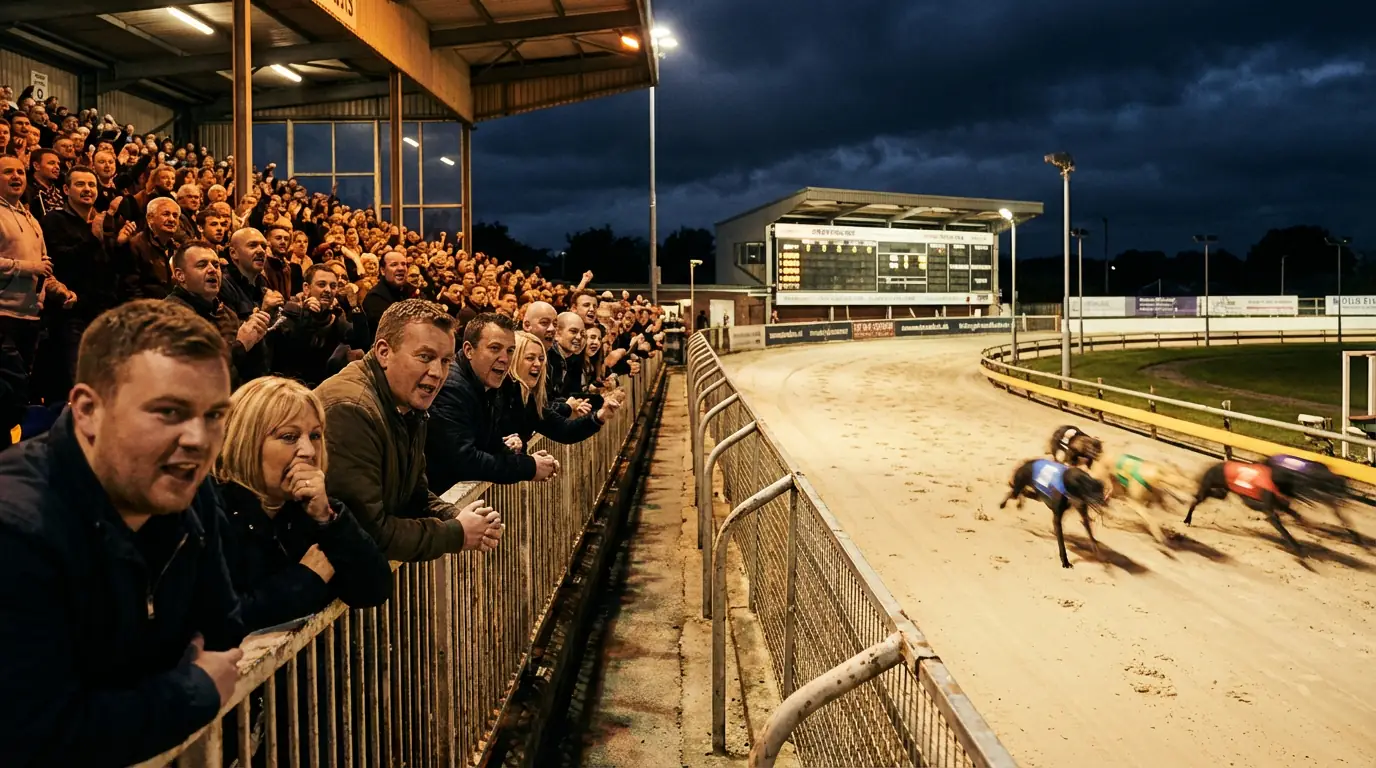
In-Play Greyhound Betting: A Different Game
Pre-race betting gives you time — time to study form, compare odds, weigh up trap draws. In-play betting removes all of that. The traps open, six dogs break, and you have seconds to assess what is happening and decide whether the live market offers value. It is a fundamentally different discipline from pre-race analysis, demanding rapid judgement, sharp visual assessment, and a clear understanding of how live greyhound markets behave.
In-play betting on greyhounds is available through selected bookmakers and betting exchanges, though the format is more limited than in-play markets for sports with longer durations. A greyhound race lasts approximately 25 to 30 seconds over standard distance, which compresses the in-play window into a brief, intense period where odds shift rapidly and the opportunity to bet may last only a few seconds.
This compression is both the challenge and the opportunity. The market cannot process information as quickly as a knowledgeable viewer, which means there are moments — brief, specific, and fleeting — where the live odds do not accurately reflect what is unfolding on the track. Exploiting those moments requires preparation, speed, and a clear framework for when in-play bets make sense and when they do not.
How Live Greyhound Markets Work
Live greyhound betting operates differently from the pre-race fixed-odds market. On betting exchanges, in-play odds are set by the balance of money offered by backers and layers, adjusting in real time as the race unfolds. The exchange model means the odds move organically — when a dog takes the lead, its price shortens as backers pile in, while the dogs behind see their odds lengthen.
With traditional bookmakers, in-play greyhound markets are more restricted. Most high-street operators do not offer in-running betting on greyhound races due to the short duration and the difficulty of managing risk on a 25-second event. Where in-play is available, it is typically through exchange platforms or specialist operators, and the market depth — the volume of money available at each price — is thinner than for pre-race markets or longer-duration sports.
The timing of odds movements in live greyhound markets follows the race dynamics closely. The first significant shift occurs at the break from the traps. A dog that misses the break entirely sees its odds spike immediately. A dog that traps brilliantly and leads into the first bend sees its price collapse. The second major shift happens at the first and second bends, where crowding incidents can eliminate contenders in an instant. A dog that is badly bumped and loses several lengths will see its odds lengthen dramatically within a second or two.
Latency is a critical consideration. The time between what happens on the track and what you see on your screen — whether via live stream or a data feed — creates a delay of typically one to three seconds. In a 25-second race, that delay is significant. A dog that is already beaten at the second bend might still show relatively short odds on your screen because the market has not yet caught up with the visual. By the time you place a lay bet against the struggling dog, the odds may have already moved. Managing this latency gap is the most important practical skill in live greyhound betting.
Liquidity is the other constraint. In-play greyhound markets on exchanges carry far less money than pre-race markets, which means the amounts you can bet at any given price are limited. Attempting to place a substantial bet in-play will often move the market against you, eating into the value that prompted the bet in the first place. In-play greyhound betting is, by necessity, a small-stakes activity for most punters.
In-Play Strategies for Dog Racing
The most productive in-play approach in greyhound racing is to identify specific pre-race scenarios that create predictable in-play value, rather than trying to react to events as they happen.
The classic strategy involves laying the favourite in-play at the first bend. If a short-priced favourite is a known front-runner, the market will have priced in the expectation that it leads from the start. If the dog breaks well and leads as expected, its in-play price drops to very short odds — perhaps 1.2 or 1.3 on the exchange. At this point, it has already been priced as a near-certainty. But the race is only a third done, and anything can happen through the remaining bends. Laying at 1.2 gives you a risk-to-reward ratio where a small outlay covers you if the dog is caught, which happens more often than a price of 1.2 implies.
The reverse approach works with closers. A known strong finisher that breaks slowly will see its odds drift sharply at the start. If you know from sectional analysis that this dog consistently produces the fastest finishing split in its races, the lengthened in-play odds may offer value — the market has overreacted to the slow start, and the dog’s closing speed gives it a genuine chance of running into the places or better.
Trading — backing before the race and laying in-play, or vice versa — is the most sophisticated in-play approach. Back a front-runner pre-race at, say, 3.0 on the exchange. If it leads at the first bend, its in-play price drops to 1.5 or below. Lay at the lower price to lock in a profit regardless of the final result. This approach does not depend on the dog winning; it depends on the dog leading at the first bend, which is a more probable outcome and one that your pre-race analysis can assess with reasonable confidence.
All in-play strategies require pre-race homework. You need to know which dogs trap fast, which run on, which are prone to first-bend trouble, and how the market is likely to respond to different scenarios. The in-play bet itself lasts seconds; the preparation behind it should take as long as any pre-race analysis.
Risks and Limitations of Live Betting
In-play greyhound betting carries risks that are qualitatively different from pre-race betting, and understating them would be irresponsible.
The speed of the market is the primary risk. Greyhound races are over in half a minute, and in-play odds move in fractions of seconds. The gap between what you see on screen and what is actually happening on the track means you are always betting on slightly stale information. Professional traders with low-latency data feeds have a structural advantage over retail punters watching a standard live stream. If you are consistently finding that your in-play bets are placed at odds that are worse than you intended, the latency gap is working against you.
Emotional discipline is harder to maintain in-play than pre-race. The adrenaline of watching a race unfold live, combined with the pressure of making split-second betting decisions, creates conditions where impulsive bets are more likely. Chasing a result — placing an in-play bet to recover a pre-race loss on the same race — is one of the most destructive habits in live betting. The decision-making framework that worked in your pre-race analysis does not apply in the heat of a live race.
Market depth is a practical constraint that limits profitability. Even when your analysis is correct and the in-play odds offer genuine value, the amount of money available at that price may be too small to make the bet meaningful. Attempting to bet more than the market can absorb moves the price against you, which erodes or eliminates the value that prompted the bet.
Finally, not every race is suitable for in-play betting. Races over sprint distances are effectively over before meaningful in-play odds have time to form. Races with very thin in-play liquidity offer no practical opportunity to bet at fair prices. The races that work for in-play are standard-distance or longer events with reasonable exchange liquidity and clear pre-identified scenarios to target. These represent a fraction of the total card, not every race.
Live or Pre-Race: When Each Approach Wins
Pre-race betting is the foundation. In-play is an occasional supplement. Getting this hierarchy wrong — treating in-play as the main event and pre-race as the warm-up — is a structural error that undermines long-term results.
Pre-race betting gives you time, data, and the full range of market options. You can compare prices across bookmakers, take advantage of Best Odds Guaranteed, place forecasts and tricasts, and make decisions without time pressure. The overwhelming majority of profitable greyhound betting happens before the traps open.
In-play adds value in specific circumstances: when you have identified a pre-race scenario that creates a predictable in-play opportunity, when exchange liquidity is sufficient, and when you can watch the race live with minimal stream delay. It is a tool for punters who have already mastered pre-race analysis and are looking for an additional edge — not a shortcut for those who have not.
The honest assessment is that most greyhound punters will find their returns are best served by concentrating entirely on pre-race betting. The in-play market in greyhound racing is thin, fast, and structurally tilted towards participants with superior technology. If you choose to engage with it, do so with clear rules, small stakes, and the understanding that in-play greyhound betting is a specialist discipline — not a natural extension of regular punting.