
Virtual Dogs: Racing Without the Track
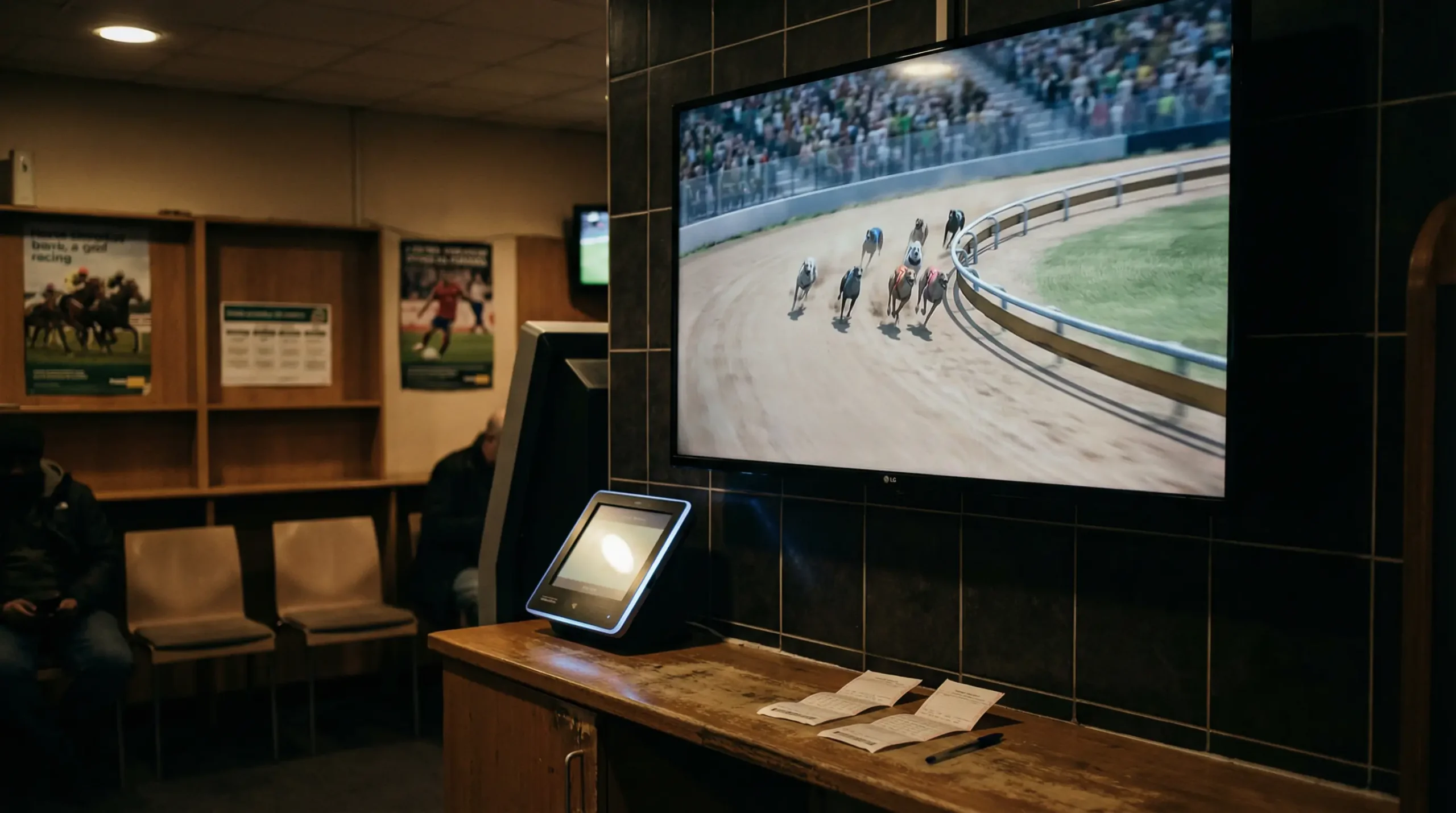
Virtual greyhound racing is a computer-generated simulation of dog racing, available around the clock through most major UK bookmakers. There is no real track, no real dogs, and no real form book. The races are produced by software that uses a random number generator to determine the outcome, wrapped in animated graphics that mimic the visual experience of a real greyhound race. A new race starts every few minutes, 24 hours a day, 365 days a year.
The product exists to fill the gaps in the live racing calendar. When no real meetings are running — during the early morning, between evening cards, or on days with a thin racing programme — virtual greyhounds provide a continuous stream of betting opportunities for punters who want action. It is ubiquitous on betting shop screens and prominently featured on bookmaker websites and apps.
For punters who bet on real greyhound racing, virtual dogs occupy an unusual position. The visual presentation borrows the language and aesthetics of the real sport — trap colours, race distances, finishing margins — but the underlying mechanics have nothing in common with live racing. Understanding what virtual greyhound betting actually is, and what it is not, is essential for anyone tempted to treat it as a substitute for the real thing.
How Virtual Greyhound Racing Is Generated
Virtual greyhound races are produced by licensed software providers who supply the product to bookmakers. The major providers include Inspired Entertainment (inseinc.com) and Leap Gaming, among others. Each company develops its own race engine, animation style, and presentation format, but the core mechanism is consistent: a certified random number generator determines the result of each race before the animation plays.
The RNG assigns each dog a finishing position based on probability weightings that are reflected in the odds displayed before the race. A dog priced at 2/1 has been assigned a higher probability of winning by the software than a dog priced at 8/1. These probabilities are not derived from any form, fitness, or physical characteristic — they are mathematical constructs designed to produce a distribution of results that mirrors the odds structure.
The animation that plays after the odds are set is purely cosmetic. It creates the visual impression of a race — dogs breaking from traps, running around bends, overtaking on the straight — but the finishing order was already determined before the first pixel moved. The animation is designed to match the predetermined result, not the other way around. Nothing that happens visually during the race is a real-time event; it is a replay of a decision that was made by the RNG.
The odds offered on virtual greyhound races carry a bookmaker margin, just as real racing odds do. However, the margin on virtuals tends to be higher — often 20-30% or more, compared to 15-20% on real greyhound racing. This higher margin reflects the operational model: virtual races run every three to four minutes, creating a much higher volume of betting events per hour, and the bookmaker extracts a larger percentage from each cycle.
One important regulatory point: virtual greyhound racing in the UK is regulated by the Gambling Commission under the Gambling Act 2005 (gamblingcommission.gov.uk), and the RNG is subject to independent testing and certification to ensure fairness. The results are genuinely random within the probability structure — the software is not rigged in the way conspiracy theories sometimes suggest — but the house edge is built into the odds, not into the randomness.
Virtual vs Live: What’s the Difference for Bettors
The fundamental difference is that live greyhound racing rewards knowledge and analysis, while virtual greyhound racing does not. In a real race, you can study form, assess trap draws, analyse sectional times, evaluate trainer patterns, and use all of that information to identify bets where your estimated probability exceeds the market’s. Skill has a measurable impact on long-term results.
In virtual racing, none of that applies. There is no form to study because the dogs do not exist. There are no trap biases because the track is not real. There are no trainers, no sectional times, no going conditions. The odds presented before each race are the complete information set — they tell you exactly what the software has determined each dog’s probability of winning to be, and there is no additional information that can give you an edge.
This means that virtual greyhound betting has a negative expected value on every bet, every time, without exception. The bookmaker’s margin is embedded in the odds, and since the outcomes are determined by a mathematical process that the odds perfectly describe, there is no analytical angle that can overcome that margin. Over time, a virtual greyhound bettor will lose at a rate equal to the bookmaker’s overround, regardless of selection method.
The bet types available on virtual greyhounds largely mirror those on live racing — win, place, forecast, tricast — but the expected returns are structurally worse due to the higher margin. A forecast on a virtual race carries a larger house edge than a forecast on a real race, which means the breakeven strike rate is higher and the long-term loss rate is faster.
The pace of virtual racing also differs meaningfully. A real greyhound meeting might feature eight to twelve races over two to three hours. Virtual racing produces a new race every three minutes — twenty races per hour. The speed encourages higher-frequency betting, which compounds the effect of the negative expected value. A punter who bets £5 per race on real greyhounds across an evening session might stake £50 to £60 total. The same punter betting £5 per virtual race over the same period could stake £200 or more.
Can You Have a Strategy for Virtual Dogs?
No. There is no strategy that overcomes the house edge on virtual greyhound racing over any meaningful sample of bets. This is not an opinion — it is a mathematical certainty derived from the way the product is constructed.
Patterns that appear to exist in virtual results — trap one winning three times in a row, the favourite losing five consecutive races, a specific number appearing as the winner at a particular interval — are the product of randomness, not exploitable trends. Human brains are wired to detect patterns even in purely random data, and this tendency is especially active during gambling. The pattern you think you have found in virtual greyhound results is an artefact of sample size and cognitive bias, not a flaw in the RNG.
Staking systems — doubling after a loss, following a progression, targeting specific odds ranges — do not change the expected value. They change the distribution of outcomes, making short-term wins more likely at the cost of larger, less frequent losses, but the long-term loss rate remains identical. The Martingale system, the Fibonacci sequence, and every other staking progression ultimately crash against the same wall: the house edge is baked into every bet, and no sequence of bets can turn a negative-expectation game into a positive one.
If you find yourself developing a system for virtual greyhound racing, that is a signal to step back and reassess. The system feels like it works because short-term results in random processes can appear streaky. Over thousands of bets, the results will converge on the house edge — every time, without exception.
The only rational approach to virtual greyhound betting is to treat it as pure entertainment with a defined cost. Set a budget for the session, accept that the money is an entertainment expense, and stop when it is gone. This is the same framework that applies to slot machines, roulette, and every other game with a fixed house edge.
Real Dogs, Virtual Stakes: Where This Fits
Virtual greyhound racing and real greyhound racing share a visual language and a betting interface, but they are fundamentally different products. One is a sport with real outcomes influenced by real variables that reward genuine analysis. The other is a mathematical game dressed in the clothing of that sport.
For punters who bet on real greyhound racing, virtual dogs serve a specific and limited purpose: filling dead time when live racing is not available. An evening meeting finishes at 10pm, there is nothing else running, and the betting app is still open. Virtual racing provides an option. Whether that option is a good use of your bankroll is a question only you can answer, but the honest answer for most serious greyhound punters is no.
The skills you have built in reading form, assessing trap draw, evaluating trainers, and interpreting sectional times have zero application in virtual racing. Every bet on virtuals is a pure gamble against a house edge. Every pound staked on virtual dogs is a pound not available for the next real meeting, where your analytical skills actually have value.
The distinction matters because the line between real and virtual greyhound betting can blur, particularly in betting shops where both products run on adjacent screens and the experience of placing bets is identical. Keeping the two firmly separate in your mind — and in your bankroll management — is a practical discipline that protects your edge in the real game from being eroded by the virtual one.