
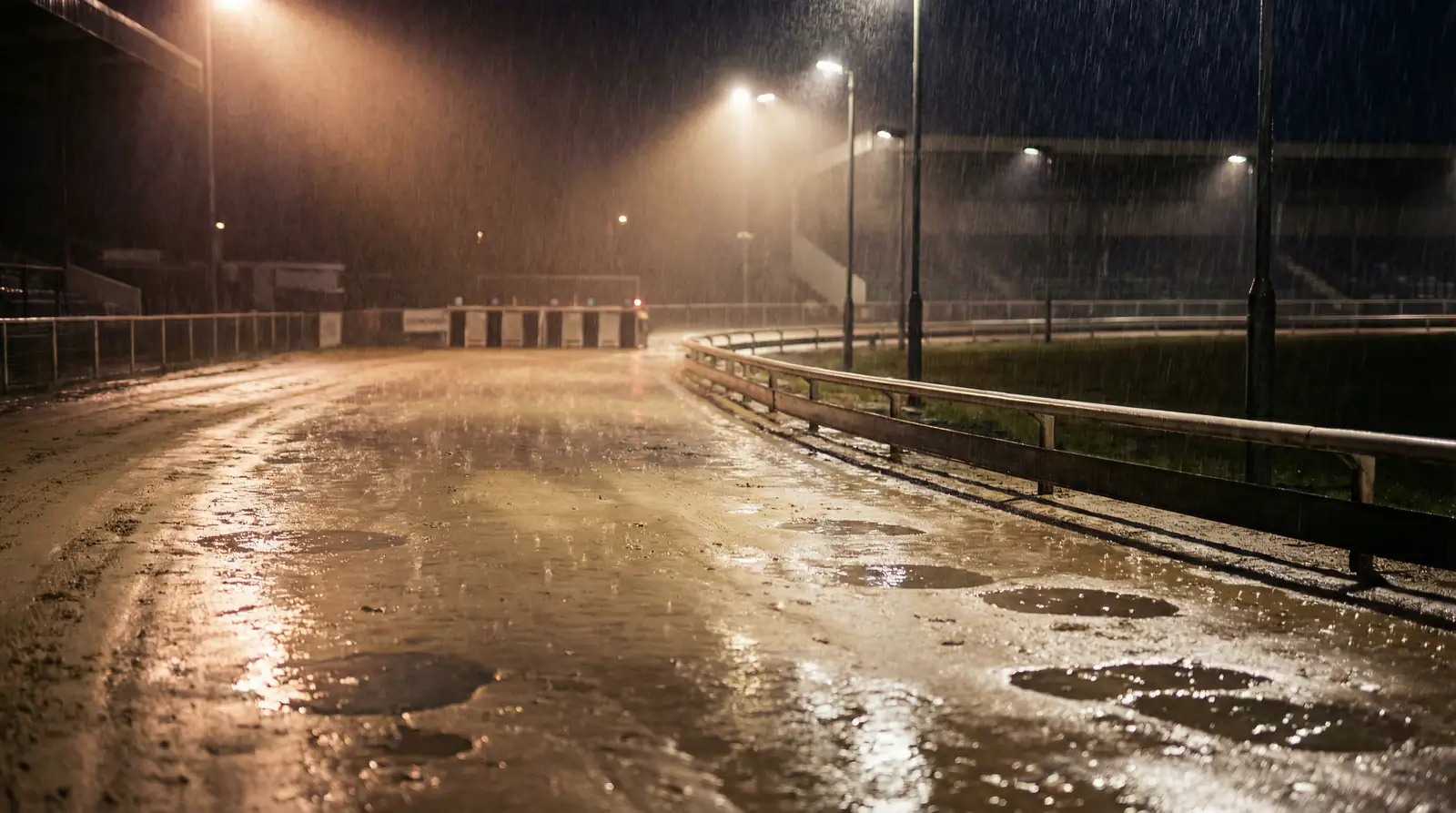
Rain, Sand, and the Form Book Rewritten
A greyhound that posted 29.20 over 480 metres last Tuesday in dry, firm conditions might clock 29.80 over the same trip at the same track this Saturday after two days of rain. The dog has not slowed down. The track has. And if you are comparing those two times without adjusting for conditions, you are reading the form book with one eye closed.
Weather is the great confounding variable in greyhound racing. It changes the surface, alters the going, shifts the advantage between different types of dogs, and renders raw time comparisons unreliable. Most punters acknowledge this in theory and ignore it in practice. They look at the clock, see a faster time, and back the faster dog — even when the faster time was recorded on a surface three grades quicker than tonight’s going. The punters who adjust for conditions, even approximately, gain an analytical edge that is both persistent and undervalued by the market.
Understanding how weather affects track conditions is not about becoming a meteorologist. It is about knowing which dogs handle which conditions, and pricing that knowledge into your selections before the traps open.
How Track Surface Responds to Weather
UK greyhound tracks use sand-based racing surfaces, and these surfaces respond to weather in predictable ways. The composition varies between tracks — some use finer sand, others a coarser grade, and many blend sand with other materials to control drainage and consistency — but the general principles apply across all venues.
Dry conditions produce a firm, fast surface. The sand compacts under minimal moisture, providing a stable platform that allows dogs to maintain traction at speed. Times are typically fastest in dry conditions because the surface resistance is lowest. Dogs with a light, efficient stride benefit most from firm going — they skim across the surface without sinking in, converting more of their energy into forward motion.
Rain softens the surface. Water saturates the sand, increasing its weight and reducing its compaction. The dogs’ paws sink slightly deeper into the wet surface with each stride, which creates additional resistance and slows the overall pace. The degree of slowing depends on the volume of rain: a light shower might add a few hundredths of a second to overall times, while a sustained downpour can add half a second or more. Heavy rain can also create standing water in low spots on the track, particularly on the bends, which causes dogs to check their stride and lose momentum.
Drainage quality is a track-specific variable that significantly influences how rain affects racing. Tracks with modern drainage systems return to near-normal conditions within hours of rain stopping. Tracks with older or less efficient drainage can remain heavy for an entire meeting. Knowing your track’s drainage capacity — something you learn from attending or watching meetings in different weather — allows you to predict how quickly conditions will recover after rainfall.
Frost and cold temperatures produce a different surface characteristic. A frozen or near-frozen surface is hard and fast but potentially dangerous, which is why many meetings are subject to track inspections in cold weather. If racing goes ahead on a cold surface, the going is typically quick — sometimes quicker than dry summer conditions — but the hard ground can be uncomfortable for some dogs, affecting their willingness to extend fully. Wind chill can compound the effect, causing dogs that are sensitive to cold conditions to underperform.
Track watering — artificial irrigation used during hot, dry periods — is the track’s attempt to manage conditions proactively. Tracks water the surface to maintain a consistent going, preventing it from becoming too hard and fast. The amount and timing of watering can vary between meetings and even between races, which means the going can change during an evening card. A surface that was firm for the first race may be softer for the fourth if the track was watered during the break.
Wet Track vs Dry Track: Which Dogs Benefit
The shift from dry to wet conditions redistributes advantage across the field in ways that the form book, based on previous runs in different conditions, does not automatically capture.
Heavier, more powerful dogs tend to handle wet conditions better than lighter, nimbler ones. The additional surface resistance on a wet track rewards dogs that can power through the sand rather than skim across it. A dog built like a middle-distance runner — muscular, strong through the hindquarters, carrying a bit more weight — often improves relative to the field when the rain arrives. Lighter dogs, particularly those with a high-speed, low-power running style, lose their advantage on a surface that demands more physical effort per stride.
Running style interacts with conditions in specific ways. Front-runners are less affected by wet going in the early stages of the race, because the surface has not yet been churned by the rest of the field. The dogs running behind encounter a progressively more disturbed surface, which adds to the resistance they face. This gives front-runners a slightly enhanced positional advantage on wet tracks — they get to the first bend on the best available ground, while the chasers contend with the kicked-up, loosened sand behind them.
Closers face a compounded disadvantage on heavy going. Their running style relies on producing a burst of speed in the closing stages, but wet surfaces sap late-race acceleration. A dog that typically produces a devastating last 50 metres may find that the finishing kick which works on a firm surface simply does not deliver the same momentum on a heavy one. The finishing split slows, the gap does not close, and the closer finishes behind dogs it would normally overhaul.
Trap draw effects can also shift in wet conditions. At tracks where rain collects unevenly — often on the inside rail where drainage is poorest — the inside traps may lose some of their usual advantage. Dogs drawn on the inside encounter the heaviest going, while those drawn wider may find slightly better surface. This is highly track-specific and not always predictable, but experienced punters who have watched racing at their regular track in various weather conditions develop an instinct for how the going deteriorates across the width of the track.
The most valuable analytical approach is to build a personal log of how specific dogs perform in different conditions. Over time, patterns emerge: Dog A, who has solid form on fast going but consistently drops two or three places on heavy, is a conditions-sensitive runner. Dog B, whose form is modest on firm ground but who suddenly produces a career-best performance when the rain arrives, has a preference for softer going. These individual condition profiles are invisible in standard form analysis but become clear with consistent tracking.
Wind and Temperature: Overlooked Variables
Rain gets most of the attention in conditions analysis, but wind and temperature also affect greyhound performance — more subtly but no less measurably.
Wind has a direct impact on race times, particularly at tracks with exposed straights. A headwind on the home straight slows the entire field and adds to finishing times. A tailwind on the home straight produces faster times without any improvement in the dogs’ actual ability. The effect is significant enough to produce time differences of several hundredths of a second, which in a sport decided by necks and short heads can influence finishing positions.
More importantly, wind affects different dogs differently. Dogs with large, upright frames present more surface area to a headwind and are slowed proportionally more than compact, low-slung dogs. In strong headwind conditions, the smaller, more aerodynamic dogs gain a relative advantage that the form book — compiled in calmer conditions — does not account for. This is not a primary selection factor, but in a tight race where the wind is gusting across an exposed track, it is worth considering.
Crosswinds affect the bends. A strong crosswind blowing across a bend can push dogs outward or inward depending on the direction, altering the effective racing line and the advantage of inside or outside traps. At tracks where the prevailing wind consistently crosses a particular bend, this can create a semi-permanent bias that adds to or subtracts from the standard trap statistics.
Temperature influences muscle function. Greyhounds, like all athletes, perform optimally within a temperature range. In very cold conditions, muscles are slower to warm up and dogs may not reach full racing speed as quickly — a factor that can disadvantage slow-starting dogs whose style depends on building speed gradually. In very hot conditions, the risk of overheating can affect dogs in the closing stages, particularly over longer distances. Most UK racing takes place in moderate temperatures, but extreme winter and summer meetings can produce conditions where temperature becomes a tangible factor.
The Conditions Edge: Betting What Others Ignore
The market prices greyhound races primarily on form — recent results, times, and grade. Conditions get a mention in preview comments and tipster notes, but they are rarely priced into the odds with any precision. This is partly because conditions data is harder to quantify than form data, and partly because most punters simply do not bother.
That indifference is your edge. When the rain is falling on race night and you know — from your own records or from watching previous meetings in similar weather — that certain dogs in the field handle wet going well while others do not, you have information that the market is not fully reflecting. The dog whose form looks ordinary on paper but who ran its best race last month in a downpour is underpriced by the market tonight. The dog whose flashy recent win came on firm going and who has never encountered a wet track before is overpriced.
Building conditions awareness into your betting routine takes minimal extra effort. Check the weather before the meeting. Note the going if it is reported. Compare the conditions to the last few meetings at that track and recall which dogs handled the going well. Cross-reference that with tonight’s runners. The entire process adds perhaps two minutes to your pre-race analysis, and the edge it provides — when conditions are genuinely different from the form — is disproportionately large.
The form book tells you what happened. The conditions tell you whether it is likely to happen again tonight. When those two pieces of information point in the same direction, bet with confidence. When they diverge — when the form says yes but the conditions say no — the conditions deserve the casting vote.