
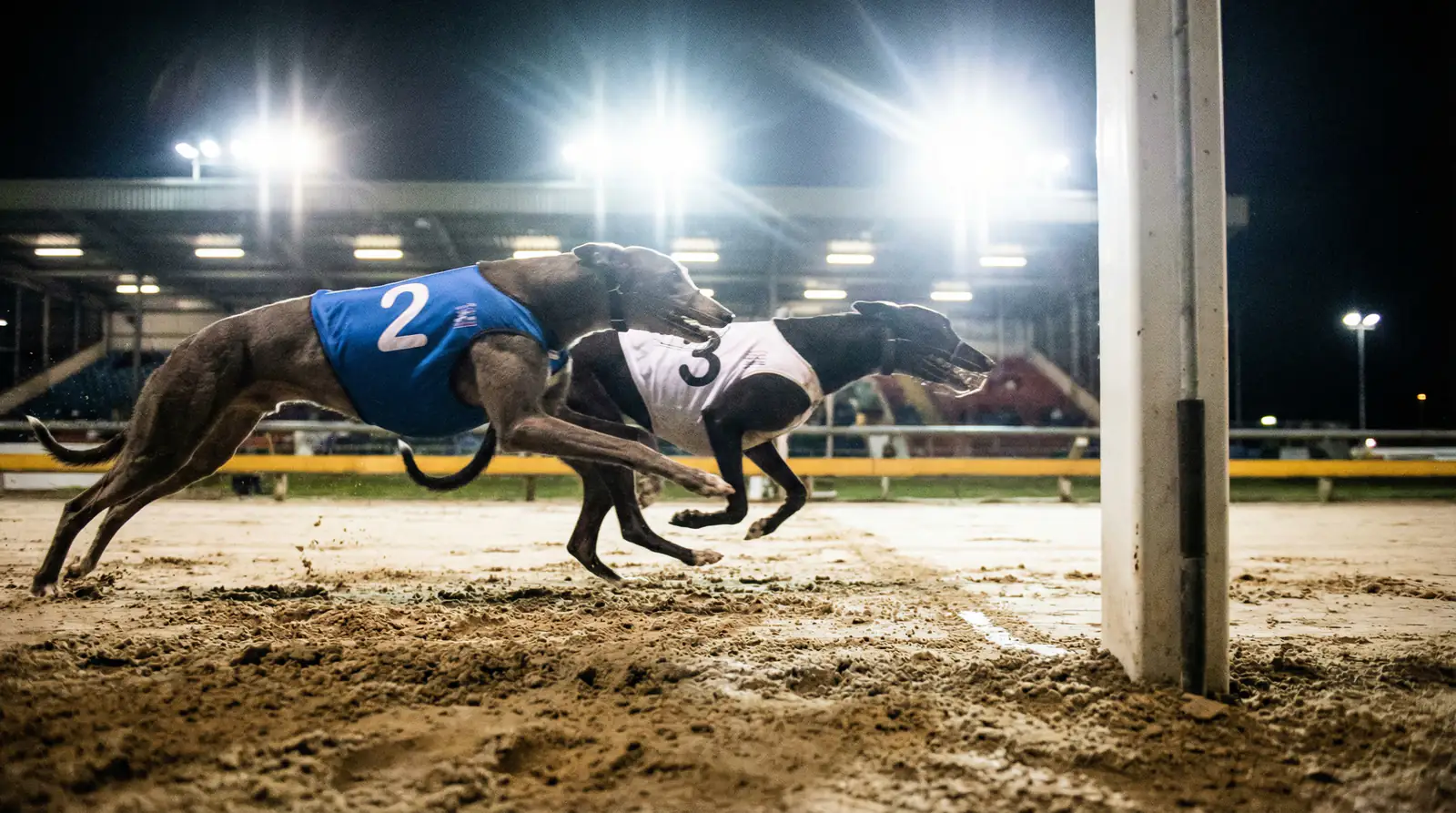
The Bet That Demands You Get Two Dogs Right
Forecast betting raises the bar — and the payout. Where a single win bet asks you to name the dog that crosses the line first, a forecast requires the first two finishers. It is the natural next step for punters who do genuine form analysis, and in a six-dog greyhound race the maths makes it particularly appealing: thirty possible exact-order combinations for the first two places, compared to six possible winners. That fivefold increase in difficulty is reflected directly in the dividend.
For bettors who study trap draws, sectional times, and running styles, forecasts convert analytical depth into proportionally higher returns. If your preparation consistently identifies the top two dogs in a race, this is the bet that rewards the extra work. It sits between the modest returns of backing singles and the slim strike rates of tricasts — the productive middle ground where skill has the most leverage over luck.
Two formats exist: the straight forecast and the reverse forecast. They differ in cost, flexibility, and the level of conviction they require. Choosing the right one for the right situation is as important as selecting the dogs themselves.
Straight Forecast: Exact Order, Higher Reward
First and second, in that order. No flexibility, no partial wins. A straight forecast requires you to name Dog A as the winner and Dog B as the runner-up, in that exact sequence. If they reverse positions — Dog B first, Dog A second — the bet is lost. There is no consolation payout for getting the pair right in the wrong order.
The cost is a single unit stake. A £1 straight forecast costs £1, making it the cheapest route into the forecast market. You are paying for one outcome out of thirty possibilities, and the dividend reflects that precision.
Returns are determined after the race by the Computer Straight Forecast calculation, which uses the starting prices of both finishers. Two short-priced dogs filling the top two spots might produce a CSF dividend of £8 to £15. A fancied winner with an outsider in second can push returns to £40, £60, or well beyond. The less the market expected the exact combination, the larger the payout.
The strongest situations for straight forecasts arise when the race shape is predictable. A front-runner with sharp early pace drawn in trap one at a tight track is a near-certain leader to the first bend. If your analysis also identifies a reliable closer — a dog that consistently runs on from behind into second — the finishing order becomes a logical deduction rather than a guess. Front-runner plus closer is one of the classic forecast patterns, and it works because the two running styles occupy different phases of the race without interfering with each other.
You should also consider straight forecasts in races where a single dog stands out clearly as the winner but the second-place market is compressed. If the favourite is 4/6 and the rest of the field is bunched between 5/1 and 8/1, a win bet on the favourite pays almost nothing. A straight forecast pairing the favourite with whichever outsider you rate for the place converts your confidence in the winner into a meaningful return.
The downside is obvious: get the order wrong and the bet is dead. This binary nature means straight forecasts demand a higher level of conviction than standard win bets. When that conviction is justified, the returns are generous. When it’s misplaced, there is no safety net.
Reverse Forecast: Any Order, Double the Stake
Two bets, one outcome — reverse forecasts trade cost for flexibility. You select two dogs, and if they finish first and second in either order, you collect. The mechanism is simple: a reverse forecast is two straight forecasts combined, covering both possible sequences. A £1 reverse forecast costs £2.
This is the bet for situations where you can confidently identify the top two dogs but not the order. It is a common scenario. Two strong dogs drawn in adjacent traps, both with sharp early pace, might battle for the lead through the first bend. Which one prevails depends on fractions of a second at the break, the angle of approach, and how they handle the pressure of racing head-to-head. Predicting the pair is a form judgement; predicting the sequence is close to a coin toss.
Returns on a reverse forecast are identical to the straight forecast dividend for whichever sequence occurs — you simply paid for two bets and one of them landed. If the CSF dividend for the actual finishing order is £30, your reverse forecast returns £30 against a £2 outlay, for a net profit of £28. Had you placed a £1 straight forecast on the correct order, you would have profited £29. The £1 difference is the cost of the insurance.
That insurance has genuine value. Over a long series of forecast bets, a punter who identifies the right pair but gets the order wrong half the time will find that reverse forecasts significantly outperform straight forecasts in net terms. The individual payouts are slightly diluted by the double stake, but the higher strike rate more than compensates.
Reverse forecasts work especially well in sprint races where margins between the first two are razor-thin. They are also productive in races without a dominant front-runner, where the lead changes through the first two bends and the eventual order depends on late-race dynamics that are difficult to predict from the form alone.
How Forecast Dividends Are Calculated
Forecast dividends are pool-based — the payout depends on what everyone else bet, not just what you picked. This is the fundamental difference from fixed-odds win betting, and it changes how you should assess forecast value.
The Computer Straight Forecast formula takes the starting prices of the first and second dogs and combines them with adjustments for the number of runners and the overall market structure. The exact formula is administered by the bookmaking industry and applied uniformly across all UK tracks. The practical consequence is that you do not know your payout until after the race. The dividend could be higher or lower than anticipated, depending on how starting prices settled in the final minutes before the off.
In broad terms, the pattern is predictable. Two short-priced dogs produce a modest dividend of £5 to £15. A favourite winning with an outsider placed pushes returns into the £30 to £80 range. When both finishers were unfancied, the dividend can pass £100 comfortably. The largest forecast payouts occur when the result is completely unexpected — a combination that almost nobody in the market backed.
Some bookmakers offer fixed-odds forecasts on selected meetings, particularly televised events. These let you see the price before committing, which allows explicit value assessment before the bet is placed. However, they are not available for every race, and the bookmaker’s built-in margin tends to be higher than the equivalent CSF return.
The single most effective lever for maximising forecast dividends is the price of the second dog. The CSF is heavily influenced by the runner-up’s starting price — a short-priced second compresses the payout; a bigger-priced second inflates it substantially. If your analysis points to a likely winner but you believe the runner-up will come from the less fancied portion of the field, the forecast dividend will be disproportionately larger than a win bet on the same favourite. This is the mathematical core of forecast betting: in the right race, the additional analytical requirement is modest but the additional reward is significant.
Two Dogs, One Edge: Making Forecasts Work
If you can identify two dogs with confidence, a forecast is the bet that rewards that clarity. But identifying the right pair requires a different analytical process from simply picking a winner.
For win bets, you ask which dog is best. For forecasts, you ask how the race will unfold. Which dog leads? Who gets into trouble at the bends? Who finishes strongest from behind? You are predicting the shape of the race, not just the result. Running style analysis and trap draw evaluation become significantly more important once you step into forecast territory.
The most productive approach combines three elements. First, identify the probable winner through form, grade, and trap draw. Second, work out which dog is most likely to fill second based on running style and race dynamics. Third, consider the pace scenario: if the favourite is a front-runner from trap one, second place is more likely to go to a strong closer or a wide runner who avoids the pack, not a mid-division runner with no tactical edge.
One habit that separates good forecast punters from average ones: watching replays. Written form tells you where a dog finished. Replays show you how it raced. A dog beaten into third after being badly hampered at the first bend is a much better prospect for second next time than one that finished third with a clear run and nothing more to give. The difference is invisible in the form figures but obvious on screen, and that hidden information is where forecast value lives.
Forecasts will not land every night. The strike rate is lower than singles and the losing runs are longer. What makes the bet worthwhile is that when the preparation is sound and the race shape cooperates, the dividend is several multiples of what a win bet would have produced — and over time, those multiples build into a meaningful edge.