
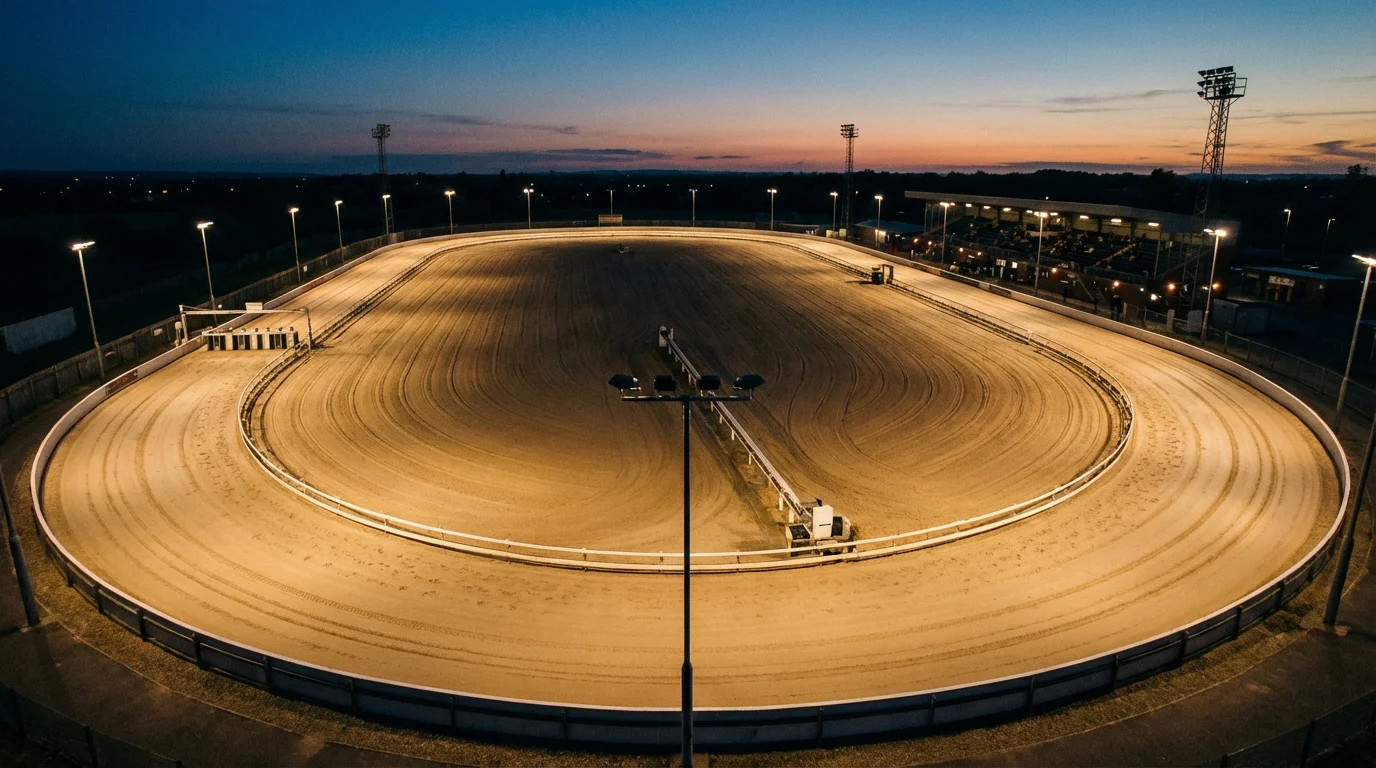
Every Track Tells a Different Story
A dog’s form at Romford means nothing at Towcester until you adjust for the track. That is not an exaggeration — it is the single most important principle in cross-venue form analysis, and it is the principle that the majority of greyhound punters ignore. They see a dog that won its last three at Romford, drawn at Towcester tonight, and back it as if form is form. It is not. Form is always conditional on where it was achieved, and in British greyhound racing, the differences between venues are large enough to transform a front-runner into an also-ran or turn a consistent loser into a course specialist.
The UK has 18 licensed greyhound tracks operating under the Greyhound Board of Great Britain (GBGB), each with its own dimensions, surface characteristics, hare system, distance menu, and bend geometry. Some are tight, short-circumference ovals where the inside trap is a concrete advantage. Others are spacious, wide-bending tracks where outside runners get a fair run and the draw matters less. Some run on sand that slows dramatically in the rain; others drain more quickly. Every one of these variables affects how a race is run, which dogs are suited to the conditions, and — crucially — which dogs are overpriced or underpriced by a market that does not always account for venue-specific nuance.
This guide walks through what makes each track different, profiles the major UK stadiums with their betting-relevant characteristics, and explains how to use track knowledge as a practical tool for identifying value. If you are currently betting on greyhounds without factoring in the track, you are making decisions with incomplete information — and this is where you fill that gap.
What Makes Greyhound Tracks Different
Circumference, surface, hare system — three variables that change everything. But the list does not stop there. Track differences in British greyhound racing extend to bend radius, run-up distance to the first bend, the number and spacing of distances offered, and even the type of sand used on the running surface. Each variable influences race dynamics, and in combination, they create venue-specific form profiles that can make the same dog look like a world-beater at one track and a plodder at another.
Circumference. The overall length of one lap around the oval varies substantially between UK tracks. Towcester, the largest, has a circumference of approximately 420 metres. Romford, one of the smallest, runs at around 350 metres. This difference is not cosmetic — it determines bend tightness, straight length, and the amount of time dogs spend changing direction. On a small-circumference track, the bends are sharper, crowding is more likely, and dogs that race on the inside rail have a measurable advantage because the geometry of the bend favours them. On a larger track, the bends are more gradual, there is more room for dogs to spread out, and the trap draw advantage is reduced.
Run-up to the first bend. This is the distance from the starting traps to the first turn, and it varies from roughly 50 metres to over 100 metres depending on the venue and the distance being raced. A short run-up means the field reaches the first bend quickly, compressed together, with less time for faster breakers to establish a clear lead. A long run-up gives early-pace dogs more time to get clear before the bend, reducing crowding incidents and rewarding clean trapping. Tracks with short run-ups amplify trap draw bias; tracks with long run-ups moderate it.
Surface. All licensed UK greyhound tracks use sand-based surfaces, but the composition varies. Some use finer sand that packs harder and runs faster in dry conditions but becomes heavy and slow in rain. Others use coarser sand with better drainage properties. The going — the condition of the surface on race day — is reported for each meeting and affects every dog’s time. A track that runs consistently fast in dry weather might slow by half a second or more in wet conditions, and the dogs that handle heavy going well are not always the same dogs that excel on quick sand.
Hare system. British greyhound tracks use one of two main hare types: the inside hare (McGee or similar systems, running along the inside rail) and the outside hare (Swaffham or similar, running outside the track perimeter). The hare type affects how dogs run, particularly on the bends. An inside hare pulls dogs toward the rail, which can create bunching on the inside and benefits dogs that naturally rail. An outside hare encourages dogs to run wider, spreading the field out and giving more room to those that race in the middle or on the outside. The hare system is rarely mentioned in form guides, but experienced track followers know that it influences running lines and, consequently, which running styles are favoured at each venue.
Distances. Each track offers a set of race distances — typically a sprint (around 265m), a standard distance (around 480m), a middle distance (around 640m), and sometimes a marathon trip. But the exact distances differ between venues because each track’s dimensions produce different configurations. A 480m race at one track might involve two full bends; at another, the same nominal distance might include a different number of bends depending on where the traps are positioned for that trip. These differences mean that a dog’s form at 480m at Track A is not directly comparable to its form at 480m at Track B without adjusting for the track’s specific geometry.
Major UK Greyhound Stadiums
Let’s walk the track list — each one has its personality and its betting edges. What follows is not an exhaustive directory but a profile of the venues that matter most to the betting punter: the tracks with the most meetings, the most form data, and the most pronounced characteristics that affect your selections.
Hove (Brighton and Hove Greyhound Stadium). One of the most popular tracks in the south of England, Hove has a medium circumference and a well-maintained sand surface that generally provides fair racing. The run-up to the first bend is moderate, which means trap draw matters but does not dominate. Hove has a reputation for competitive racing across grades, and its results data is among the most extensive in British greyhound racing. For punters building a form database, Hove’s volume of meetings and quality of field make it an ideal venue to specialise in. Inside traps show a slight statistical advantage over larger samples, but less pronounced than at tighter venues.
Sheffield (Owlerton Stadium). A northern track that runs frequent meetings and attracts strong fields. Sheffield has a slightly larger circumference than many tracks and a reasonable run-up to the first bend, which produces racing that is generally less dependent on trap position than at tighter circuits. The surface drains reasonably well, though wet meetings do slow the sand noticeably. Sheffield is known for producing honest form — dogs tend to run to their ability here, with fewer track-induced quirks than at some of the smaller or more idiosyncratic venues.
Monmore Green (Wolverhampton). A medium-sized Midlands track that races regularly and provides solid betting opportunities. Monmore’s surface is fast in dry conditions and the bends are tighter than at Sheffield or Towcester, which gives inside traps a more significant advantage. The track hosts racing at multiple distances and attracts a good spread of grades. For punters focused on trap-bias angles, Monmore is one of the venues where inside-draw statistics consistently outperform the average.
Sunderland. The main track in the north-east, Sunderland runs frequent meetings and offers a range of distances from sprints to middle-distance events. The circumference is moderate and the bends are not excessively tight, producing a balanced track where form tends to hold up well. Sunderland is a good venue for punters who prefer races where the best dog on form usually wins — it is a less quirky track than some, with fewer extreme trap biases. The going can change significantly in wet weather, particularly during winter months, so checking conditions before betting on Sunderland meetings is especially important during the colder half of the year.
Dunstall Park (Wolverhampton). Opened in September 2025 as a replacement for the now-closed Perry Barr (Birmingham), Dunstall Park is the UK’s newest greyhound track, built inside Wolverhampton Racecourse. The large-circumference circuit offers wide bends and long straights that suit dogs with stamina and a running style that benefits from room to manoeuvre. The trap draw advantage is expected to be less pronounced than at tighter circuits, and wide runners should have a better chance here than at most UK tracks. Dunstall Park now hosts major competitions formerly held at Perry Barr, including the English Oaks.
Nottingham (Colwick Park). A Midlands track with a decent circumference and a history of hosting competitive open-class racing. Nottingham’s surface is generally fast, and the track produces reliable form data for punters who follow it regularly. The venue hosts some of the better-grade meetings in its region, and the quality of field means that grade-based form analysis tends to be more meaningful here than at smaller tracks where the depth of competition is thinner.
Central Park (Sittingbourne). A smaller track in Kent that runs frequent meetings, often several times per week. Central Park’s tight bends and short run-up create significant trap bias toward the inside boxes, particularly at sprint distances. This is a track where trap draw statistics are essential reading before placing a bet — a form-best dog drawn in trap 6 at a sprint distance faces a genuine structural disadvantage that the market does not always price correctly.
Towcester: Home of the English Greyhound Derby
Towcester is where the best dogs race and the fairest results happen. As the largest track in British greyhound racing, Towcester’s wide bends and long straights produce racing that is more about ability and less about draw advantage than at any other licensed venue. The English Greyhound Derby — the sport’s most prestigious event — is held here, and the track’s dimensions are a deliberate choice: at the highest level of the sport, the industry wants the best dog to win, not the best-drawn dog.
For the punter, Towcester’s characteristics have specific implications. Trap draw bias is minimal compared to tighter circuits — all six traps win at close to their fair share over large samples, which means form analysis carries more weight here than trap statistics. Dogs with genuine speed ratings excel at Towcester because there is less interference and crowding to disrupt their natural running. If you rate a dog as the fastest in the field on adjusted times, Towcester is the track where that assessment is most likely to translate to a winning bet.
The surface at Towcester is well-maintained and generally runs true, though like all sand tracks it responds to weather. Going conditions should always be checked, but the track’s drainage is good and it recovers from rain more quickly than some smaller venues. Towcester meetings attract strong fields, particularly for open-class and feature events, and the depth of form data available makes it a rewarding track for punters who invest time in building a venue-specific knowledge base.
Romford: The Friday Night Favourite
Romford’s tight bends punish wide runners — trap 1 is king here. If Towcester is the track where the best dog wins, Romford is the track where the best-drawn dog wins. The circumference is one of the smallest in British greyhound racing, the bends are sharp, and the run-up to the first turn is short. All of this conspires to create a venue where inside traps, particularly trap 1, enjoy a statistical advantage that is well-documented and persistent across thousands of races.
Romford’s Friday night meetings are among the most popular and most heavily bet cards on the UK greyhound calendar. The atmosphere — for those who attend — is electric, and the racing is fast, tight, and chaotic in the best possible way. For the bettor, Romford requires a specific approach. Form from other tracks must be heavily discounted unless the dog has proven course-and-distance form at Romford itself. A dog that runs well at Towcester — where the bends are wide and there is room to recover from a poor break — may be completely unsuited to Romford’s tight geometry, where one bad bend can end a dog’s race.
The practical advice for Romford is blunt: weight trap draw heavily, favour railers over wide runners, and look for dogs with fast break times. If you are betting at Romford and your selection is drawn in trap 5 or 6, you need an exceptionally strong form case to override the structural disadvantage. The market knows this to some degree — inside-drawn dogs tend to be shorter in the betting — but the correction is rarely enough to eliminate the value entirely. Track-specific trap data is your best friend at venues like this.
How to Use Track Data in Your Betting
Adjusting form between tracks is the skill that separates grinders from guessers. It is also one of the least discussed aspects of greyhound betting, partly because the data is not always easy to access and partly because the process requires effort that most punters are not willing to invest. That is precisely why it offers an edge — the work is the barrier, and barriers keep the majority out.
The starting point is track-specific form. When evaluating a dog’s chances at a particular venue, the most valuable data is its record at that track. A dog with six runs at Hove and a 33% win rate at the course is a more reliable proposition at Hove than a dog with superior adjusted times from Sheffield that has never raced there. Course form captures everything — the dog’s response to the bend geometry, its comfort with the surface, its trap preferences at that specific venue — in a way that cross-track comparisons cannot.
When course form is not available — the dog is making its debut at the track, or has only one or two runs there — you need to adjust its form from other venues. The tool for this is the speed rating, or more specifically, the adjusted time relative to track standards. Each track has a standard time for each distance, representing what a typical A3 dog (or whatever the baseline grade is) would run under standard going conditions. Adjusted times strip out the going variation; speed ratings go a step further by normalising across tracks, so that a rating of 85 at Romford and a rating of 85 at Towcester represent equivalent levels of ability despite the raw times being different.
Timeform and Greyhound Stats both provide speed ratings that allow cross-track comparison. If you are using raw adjusted times rather than ratings, you will need to do the conversion manually: compare each dog’s adjusted time to the track standard at the venue where it was achieved, calculate the variance, and then apply that variance to the standard at tonight’s venue. It sounds laborious, and it is, but the punters who do this routinely have a quantitative framework for cross-track assessment that the punters who simply eyeball raw times do not.
Beyond speed ratings, track data includes trap statistics (win percentages by trap number and distance at each venue), going records (how the track performs in different weather conditions), and trainer records (which trainers have notably high or low strike rates at specific venues). All of this data is available from specialist services and, with patience, from manual collection. The investment of time pays off because track knowledge is durable — the physical characteristics of a venue do not change, so the patterns you identify persist across seasons and years. A trap bias at Romford in 2026 is the same trap bias it had in 2024, because the geometry of the track has not changed.
Going Conditions: Sand, Weather, and Their Effect
Rain does not cancel greyhound racing — it changes the entire form book. Unlike horse racing, where waterlogging can lead to abandonments, greyhound tracks run through most weather conditions. The sand surface drains and the meeting goes ahead. But the characteristics of the racing change fundamentally when the going shifts from fast to slow, and the punter who does not account for this is working with outdated information.
Wet sand is heavier, slower, and more energy-sapping than dry sand. Dogs have to work harder to maintain speed, and the overall times for every race on a wet card will be slower than on a dry card at the same venue. The going correction — the adjustment applied to raw times to produce calculated times — accounts for this, but it is an aggregate measure. It tells you that the track was running slow; it does not tell you which individual dogs handle the conditions better or worse than their rivals.
Some dogs thrive in heavy conditions. Typically, these are dogs with more physical bulk and power — they can drive through wet sand where lighter, more nimble runners lose their edge. Front-runners who rely on speed to establish an early lead may find that their advantage is reduced in the going, because the slower surface compresses the field and allows closers to stay in touch. Conversely, dogs that run from behind may find that heavy going saps their finishing kick, because the energy cost of making up ground on slow sand is higher. The effect is not uniform, and it varies by individual — which is why maintaining your own records of how specific dogs perform in different conditions is a valuable exercise.
Wind is a less discussed but real factor at some venues. Tracks with open aspects — not sheltered by buildings or stands — can experience significant wind effects, particularly on the back straight. A headwind on the run-in slows dogs and favours those with the stamina to push through it; a tailwind quickens the last section and benefits dogs with natural pace. Wind data is not routinely published for greyhound meetings, but attending the track or checking local weather conditions before betting gives you information that most online punters do not have.
Temperature also plays a role. Very cold conditions can tighten the sand surface and quicken times slightly, while extreme heat — less common in Britain, but not unknown during summer meetings — can dry the sand to the point where it becomes loose and energy-sapping in a different way from wet going. The practical advice is straightforward: always check the going report for any meeting you are betting on, and if conditions are notably different from the dog’s recent runs, factor that into your assessment. A dog with all its form on fast going faces an unknown at a meeting reported as slow — and unknowns in betting should be priced as risks, not ignored.
Where Sand Meets Money: Track Knowledge as Betting Capital
Know the track better than the market does, and the market pays you for it. That is the proposition, and it is more achievable in greyhound racing than in almost any other betting medium. Horse racing tracks are analysed exhaustively by professional form analysts, media pundits, and large-scale syndicates. Greyhound tracks receive a fraction of that scrutiny. The information is available — trap statistics, going records, speed ratings, surface characteristics — but the number of punters who systematically compile and use it is small. That imbalance between available information and applied information is the gap where track specialists operate.
The most effective approach is to specialise. Pick two or three tracks, preferably ones with frequent meetings and good data availability, and learn them thoroughly. Study the trap statistics for every distance at each venue. Note which trainers have strong course records. Track the going reports and correlate them with individual dog performances. Build a mental — or ideally, physical — database of how each track behaves in different conditions. Over time, this accumulated knowledge creates a decision-making advantage that the general market, which prices dogs based on overall form rather than venue-specific analysis, does not possess.
Specialisation also protects you from the most common error in greyhound betting: treating all tracks as interchangeable. The punter who backs a form-best dog at every track without venue adjustment is effectively betting with a permanent blind spot. The specialist who knows that trap 1 at Central Park wins 28% of sprint races, or that a particular trainer’s dogs consistently outperform at Sheffield but underperform at Hove, has information that translates directly into better pricing assessments and more accurate selection.
Most punters bet generically. They open the card, scan the form, and back their fancy without reference to the specific arena in which tonight’s race takes place. The track-literate punter does the opposite: every assessment begins with the venue, because the venue is the constant that shapes how every variable — form, trap draw, speed, running style — translates into performance. That is not a marginal advantage. Over a year of regular betting, it is the difference between fighting the market and understanding it. The sand is where the dogs run. The money follows whoever reads the sand best.